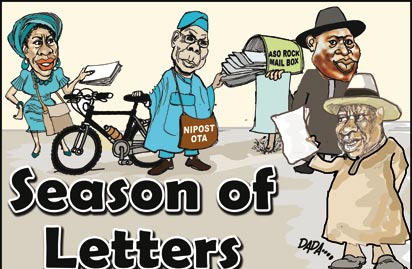
NIGERIANS are now familiar with the regular arguments between the supporters of the present Federal Government led by President Goodluck Jonathan and the known antagonists represented by the Opposition party, All Progressives Congress (APC) and other ordinary, but well-meaning Nigerians. The argument is always on the “The State of the Nation”.
The argument has always been, and still is, that a country so naturally endowed as Nigeria has nothing to do with suffering associated with poverty.
But the fact is that poverty is a reality of Nigerian life and suffering is wide-spread.
What is wrong even as the Federal Government continue to roll out elegant statistical figures and songs of praises from world acclaimed economic watchers?
Perhaps the debate is often blurred by lack of distinction between party and the individual by the opposing party, but often helped by the distortion of the protagonists.
To some analysts, there should be a clear distinction between Dr. Ebele Jonathan as a person and his ruling party as a single party, Peoples Democratic Party (PDP).
However, in any civilised environment, the quality of leadership could count more on the direction of the policy of a party – if that party has one.
The truth is that, as some would assert, the ruling party has no definite policy on any subject recognizable either in the Federal, State or local government areas. Perhaps what is commonly regarded as President Jonathan‘s Transformation Agenda, is regarded as the party policy, well-packaged but not neatly implemented. As a matter of fact, there is in the Transformation Agenda a big assignment for Agricultural developments to feed the nation and earn foreign exchange from exports of cash crops.
This important role calls for rural integration and development which would involve states and local governments ruled by different political parties and also, by the same party with different ideologies. It needs the co-operation of all for the transformation policy to become a needed revolution.
Also, there should be a clear distinction between incentives for peasant farming which is the vogue in Nigeria and plantation farming which is more profitable and desirable.
The phrase of scientific farming which adorns our official policy concerning the use of computers and other sophisticated equipment for productive farming may be of not much use to a peasant farmer who believes in planting his crops at the appropriate time of the year, weeding them properly and seeing that the crops are harvested promptly.
To such a farmer, the additional little investment he needs for a bumper harvest are a bit of improved variety of seed, some fertilizer to aid their growth and sprays of insecticides against destructive insects.
A successful peasant farmer would do well to grow cash in addition to food crops. For success, he needs external aid in terms of market and right price at the selling point to ensure continuous production.
In addition, the market would also be a point where the farmer could purchase his economic needs for survival.
Thus, agricultural policy that would succeed needs a policy of rural development.
The old groundnut pyramids of the North, Cocoa of the West and Palm Oil of the Eastern States were built on prompt payments for crops at reasonable prices and also the existence of exchangeable commodities on which to spend money realized.
A prosperous peasant farming will need not only fertilizer and pesticides but also tools and new technology – these would depend on improved transportation and communication facilities.
There is no need for Agriculture Science graduates to be unemployed; they could be trained in agricultural extension services and later deployed into numerous farms to teach peasant farmers to utilize simple equipment and tools, and to offer advices on modern technique and profitable farming.
A progressive agriculture is in a state of constant evolution and a revolution is not achieved in a single term.
The country should go back the old ways of helping the farmers from planting to harvesting in capital and equipment provision backed by adequate training.
There is no doubt that the present Federal Government is trying through several measures to encourage farmers and to increase agricultural production throughout the country.
However, more intensification is needed and more visible federal presence is required in all the corners of the country, and especially in States not ruled by the ruling party (PDP).
There should be total integration of all agricultural policies in the country to ensure that Nigeria feeds itself now and in the future. The land is there, the people are there, but the will seems to be lacking.
OBJ and others
I must say that I am a bit disappointed that the issue of letter writing did not go with the problems associated with the eventful year 2013.
Unfortunately, the respected octogenarian Ijaw leader has refused to forgive and forget in his comical misunderstanding of the characteristics of that soldier-turned politician, Chief (General) Olusegun Obasanjo, a former President of Nigeria.
Since the former President has been subjected to all forms of abuse with his ‘head bloody but unbowed‘, what happens if the embattled former President writes again as he might?
I remember always late General J. J. Oluleye‘s opinion on Chief (Gen) Obasanjo. He wrote, “In terms of crafts, he looks deceptive, but he can sketch good and bad schemes with equal dexterity. He is an expert in confrontational tactics’‘.
I think the former President (Obasanjo) deserves a better study that the simplistic approach of his many of his critics: (the old foxy general de laugh o).
It looks that after abuses and condemnation of the General, the points he raised in his letter to the President concerning security, infrastructural decay and corruption still present formidable problems. Agreed he could not solve them during his time.
Disclaimer
Comments expressed here do not reflect the opinions of Vanguard newspapers or any employee thereof.