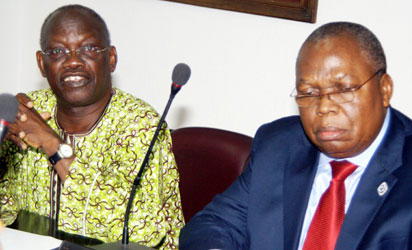
Prof. Adele Jinadu , Resource Person NSC (left) and Dr Fidelis Ugbo Executive Secretary National Planning Commission
CLIFFORD NDUJIHE & BY KELECHI AZUBIKE
Members of the National Steering Committee of the African Peer Review Mechanism led by former Senate President, Senator Ken Nnamani visited Vanguard Media’s head office, Lagos, recently, and interacted with senior editors on the mileage Nigeria has recorded in human index compared to her 36 peers on the African continent.
The team had Professor Adele Jinadu, Professor Ben Amgbe, Ms Yemisi Ransome-Kuti and Dr Fidelis Ugbo among others as members. With a mandate to carry out an unbiased all-inclusive evaluation and self assessment of Nigeria’s democracy and political governance, socio-economic development and corporate governance, the team, which has been on the job for five years said it is not all thumbs down for Nigeria.
Speaking on why the team visited Vanguard and the need for the media to back the APRM process, Nnamani said the mechanism is aimed at enhancing and entrenching good governance in the continent by reviewing four thematic areas: democracy and political governance, economic governance and management, Socio economic development and Corporate Governance.

Prof. Adele Jinadu , Resource Person NSC (left) and Dr Fidelis Ugbo Executive Secretary National Planning Commission
His words: “Those are the four areas constituting the acceptable standard for evaluating how well our democracy is moving and how well the people are benefiting from the dividends of democracy and intangible things like elections, freedom of speech and while you (Vanguard) are here, nobody is coming to shut your doors because of what you have said in the papers as long as it is within the ambit of the law.
“So those four thematic areas are the areas being used to evaluate good governance in Nigeria and our role as members of the National Steering Committee is to oversee or supervise the process. One of the elements is household opinion survey. The committee’s mandate is to make sure that we carry out an unbiased all inclusive evaluation, self assessment of our democracy and other four areas I already mentioned.”
There’s cause for cheer — Nnamani
On comments that there is nothing to review in the country because infrastructure is poor and the Peoples Democratic Party (PDP) crisis in which the G-7 governors were not allowed to meet was hurting freedom of association, Senator Nnamani said he was not going to hold brief for the Inspector General of Police on the issue of not allowing people to meet.
However, he noted that people should not overstretch the issue of freedom. “My fear is that if we excessively talk about freedom will we allow people commit suicide because they are free to take rope and tie around their neck and kill themselves? We must be very careful how we try to make it sound like Nigeria is now a police state because I am not aware that Nigerians are being barred from holding meetings unless you have a specific case. There is freedom of speech and association as long as you have a level playing field and you are given equal chance to make your point; that is my own understanding of justice.”
He continued: “On the issue of your saying that you don’t see what the people are coming to peer-review, ‘peer’ means they are equals. As heads of state, if they come they have something to talk about. In Nigeria, everybody now enjoys communication (phone).
It might not be efficient because at times if you are talking the thing goes off, there is no perfection and perfection is an unrealistic standard by which you can judge. It is not proper if we say there is nothing to peer-review and that they are coming to do nothing. If you go to other African countries and some other countries even outside the African continent you’ll find out that Nigeria while we have enormous problems there is no question about that, we are doing well in certain areas.
“On freedom of speech, yes our act is not functioning properly but the fact that you are writing and expressing your opinion on daily basis, no person charges you to court, no person tells you why must you write this or come and lock up your gate is part of dividends of democracy that we are enjoying.
There are not many places you can enjoy that. There are some areas where we have made progress even though I agree with you to a large extent that in some areas we have shown retrogression, we have not gone forward at all. But regardless of what you are doing you still gather together to talk and look at events and say maybe we should have gone this way, we should have gone the other way, that is what peer-review is about.
Why APRM is necessary –Jinadu
Professor Jinadu gave the context the APRM arose, which he traced to the legacy of military rule, one party rule, single dominant party rule, etc since African countries gained independence in the 1960s and various international covenants on democracy and human rights.
In reacting to that, he said, the African Union said there was need to define the principles of governance away from political centralization and to improve on the means of managing diversity.
“It is in these contexts that a number of African leaders notably our own ex president Olusegun Obasanjo and Abdulahi Wade of Senegal Thambo Mbeki of South Africa, etc conceived the idea of the African Peer Review Mechanism as a voluntary device which countries that feel like will be bound by the principles and the process enunciated in the APRM memorandum of understanding.
Nigeria has been very prominent, in fact the memorandum was signed in Abuja and as of now about 37 Africa countries have acceded voluntarily to the APRM and over 25 per cent of the population of Africa and 17 of the 37 countries have been peer reviewed and what that means is that they’ve gone through a series of processes beginning with what is called country self assessment in terms of the various indices in the APRM MOU for corporate governance, socio economic developments, economic management, and democratic governance.
“The clear review dimension of it is really at the level of the heads of state and government of the member states of the APRM, which is called the APRM forum. The forum meets twice a year on the side lines of the African Union meetings to consider reports from countries that have been peer reviewed. This is followed by a country review mission sent from the APRM secretariat in Johannesburg to go round the country to talk with stake holders about the state of governance in the four areas.
“Now, the country review mission submits a report to the APRM forum in terms of what their findings and recommendations are. All the heads of state meet as a group at this level and consider that country’s report, make comments and advise the country on how to move governance ahead.
The country responds and after every six months the country is expected to report back to the APRM forum on how far it had gone in meeting the recommendations of the country review report and the National Programme of Action. The national programme of action is like a road map of what will be done to improve governance in the country.
“So, the basic issue here is that the APRM tries to redefine governance in terms of a partnership between various stake holders and non- state stakeholders like civil society organizations, the private sector, community-based organisations and individual citizens.
“Under the democracy and political governance thematic area there are seven objectives namely: human rights, constitutional government, competitive politics, women rights, children rights, youth rights, and rights of the physically disabled. Under the socio economic development thematic area we are looking at issues relating to the millennium development goals basically provision of infrastructures, human security issues, etc. Nigeria was peer reviewed in 2008 and it is supposed to be done every four years, so it’s the next one now that we are in.”
Why we do peer-review — Ugbo
Expatiating on the importance of APRM, Dr Fidelis Ugbo said: “We peer-review because we believe that they are best practices within African continent which we do not need to go and look for elsewhere. If we have best practices that are going on in any African country, other African countries will like to share, that is the essence of the peer review.
How it operates
“Key performance indicators are set which are like guidelines which countries review in assessing where they are in terms of security, economic governance, human rights, etc. If the country tells the entire African nations that this is what we have achieved in terms of economic governance, security, economic development, infrastructure, etc, a team will be sent to verify all the claims. After the verification exercise we’ll begin to know the best things that we can pick from every country of Africa and recommend to other African countries to apply in the process of implementing their own programmes.
“Nigeria has made substantial progress in terms of economic governance. Yes, we have security challenges but it’s not only in Nigeria it is all over other African countries but we are making good efforts to put in place structures to check some of these threats to our democracy. So we believe that Nigeria is ready we have a lot of best practices we can sell to other African countries and we look forward to that. When the peer review team arrives Nigeria next year they will be able to find a few things they can tell other African countries. We might not be there but we are making progress in terms of achieving the targets set by the APRM council.
On the progress Nigeria has made since the 2008 review
He said Nigeria seems to have made substantial progress in area of allowing people to make choice on who will lead them. We have not done so well fighting corruption it’s still one of the challenges facing the country and I am sure there are other areas where we have made substantial gains.
Contributing, Ms Ransome-Kuti said: “Nigeria has made some progress even though we feel uncomfortable with the level of development because we believe we should have done better given our capacity, human resource and the leadership role we play both in the continent and outside. So we don’t feel very comfortable saying we are doing well in a lot of things but coming from where we were during the military rule, we think we feel a lot more comfortable that we are beginning to taste the benefits of democracy in that we have the FOI Act in place, we have more freedom of speech, we have the elections and there has been a degree of growth in economic activities not just with the GDP but in terms of the privatization processes that we have undergone.
“We are beginning to privatise electricity. I know there may be contrary opinions on the process but there is obvious improvement in power and some other sectors and the SME sector is also beginning to feel the impact of the reforms in the banking sector. In all the socio and economic indicators, I think we have done better than we were doing before. However, we still have a long way to go.”
How we’re getting reliable data
On whether the reports of the APRM are reliable giving the difficulty of getting accurate data in Nigeria, the team said APRM was doing its best on that score.
“That is a fair question; in many African countries data are not up to date. But as researchers we have other means of supplementing and certifying our facts. There is also a qualitative dimension to this, it is not just about figures, it is just about human beings and you talk to ordinary people on the streets in validation sections: what do you think about your government? What have you benefited from government? And they spoke frankly.
One of the processes has to do with house hold survey. The bureau of statistics has established offices all over the country; they have carried out house hold surveys asking similar questions. That’s why I say they can be no perfection. We may not have accurate data but can you imagine working without data at all? So the primary data being gathered now will go into this type of issues that we are raising. It’s a kind of feedback to our people, what do you think about our government, regardless of whether it is party A that is in charge or party B? We are talking about those areas that affect your life.
“Africa peer review mechanism provides an opportunity for the people to now begin to have a say in the affairs of the state that affect them. In this regard, we have come to you to reach out to Nigerians and say today we have an opportunity to speak out on so many issues. You talk about the rule of law, the government says, ‘yes we are a democratic government,’ if indeed the rule of law is not being practised it is for the people to rise, to come out not to carry guns but to take such steps that will ensure that the government is applying to the rule of law. If governors or other people are not given that freedom of expression, how many of these governors have gone to court to challenge their restrictions?
“Today the Nigeria government is saying that we are building national institutions and are giving them opportunities to now serve the Nigerian people. For instance you have INEC; the election commission is given autonomy and independence. You have the Nigeria human rights commission, the law that established the human rights commission today gives the human right commission independence and clearly states that in carrying out your operations you are not answerable to the direction or control of any authority.
If a governor petitions the human rights commission today that our rights or his rights are threatened it is for this commission to accept it in accordance to the law, which requires that there should be no interference on the part of the department and again if there is a decision of the court and the government is not implementing or executing that decision, it is for the people to rise and protest.
So I think that it is the right time for the media to encourage Nigerians to rise up not only to be observers or watchers of what the government is doing but also to claim their right. It is our responsibility as Nigerian people to hold government accountable.
“When this exercise (2013 peer review of Nigeria) takes place, the report will be a fair representation of what the people want and this report, before it is sent out, will be validated by the Nigerian people through stake holders, who will be called upon to validate it. So it is for the state to say, ‘No this is not a true reflection of what is happening in our country’ and bring out what it thinks is the true reflection of what is happening in the country. What it brings out will become a yardstick for this other people who are coming to assess Nigeria to say this is what Nigerians are saying.
“If they come up with their report even if the government does not want to implement that report Nigerians again will say this country has acceded to this thing voluntarily why don’t you discharge your international obligation to this agreement that you have agreed to implement? So it is really a good opportunity for you to begin to educate Nigerians. What is important here is to educate our people to be in the position to decide what they want as to the future of this country. Even the leaders it is for the people to choose the people that they consider to be the right people to lead them and when they choose them they should be able to ask for accountability and transparency in terms of the things the government had committed itself that it will do as far as the people of Nigeria are concerned.”
Disclaimer
Comments expressed here do not reflect the opinions of Vanguard newspapers or any employee thereof.