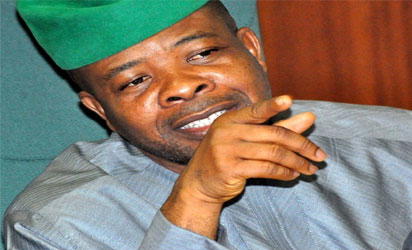
Imo governor-elect Emeka Ihedioha
By LEVINUS NWABUGHIOGU
ABUJA — Deputy Speaker, House of Representatives, Emeka Ihedioha, said yesterday, that members voted in favour of the 87 clauses in the on-going constitutional amendment in consideration of the yearnings of the people.
Ihedioha, who said the House shunned pressures mounted on them by powerful interests to vote otherwise, also noted that the House of Representatives kept faith with the decisions and wishes of Nigerians which had earlier been expressed during the Peoples’ Public Sessions that took place in the 360 federal constituencies of the country on November 10, 2012.
Offering details of the voting in a release, the Deputy Speaker, who doubled as Chairman of the Constitutional Amendment Ad-hoc Committee that collated the proposals, said the House voted overwhelmingly to give full financial, administrative, executive and legislative autonomy to local government councils in Nigeria.
According to him, the vote made local councils, a tier of government in Nigeria denied of any revenue allocation from the Federation Account or from the states, created a uniform four years tenure for local government councils, provided for the mode of exercising legislative power of the LGC and their remuneration to be determined by the Revenue Mobilisation Allocation and Fiscal Commission, RMAFC, abolished the “State Joint Local government Account and replaced same with the “Local Government Council Allocation Account.
He also said henceforth, the Independent National Electoral Commission, INEC, would be conducting elections for local government areas, instead of State Independent Electoral Commission, SIECs.

Deputy Speaker, Emeka Ihedioha
He said: “The Independent National Electoral Commission has been empowered to conduct elections into the local councils, following the abolition of the State Independent Electoral Commission by a vote of 331 in favour, 16 against, and 11 abstentions”.
“The House vote also endorsed alteration of Section 33 of the Constitution to redefine the use of reasonable force by law enforcement agents to now mean that only a “commensurate, proportionate or equal force can be used in self defence by law enforcement agent.”
This, he said, provided for a more restrained method of policing to protect the fundamental rights of Nigerians.
The House voted overwhelmingly to amend sections 34(2),35(7): 39(3): 42f3): 89(2): Section l29(2): Section 162(1): and other parts of the Constitution to replace “Nigeria Police Force” with “Nigeria Police.
The rationale was to emphasise the civil nature of policing rather than celebrate “brute” force.
The deputy speaker also defended the House for voting for the removal of immunity clause currently enjoyed by the President and governors.
He said: “Perhaps one of the most courageous decisions of the House of Representatives in this amendment exercise is the removal of Criminal Immunity from the President, Vice- President, Governors and Deputy Governors leaving only immunity against Civil Proceedings.
“This was effected by a vote of 292 members For, 26 members Against and 30 Abstentions. Members simply opted to keep faith with what their constituents decided. The House further decided that conviction of a sitting President, Vice President, Governor or Deputy Governors is a ground for leaving office. This is why Section 180 was altered.
“The House deleted Section 315 (2); Section 315 (4) (A), fi), fif), and Section 315(4)fc). This should bring to an end the anachronistic position that allows the President or Governor to act as both the Executive and Legislative arms alone, by way of repealing or altering by modifications any existing laws. It was meant to be a transitional provision but there was no time limit placed on its use unlike the 1963 Constitution where such provision lasted only 6 months.”
Other areas the Deputy Speaker also threw more light included the limiting the period by which the Federation and States may operate without an appropriation Act in any new financial year; life pension of officers of the National Assembly and the splitting of the offices of Accountant General of the Federation.
“The House further amended Section 82 and Section 122 of the Constitution by limiting the period by which the Federation and States may operate without an appropriation Act in any new financial year to three months instead of six months.
“The House amended Section 84(5) and Section 124(5) of the Constitution by introducing the Presiding officers of the National Assembly and State Houses of Assembly to join the President, Vice President, Governors and Deputy Governors as persons entitled to pensions after office, provided that they were not impeached or removed from office. This decision is to correct a historic wrong perpetuation by the military against the legislative arm of government in order to deliberately undermine it as a Co-equal arm in the Administrative Structure of Governance. It is wrong to provide for the leaders of the Executive Arm of Government that has four years tenure and the leaders of the Judicial arm without providing for the Leaders of the legislative arm. It is better that all leaders of the three arms of Government are provided for jointly or none at all. This provision will help to insulate the officers concerned from financial and even political manipulations and corruption, while in office.
“The House amendments introduced new Section 84A-84F splitting the offices of Accountant General of the Federation, with a 5 years tenure to handle the disbursement of Allocactions from the Federation Account to the three tiers of Government and the Accountant-General of the Federal Government with a four years tenure to administer Federal Government Accounts. It is significant that the Accountant-General of the Federation is to be appointed by the President on the recommendation of the National
Economic Council, which is made of all the Governors of States. This appointment is however made subject to the confirmation of the Senate.
“Furthermore, Sectionl62 was amended to provide for the funding of the office of the Accountant-General of the Federation from the Federation Account pursuant to an Act of the National Assembly.
“The House voted also to separate the offices of the Attorney-General of the Federation and the Attorney General of the States from the Minister of Justice and Commissioner of Justice respectively by amending Section 173(1) and 2 and introducing new Section 174A 174L and the equivalent sections for the states.
“The new Attorney-General shall be a distinguished Legal Practitioner with knowledge of the workings of the Criminal Justice System and shall be independent of any authority or person. He shall not be a member of any Political Party. He will have complete control and authority over Public Prosecutions. He has a 5 year fixed term renewable only for another 5 years. His appointment shall be on the recommendation of the National Judicial Council for the Federation and State Judicial Service Commission for the States. He can only be removed by 2/3 of the Senate.
“In order to check the excesses that may arise following the introduction of Local Government Council Autonomy, an independent Auditor-General of Local Government Councils of a State has been provided for.
“The House voted in favour of establishment of Electoral Offences Commission in Section 153 as one of the Federal Bodies in the Constitution. This is a bold attempt by the House of Representative to tackle the hydra-Headed problem of electoral integrity and effective sanctions for electoral malpractices. The word “Executive” was expunged as some bodies listed in Section 153 like the National Judicial Council cannot be said to be an Executive Body.”
“The Deputy Speaker however said that the House of Representatives has lived up to the expectations of the people in endorsing the clause, noting that expectations were high that the State House of Assembly will follow suit when the process reaches them.
“In conclusion, the House of Representatives have done it job as Representatives of Nigeria People. A lot of work will need to be done to harmonize matters with the Senate”.
Disclaimer
Comments expressed here do not reflect the opinions of Vanguard newspapers or any employee thereof.