By Emmanuel Aziken, Political Editor
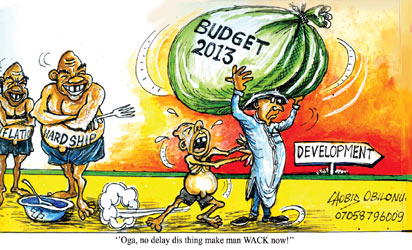
President Jonathan’s assent to the 2013 budget may have averted an unprecedented constitutional crisis, but the dangers in implementation still abound.
It was a landmark that was expected to repair the soured relationship between the presidency and the legislative arms of government.
The quick passage of the 2013 budget of the Federal Government, however, turned into another sore that effectively put relations between the two arms of government on the wrong foot from the beginning of the year. Remarkably, the passage last December, of the 2013 budget was the earliest time that the National Assembly had passed a Federal Government budget for the following year.
Past budgets of the Federal Government were almost always passed at the twilight of the first quarter and signed into law in the second quarter of the implementing year.
However, President Goodluck Jonathan and the new leadership of the National Assembly had sought to change that pattern with a promise to improve the fiscal credentials of the government through more adherence to budget implementation. In that direction President Goodluck Jonathan laid down the 2013 budget proposals of the Federal Government before the National Assembly on October 9, 2012, itself the earliest time that a budget of the Federal Government was presented to the National Assembly in the fourth republic.
The proposals laid down by the president was a total of N4.92 trillion. On December 20, 2012 just before proceeding on the yuletide holidays, the two chambers of the National Assembly passed a budget of N4.98 trillion of the Federal Government for 2013.
The speed with which the budget was passed was hailed in nearly all quarters. Besides the seeming good gestures of the president was his deployment of his senior aides led by Senator Joy Emodi, in pushing through the budget.
Immense goodwill
Emodi was especially handy for the job, given the immense goodwill she garnered in the course of her own time in the National Assembly between 2005 and 2010.
Working with her aides she was able to sooth the sometimes combustible temper of the legislators, especially members of the House of Representatives, building bridges and linkages between the two arms of government. Her efforts nonetheless, the fiends that had until now sought to truncate seamless implementation of the Federal Government budget would not give way. Expectations that the president would sign the budget into law before the beginning of the new year faded as administration officials expressed misgivings over the details of the budget.
The misgivings were centered on the review of some fundamentals of the budget, notably the increase in the benchmark for oil revenue which was raised from the $75 per barrel fixed by the president to $79 per barrel. The president allegedly egged on by finance minister, Dr. Ngozi Okonjo-Iweala was said to have told the National Assembly leadership that the oil benchmark was too optimistic.
The administration was also peeved by the clause in the budget which barred the Securities and Exchange Commission, SEC from utilizing its funds for any expenditure without the prior approval of the National Assembly.
That particular clause, generally seen as a grudge clause, was put to project the misgiving of the House of Representatives on the refusal of the president to pay heed to the resolution of the House demanding the sack of Ms Arumah Oteh as the director general of SEC based on what the House said was her lack of qualification for the job.
The presidency was also said to have complained seriously of distortions in the budget. The distortions, according to inside sources was observed in the movement of funds from overhead and personnel sides to capital, a development the administration feared would have left the Federal Government unable to pay salaries in the fiscal year. Besides, the details perhaps because of the speed used in working on them also contained mistakes and sometimes forgivable typographical mistakes which the president was, nevertheless, apprehensive of.

President Jonathan; Senate President, David Mark and Speaker, House of Reps, Hon Aminu Tambuwal
National Assembly officials Vanguard learnt were conscious of the mistakes made and readily admitted such, but the legislators, Vanguard learnt were unmoving on the president’s demands on the removal of the clause on SEC and the reduction of the benchmark.
It was thus inevitable that a stalemate ensured. By some accounts, it was only the repeated troubleshooting missions by Senator Emodi, that stopped an explosion of emotion by the legislators who believed that the administration was pouring contempt on them despite their good gestures.
As the standoff continued, it was inevitable that some people started counting the days from the date the budget was transmitted to the president, which was on January 14.
Many were now expecting the National Assembly to mobilize the votes to override what was being seen in some circles as a presidential veto on the budget.
30 working days deadline
As the count progressed, some opined that the number of days required for the president to assent was 30 working days and not 30 straight days. Willy-nilly as the 30 working days deadline approached last Wednesday presidential aides and some legislators were getting apprehensive.
Indeed, on the final day on Wednesday, the House of Representatives in a closed door session resolved to take action and mandated its leadership to consult with the senate leadership on possible actions to be taken. But before the meeting could take place, the president played a fast one on everybody when he signed the budget document, albeit, without ceremony perhaps reflective of his unwillingness. What document he signed still remains an issue. Was it the altered document or the one approved by the National Assembly?
Presidential spokesman, Dr. Reuben Abati in a press statement disclosing the president’s action, did not leave anyone in doubt of the president’s unwillingness.
“As part of the understanding reached with its leadership, the observations of the executive arm of government about the Appropriation Bill as passed by the National Assembly will be further considered by the National Assembly through legislative action, to ensure effective and smooth implementation of the 2013 Appropriation Act in all aspects,” Abati said as he relayed the president’s directive to ministries and agencies to implement the budget.
Had the president failed to sign the budget at the end of the 30 working days deadline, he would have been expected to re-present it or another proposal to the National Assembly in line with section 59 (4) of the constitution.
A constitutional lawyer in the National Assembly pointed to what he claimed was the ignorance of presidency officials who were mistaking the constitutional provisions on appropriation with that pertaining to other bills.
Whereas section 58 of the constitution pertaining to ordinary bills allows the president to wield a veto on a bill passed by the National Assembly and allow the National Assembly to override the veto, the president is, however, bound by the provisions of section 59 (4) which applies to money bills to re-present the budget where he applies the veto.
The provision states thus:
(4) Where the President, within thirty days after the presentation of the bill to him, fails to signify his assent or where he withholds assent, then the bill shall again be presented to the National Assembly sitting at a joint meeting, and if passed by two-thirds majority of members of both houses at such joint meeting, the bill shall become law and the assent of the President shall not be required.
Disclaimer
Comments expressed here do not reflect the opinions of Vanguard newspapers or any employee thereof.