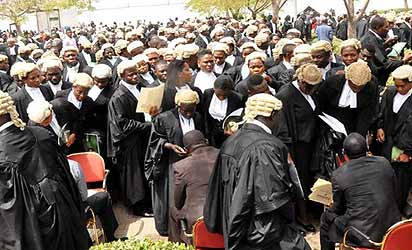
File: Lawyers
By Innocent Anaba
The debate over state police heralded the recent annual conference of the Nigerian Bar Association, NBA, in Abuja, as immediate past President of the association, Mr Joseph Daudu, SAN, disagreed with President Goodluck Jonathan on the desirability or otherwise of state police.
While President Jonathan had argued that state governors will abuse their respective state police as they have abused their respective state independent electoral body, Daudu argued that the fear was misplaced.
Governor Rochas Okorocha of Imo State, meanwhile supported the call for state police, while his Edo counterpart, Mr Adam Oshiomhole, said it was not necessary.
The proposed introduction of N5,000 note also elicited strong reactions, with the association calling for a halt in the plan.
The association warned that it may resort to legal action, if the Governor of the Central Bank of Nigeria, CBN, Mallam Sanusi Lamido Sanusi insists on going ahead with the plan, which the association noted was ill conceived and aimed and further devaluing the naira.
The association argued that it will “damage the lives of Nigerians,” insisting that it was “a shallow scheme”.
”The looming danger is that using large bills will devalue the naira. It will promote money laundering and massive monetary inducement in the next general election. It’s also against the cash-lite policy of the NBA, and is disparate to what obtains elsewhere.
”If it had to be litigated against, so be it. The CBN should not be allowed to damage the lives of Nigerians through shallow schemes such as this,” NBA said.
It also called on the Federal Government to revisit the Bakassi Peninsula case, following growing agitation by the people of the area, who were displaced from their ancestral homes by the judgment of the International Court of Justice, IJC, which ceded the peninsula to Republic of Cameroon.
Mrs Anden Lawan-Rabana, SAN, had raised concern over the condition of Bakassi people, which she said had worsened.
She argued that people of Bakassi, had been abandoned as their land and sources of livelihood had been taken from them by the judgment, further contending that the judgment should be challenged now before the October 10, which will make it 10 years and renders it statute bar.
The conference was not without an incident, as protesting lawyers, on the fourth day of the event, shut the main entrance of the Abuja International Conference Centre, venue of the conference.
The protest, which lasted over two hours threw the entrance of the conference venue and adjourning areas into confusion.
The grouse of the protesting lawyers was the 500 percent hike in conference fee, as they blocked the entrance of the conference venue, which had been manned by fierce looking security personnel.
Lawyers who did not register and who had no conference tags were prevented from gaining access into the conference venue.
But the protesting lawyers, argued that entrance to the AGM venue was upon payment of practicing fee as provided in section 6, sub-section 7 of the NBA constitution and not upon payment of conference fee as erroneously held by the out-going national executive.
At the conference, Chief Judge of Federal Capital Territory, FCT, Court, Justice Lawal Gummi, urged the National Judicial Council, NJC, to “do away” with the requirement mandating judges to make returns on more than one area of adjudication.
He called for specialisation in the legal profession, saying a criminal trial judge, for instance, should be allowed to remain so “for years.”
Gummi noted that if judges were allowed to specialise, they will be able to write authoritative books in their areas of specialisation.
He spoke at Women Forum with theme The Female Lawyer and Legal Practice: Breaking the Barrier.
Gummi, who chaired the event and was represented by Justice Ishaq Bello, said reading widely to be versatile does not negate the need for a legal practitioner to be a specialist.
He urged senior lawyers to do more to educate the younger ones, saying: “Are the older lawyers willing to teach their juniors?
Mr Rickey Tarfa, SAN, who spoke on Running a Law Practice as a Business – My Practice, My Business, said there is a shift from the traditional practice of law as a vocation to a business enterprise.
Similarly, former Chief Justice of Nigeria, CJN, Justice Alfa Belgore, noted that the country has been unable to develop, despite its huge natural resources due to political instability.
He said that Nigeria will rank among the five most prosperous countries of the world, if the democratic process survives for at least 20 years, with its affairs well-managed.
He added that the bilateral agreements with European countries, such as Germany, which would have led to the country’s industrialisation, were aborted by the military regimes, which stunted democracy and had no development ideas.
Meanwhile, at the session of Section on Legal Practice, SLP, Chairman of Economic and Financial Crimes Commission, EFCC, Mr Ibrahim Lamorde, noted that drastic measures were needed to check corruption in the country .He said, that corruption has eaten deep into the society’s fabric.
He pointed out that existing laws were adequate to deal with corruption, adding that all that was needed was effective enforcement of law already in existence.
He said: “Everybody agrees that the existing legislation is adequate. There may be one or two amendments needed. If the existing legislations are effectively enforced, it will be able to address issues of corruption.” “The successes we have recorded in EFCC so far is because of the collaboration we have had with the NBA. We are in agreement that corruption has eaten deep into the fabrics of Nigerian nation and there is need for drastic measures to address it. So, going forward, you are going to see a more efficient prosecution of cases.”
At the Section on Public Interest and Development Law session, lawyers called for the reform of NJC, to make it effective in checking corruption on the bench.
Leading the call was former President of the association, Chief Thompson Okpoko, SAN, who said ”NJC was a well throughout concept but the Nigerian factor destroyed it. The constitution makes it to be at the whims of the Chief Justice of Nigeria, CJN, as he appoints 16 members of the 22 member council and you can imagine what that will mean if the CJN is not disposed to pursuing a particular petition.
Also, Mr Lucius Nwosu, SAN, on his part noted “our legal system has been broken down because of poverty, quota system, greed, inadequate salaries and emolument among others. We now have a situation where people no longer have confidence in the judiciary because of the number of years it requires to get judgment. It is even worst that some Nigerians don’t mind litigating their cases abroad, where it is possible”
Disclaimer
Comments expressed here do not reflect the opinions of Vanguard newspapers or any employee thereof.