By Ebele Orakpo
Some years ago, public institutions were the in-thing; parents struggled to get their wards into public universities, while private schools were established mostly to cater for children with special needs and cannot cope in a normal school environment.
Unfortunately, like every other thing in Nigeria, public institutions took a nosedive. There were incessant disruptions in the academic calendar as the staff complained of poor remunerations, poor infrastructure, lack of funds etc. It is said that if you pay peanuts, you get monkeys.
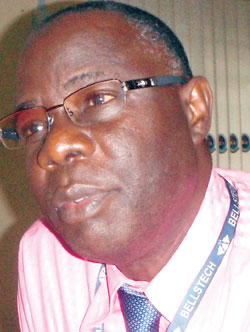
To stem this tide, private universities were established to meet a need. In this chat with Professor Isaac Adeyemi, Vice-Chancellor of Bells University of Technology, Ota, Ogun State, he said private universities have been able to justify their establishment. Excerpts:
Why private universities: According to the professor of Food Science, “private universities were established to fill a gap in our university system. First and foremost, there has been an increase in the number of applicants which the public institutions – federal and state – could not absorb.
Secondly, the increasing cost of running the university system was becoming too much for government to bear knowing full well that there are other sectors of the economy they have to invest in to make life more meaningful for Nigerians. Also, getting quality education was another reason for the establishment of private universities. Based on these parameters, the government, I believe, supported the idea of having private universities in place.”
Meeting the need: The question now is, have all these reasons been justified? Have the private universities lived up to expectation? I will say yes, they have, in the sense that at least, they have been able to attract or to take care of some of the applicants who would have been denied university education.
Two, it has also introduced a sort of competition. I believe that the approach in running private universities is having some positive effects on the running of public institutions as well although private universities for now, are still not the model but rely partially on some of the existing institutions to survive in terms of manpower development. Also, most of these private universities are relatively new but at least, they are absorbing between 10 and 20 per cent of total admissions and I believe that this will keep increasing with time.
In terms of qualitative education, from my own perception, private universities have been doing well. First and foremost, the student knows that if a programme is four years and he does very well, he will have no cause to exceed four years.
Incidences of strikes, students’ unrest etc, are minimal in private institutions; that is an aspect public institutions are trying to see how they can adjust and it means if we can have crisis-free private universities, then it is possible to run public institutions that are crisis-free. That is a dimension that private universities have introduced,” he said.
High school fees: Although Adeyemi acknowledged that school fees in private universities are relatively high compared with fees in public institutions, but argued that they still charge lower than what it actually takes to train an average undergraduate in Nigeria. “My argument is this; first, public institutions are cheaper but somebody is paying to bridge the gap between students’ fees and what it takes to train an average undergraduate in Nigeria. Even the private universities you claim to be very expensive charge lower than what it takes to educate an average Nigerian undergraduate. From studies, I know that it takes about N1.2 – N1.5 million per session because when you talk about cost, you have to think of salaries of workers, enabling environment, facilities etc. It is more expensive to train an average medical doctor than those in the liberal arts. So where students are paying N40,000 or N100,000 per session in public institutions and cost of maintaining an undergraduate is over N1 million, who is pay
ing the difference?
Government of course! Private institutions are not being financed by government, so our sources of income are mainly from students’ fees, proprietary contributions and donations from friends of the university. By the time you aggregate all these, you discover that whatever is being charged as fees, is still below the cost of training. “
Carrying capacity: Giving reasons for the relatively low carrying capacity of private universities when compared with public schools, Adeyemi said their carrying capacity will increase with time as they develop and mature, adding that some private universities like Bells, “right from inception, have a ceiling as to number of students to be admitted.
In Bells, it is planned that the student population should not exceed 5,000 so we are talking of manageable student population. By the time you have so many students and you cannot meet their needs, you water down the quality,” he stated.
Way forward: Speaking on the way forward for Nigeria’s educational system, Adeyemi noted that the fact that some of our graduates are not employable “is fallout of our curriculum which the 6-3-3-4 system was meant to correct although it did not really work due to incessant policy shifts.”
He was, however, happy that the problem is being addressed as most institutions now have entrepreneurship programme in their curricula.
He also blamed the economy for the woes in the education sector. “We are operating within a macro economy and the enabling environment must be there. For instance, if a graduate who is not from a rich home has an idea, who funds such a project? Does he go to the capital market, to banks where the interest rate is about 17, 20 per cent or to microfinance banks where the interest could be as high as 30 per cent?”
Surviving in rural areas
He advocated Silicon Valley-like environment where such graduates can go. “Again, we have to make life more meaningful in the rural and semi-urban areas. Almost 60 per cent of our graduates are in the key towns because to survive in the rural areas is a problem. But if life becomes more meaningful in rural areas, you discover that people can operate within their own immediate environment and survive.“
Strengths: Bells which offers two novel programmes in engineering – Mechatronics, a combination of mechanical and electronic engineering, and biomedical engineering – handling and repairs of medical equipment, according to the vice-chancellor, is very strong in information and communications technology.
“We participated in a national competition organised by the National Mathematical Centre on computer programming. In 2008, we came third, second in 2009, first and second in 2010 and first in 2011. The school currently has about 1,700 students,” he said.
Disclaimer
Comments expressed here do not reflect the opinions of Vanguard newspapers or any employee thereof.