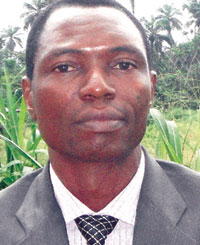
Dr. Victor Enemor
By Ebele Orakpo
Nigeria may be having all she needs in terms of pharmaceuticals within the rich vegetations scattered throughout the nation. This much was said by Dr. Victor Enemor, a lecturer in the Department of Applied Biochemistry, Nnamdi Azikiwe University, Awka, in this chat with Vanguard Learning in his office.
He spoke on his research work on a local shrub, Sarcocephalus latifolius (Nauclea latifolia) whose edible fruit is known as African peach, Guinea peach, Sierra Leone peach or Country fig in English and ubulu inu (bitter apple) in Igbo. Excerpts:
Area of research:
According to Enemor, his research was initially in the branch of biochemistry called enzymology, but along the line, he discovered that it was not what Nigerians need at this time because “I realised that we do not have adequate technology to utilise or carry out appropriate research in enzymology,” he said. As a result, he decided to look into local plants that have medicinal values.
Said Enemor: “Essentially, my area of research now is pharmacology. We have an environment that is largely untapped. The natural resources around us are grossly under-utilised. All the plant species around us have one potential or another.
“Unfortunately, due to our limitations, many of the plants have great potentials that have not been recognised. God has given us an environment that supports the growth of a large number of plant species with different chemical components.”
Phytochemical/secondary metabolites:
“We know that the quarrel between traditional and orthodox medicine is on products’ refining. Usually, when a herbal medicine practitioner gets leaves or roots, he either applies decoction (boil or soak it in water) or sometimes uses other solvents like ethanol and methanol to extract.

Dr. Victor Enemor
“He lacks the necessary facilities to actually separate or identify components of the extract so he administers it the way it is. One danger is that plant extracts contain a lot of chemicals. There are up to 30,000 plant chemicals known as phytochemical or secondary metabolites which have potentials to improve human health, protect the body from free radicals, kill pathogens etc. The problem is identifying them and then finding out what exactly their functions are individually,” he said.
Uses of the African peach:
“Sarcocephalus latifolius, also called African peach, is a very common evergreen shrub. Local people recognise its medicinal potentials and use it for varieties of health interests. Many have reported diverse usage, notably, for malaria. I have seen evidence that it has anti-malarial properties. It is said to also have effect on diabetes, hypertension, diarrhoea, dysentery, dental, cardiovascular problems, pathogens, sleeping sickness, depression, measles, piles, menstrual disorders, a myorelaxant etc.
Reports also said that the extract can be used to arrest pre-term contraction in pregnancy; so many exciting claims. People have even mentioned leprosy and gonorrhoea. Interestingly, one school of thought has said that the fruit extract has the potential of curing HIV. If it is true, that alone is a pointer to the fact that we may be having at least if not wholly, part of the answer to the HIV scourge. In Cameroon, it is a first line treatment for pains and fever. There are also certain things that point to me that this plant might be useful in treating arthritis,” he stated.
Toxicity: Continued Enemor: “Science pays great attention to the issue of toxicity. Although a plant species may contain useful secondary metabolites or chemical substances that are pharmacologically active, we must pay attention to whether this plant also has any substance that may have any level of toxicity. So in drug discovery, when you want to screen a substance for pharmacological values, the toxicity testing is a major factor.
A plant extract may contain so many useful substances but if it contains one that can have serious negative effect on the subject, then it becomes a very big concern because you cannot derive benefit of 10 components and then suffer the loss of your life and all the benefits because of the presence of one. This is why research is important as it seeks to isolate different components, identify and purify the useful ones.
Again, toxicity is a relative term because in pharmacology, before a substance can induce toxicity, it must first of all accumulate to a particular dose level, it is not all levels that can actually induce toxicity. From my research, this plant is relatively safe. It is believed that every part of it is medicinal but one single report said that the plant is carcinogenic, that humans should have nothing to do with it.
It cited one compound, 1hydroxyanthraquinone known to be carcinogenic. My worry is that the report is not fully referenced, it does not give me that confidence to actually quote it but I have asked around laboratories to find out those that have reagents and equipment that would detect that compound and confirm whether or not it is present in the plant.
“With all the parameters I tested using experimental animals, I can say that the extract is relatively safe. I cannot outrightly say that what those people have pointed out is wrong, it may be wrong at the end of the day because I have seen a report that said the plant does not contain alkaloids but when we looked into it, we found that alkaloid is a major component.”
Chemical lead:
Dr. Enemor believes that this plant can be a chemical lead. “A chemical lead is an original substance from which a drug or drugs may be produced. So in drug research, we look for chemical leads. If it is certified that this plant has so much potentials and it is relatively safe, it might provide a lead for many useful drugs.”
He regretted that most people will prefer to build skyscrapers than plant trees because of ignorance. “One thing we don’t appreciate is that the vegetation around us is a cleaner. They clean up our environment and when we talk about photosynthesis, it sounds like Greek, but actually, it is an indispensable property of life.
“When we have enough vegetation, they mop up the carbon dioxide that our activities push out and use them to produce food for us and give us oxygen. It is an act of ignorance when people want to see sky scrapers instead of trees.”
Disclaimer
Comments expressed here do not reflect the opinions of Vanguard newspapers or any employee thereof.