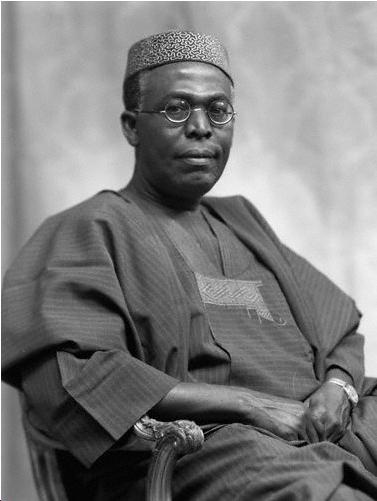
Chief Awolowo
BY CHARLES KUMOLU
…as Sultan, Emirs, others honour him
WITH the twin issues of insecurity arising from the activities Boko Haram Islamic sect and contentions on a new revenue sharing principle clouding the political space, prominent Nigerians of different tendencies gathered last Friday in memory of one of the country’s founding fathers in a rare display of unity.
THE 2012 Obafemi Awolowo memorial lecture organized by the foundation established to propagate the legacies and memory of the late nationalist was an unusual gathering. Nigerians of various political persuasions, traditional rulers from various sections of the country all set aside their differences to ponder on the ways and wonders of the man hailed for his pioneering vision in the development of Southwest Nigeria.
As early as 9:30 am Friday, March 9, guests were already seated at the NECA House venue in Lagos in anticipation of what turned out as, as a star-studded forum for first class national leaders.
Among those present at the event, convened by the Obafemi Awolowo Foundation, OAF, were the Ooni of Ife, Oba Okunade Sijuwade; Sultan of Sokoto Alhaji Mohammed Sa’ad Abubakar; Emir of Kano, Alhaji Ado Bayero, Emir of Zauzzau Alhaji Shehu Idriss; Obi of Onitsha Igwe Nnaemeka Achebe; Emir of Ilorin Alhaji Suru Gambari; King Edmund Daukoru Amyanabo on Nembe; King Dandeson Douglas Jaja Amyanabo of Opobo; King Mujakpero Orodje of Okpe.
Others included two former governors of Lagos Alhaji Lateef Jakande and Bola Ahmed Tinubu and former governors of Ogun, Ekiti, Ondo and Kaduna States, respectively, Chief Olusegun Osoba, Niyi Adebayo, Gbenga Daniel and Alhaji Balarabe Musa respectively.
Also present were Prof. Ben Nwabueze, Justice Modibo Alfa Belgore, Justice Mohammedu Uwais, Senator Olorunnimbe Mamora, Senator Anthony Adefuye, Chief Ebenezer Babatope, Sen Daisy Danjuma, Sen Jubril Aminu among others.
South/West govs absent
Given the prominence of some of the country’s leading personalities from the six geo-political zones, the conspicuous absence of the six Southwest governors, who are supposedly the torchbearers of the Awolowo legacy, was resoundingly embarrassing. Alhaji Balarabe Musa who was the chairman of the occasion, in his remarks lamented the loss to the country arising from the inability of Awolowo to rule Nigeria.
“Late Chief Obafemi Awolowo is the most outstanding and memorable legend of Nigerian politics and governance since the 1940s. He is the one whose role in politics and governance can still be a reliable guide for any first-time President of Nigeria even though Nigeria “lost the opportunity of having Chief Awolowo as its National President.”

Chief Awolowo
North is problem of national unity
“He knew how to be relevant both in government and in opposition. When he ceased to be the Premier of the old Western Region, he became a credible and dependable opposition leader.
“If his policy of free, qualitative, and functional education, for instance, had been implemented and sustained throughout Nigeria, the 40 year gap in educational development between the northern and the southern parts, which inevitably makes the North stand more in the way of peace and national unity would have been avoided. And the result of higher educational advancement would not have been almost absent in Nigeria.”
As a leader of opposition, Musa submitted, “Awolowo knew how to be relevant, both in government and in opposition.
“When he ceased to be the premier of the old Western Region, he became a credible and dependable opposition leader.
For the 1983 presidential election, even the arch opponents of Chief Awolowo, the semi-feudal and conservative northern oligarchy or Kaduna mafia, as represented by the political group of the late Shehu Musa Yar’Adua preferred him and went into a principled electoral alliance with the Unity Party of Nigeria (UPN), the political party, he led,” he stated.
Earlier in her address, the Executive Director, Chief Obafemi Awolowo Foundation, Dr. Olatokunbo Awolowo-Dosumu, said the presence of some of the eminent royal fathers across Nigeria as well as the sizeable and high profile audience drawn from all sectors of Nigeria spoke eloquently to the fact that, 25 years after his transition, Chief Awolowo’s trailblazing leadership continues to be acknowledged and celebrated.
Awo knew, found and showed the way
Giving an indication of the foundation’s determination to inspire Nigerians to emulate Awolowo’s traits, the executive director said it had established the Obafemi Awolowo Leadership Prize, aimed at rewarding leadership and good governance which she described as the hallmarks of Chief Awolowo’s leadership. Chief Awolowo leadership vision according to her included credibility, integrity, courage and discipline among many others.
She said that a committee would select winners of the prize based on thirteen criteria including leadership and governance characteristics.
The guest lecturer was Prof Toyin Falola, who is a professor of History at the University of Texas in Austin, USA and spoke on the topic Power Politics or Welfare Politics; Chief Obafemi Awolowo in the History of African Nationalist Political Thought.
“Chief Awolowo chose welfare politics and his entire career was based on the pursuit of this vision. Welfare politics would generate patriotism and loyalty to the state in a way that would keep Nigeria stable, orderly and peaceful.”
Time for transparent governance.
He noted that one thing the late sage had in abundance and often deployed for the good of all was visionary leadership. He regretted that such visionary leadership is missing today.
He urged the people to call for accountability and visionary leadership from those who govern and rule them. “We once blamed our woes on the British. The British left but the woes remained. Then the politicians were replaced by the military. The woes continued. Then we blamed the military and called for democracy.
Greater woes. Now is the time to call for accountability and visionary leadership of the type demonstrated by the example of Chief Awolowo,” he said.
He canvassed service as the hallmark of leadership, saying Awolowo demonstrated “servant-leadership in practice.” Prof Falola lamented that in today’s Nigeria, public service “has become about accumulation of personal aggrandisement in which the leader becomes the master. The state is imperialised, converting citizens to subjects, resources into private ownership. In that environment, power brings wealth, fame and adulation, not public service.”
He declared: “If Chief Awolowo were still alive, he would argue that we need a set of leaders who will be our servants, not bosses, who will endure the same kind of suffering as the majority of the population and would make the same immortal statement he made over 60 years ago: ‘it is the amount of patriotism, unstinted effort and wisdom which we apply to the exploitation of our vast resources, and of the just and equitable distribution of the results of such exploitation that will determine the measure of our greatness and happiness as a people.”
Disclaimer
Comments expressed here do not reflect the opinions of Vanguard newspapers or any employee thereof.