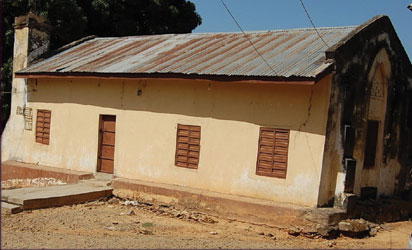
Church where the Ojukwus worshiped in Zungeru
By Wole Mosadomi Minna
Zungeru, located in Niger state is a small town but with a loaded history. It served as the colonial capital of Northern Nigeria from 1902-1916. Indeed, it was where the Northern and Southern Nigeria were amalgamated by Lord Lugard in 1914 and therefore could be regarded as the first capital of Nigeria.
Besides the political history to its credit, Zungeru town was the first organized modern military cantonment in the country and therefore served as the first headquarters of the Nigerian based West Africa frontier force of the British imperialists.
With this development, it goes to show that there were structures solidly put in place which served as military barracks, European cemetery, Government House and Government Reserve Area (GRA), Hospital, Treasury, Schools, Churches, Rest House, Colonial Prison, Government House bridge, old rail-road bridge, among others.
All these infrastructures have now become history as they have given way. However, some of these colonial buildings though collapsed still have their foundations intact. Some are overgrown with weeds during the raining season.
Such buildings include that of parents of Late Biafra leader, Chief Emeka Odumegwu Ojukwu which has been reduced to foundation level.
Home of titans
The first indigenous Governor General of Nigeria, Dr. Nnamdi Azikiwe was born in Zungeru in 1904.
The head of the defunct Biafra, Chief Odumegwu Ojukwu was also born in Zungeru in November, 1933.
The residences of parents of the two great Nigerians have now been leveled. One can only manage to locate the sites.

Church where the Ojukwus worshiped in Zungeru
If not for the proposed Zik Centre started but abandoned at a site close to his parents residence, the history of the great leader may not be traced to the town at all in future.
As for Chief Odumegwu Ojukwu, many residents of the town are familiar with the name but virtually most of them have never come across him.
Unlike Zik who last visited the town and even his birth place in 1991 during the official stone laying foundation of the Zik Centre and also on political campaigns as the president candidate of the defunct Nigeria Peoples Party (NPP), Late Ojukwu had no opportunity of living in the town at all before his parents left Zungeru back to Lagos in 1918.
What Ojukwu’s death mean to the people of Zungeru
Since the demise of Chief Ojukwu, many tributes and encomium have been showered on him by many Nigerians. In his birth place Zungeru, the people are yearning to see his corpse at least as a consolation for not seeing him while alive.
An elder of the town, Alhaji Sule Jebu who spoke on behalf of the Dagachin Zungeru, Alhaji Alimu Abubakar, described late Ojukwu as a courageous man and a Nigerian who has brought honour not only to Zungeru his birth place but also to Nigeria his country.
Alhaji Jebu who spoke in Hausa said, “even if most people in this town, (Zungeru) don’t know him, the fact that he was a Nigerian and given birth to in our community is enough for us to identify with him, appreciate and mourn with his family and other Nigerians.”
According to him, “the fact that he attempted to break away from Nigeria even though unsuccessful was not enough reasons why anybody should distant himself from him.
“It was an intention and ambition but not allowed by God and since he retraced his steps back home, he should be fully embraced as was done when he was alive and even in death,” the elder said.

*Ikemba Nnewi, Odumegwu Ojukwu.
Another resident of the town, Hajiya Hafusatu Abubakar said Zungeru town is proud to be the birth place to prominent Nigerians including Chief Ojukwu.
“We all witnessed the burial ceremony of late Azikiwe some years back when his corpse was brought back to this town (Zungeru) which is his birth place and as government did to Zik, we will also want the corpse of late Ojukwu to be brought to Zungeru for all of us to see it and bid final farewell to him,” the old woman remarked.
Hajiya Hafusatu explained that while the “home coming” of the corpse will afford the people of the community the opportunity to participate in the final funeral of the national leader, it will also be an eye opener to the present leaders both at the national, state and even at the local level at the total neglect of a town that not only gave birth to prominent Nigerians and international figures but also a town that once served as the capital of Northern Nigeria and the first capital of the country, Nigeria.”
A prominent researcher resident in Zungeru town, Malam Mohammed Jibrin said the father of Late Emeka Odumegwu worked with the colonial masters for several years as one of the clerks and left for Lagos in 1918 after the white men left for Kaduna in 1916.
He said even while the deceased father was working with the white men, he was also engaged in his private business and had no problem of relocating back to Lagos as a full time businessman and took along Late Emeka Ojukwu also for his education.
Malam Jibrin who took our correspondent to the relics of the family compound where Late Emeka Ojukwu was born said even though, he Emeka and his parents did not come back to Zungeru since they left the town, the fame the family has brought to the town and even Nigeria as a whole is enough for the people of the community to identify with him even in death.
“Let us not deceive ourselves, Ojukwu has played an important role in Nigeria and across. I remember him most especially with this simple quotation while alive, which says, “how can we be immigrants in our father’s land. We fought to unite and why should we fight again to disunite.”
Expectation by the people
Many of the residents of Zungeru interviewed spoke of their high expectations on the demise of Late Emeka Ojukwu especially as related to Zungeru his birth place.
Malam Jibrin said the only thing to do in recognition of our past heroes is to immortalize their names.
Pointing to the relics of the house where Emeka Ojukwu was born, Malam Jibrin said “that land as you see which is near the primary school could have a library erected on top of the foundation by government and named after him. If not, he will be totally forgotten and untraceable to this town in future.”
While making case for the immortalization of both Late Zik and Ojukwu, Malam Jibrin also seized the opportunity to make a clarion call to both state and federal governments to give Zungeru a facelift.
“I must tell you that there is nothing to show that Zungeru town played a prominent role in the history of this country and in the lives of individual Nigerians of repute. The feeling of the people of this town is very clear and it is that they have been totally neglected by government.
They remember that they played a vital role in the history of Nigeria because Nigeria was named at Zungeru, it was here that amalgamation took place, it served as the headquarters of the Northern Nigeria and even Nigeria as a whole among others. What is only relevant and significant here now are the relics of these colonial buildings which in an ideal situation ought to have been rebuilt and turned into a monument and tourist centre for people within and outside the country and thereby generate revenue for the state,” Malam Jibrin declared.
He said the office where the Amalgamation took place in 1914 is still there and not even renovated or transformed. He described Zungeru as a historical town that should be developed. Many Nigerians according to him don’t know how and where Nigeria got its name.
According to him, “Zungeru is the home of Nigeria but unfortunately is disowned by its own people. The British Ambassador to Nigeria had been here to inspect the relics scattered all over and went back and shortly after his departure, some people from Britain came back to Zungeru with enthusiasm to inspect the tombs of their grand parents who died during the colonial days in the town. So, you can see the role this town can play as a tourist Centre to both Nigerians and non Nigerians if properly developed.”
He then called on government at all levels to learn the simple way of honoring and immortalizing our past heroes living and dead and also pay full attention to their homes.
Disclaimer
Comments expressed here do not reflect the opinions of Vanguard newspapers or any employee thereof.