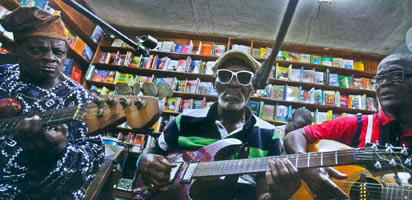
*Fatai Rolling Dollar (m) flanked by members of his band: Photo by Andrew Esiebo
By TOKUNBO DAVID
You have a serious fanbase abroad …
I do. My last European tour was in 2005/6. At the time we did a record called Lagos No Shaking with drummer Tony Allen. On the strength of my track on the album Awa Na Re, the band was invited to London and from there we toured Europe.
This will be your seventh decade making music professionally, since you started in the 1950s. Have you noticed a change in your fanbase over the years – are there younger audience members for instance?
Not really. Young, old, middle-aged, they all love my music because it’s different from what you have in Nigeria or anywhere else in the world.
How would you describe your music?
I’d say simply ‘Highlife in Juju idiom’, that takes in so many styles: highlife, rumba, cha-cha, afrobeat. There are a number of veterans in the field here in Nigeria but not one of them can do exactly what I’m doing.

*Fatai Rolling Dollar (m) flanked by members of his band: Photo by Andrew Esiebo
Take us back in time before you hit your stride professionally, pre-1950s …
Around 1945 I was still playing a style of music called Kokoma, an import from the Benin Republic. I also experimented playing Mambo with the Agidigbo [traditional plucked lamellophone], but at the root of everything was the Juju sound. I developed my craft back then which is more than I can say for a lot of young artists today. I wasn’t lazy.
You’ve seen quite a lot in 85 years and as a performer, and have lived through both good and hard times; is there a point when you will say to yourself: This is it. I’m retiring?
No. I still have a lot to do. It’s rather unfortunate that artists based in Nigeria are not getting as much institutional support as we do when we go outside the country but then I see a lot of young talented artists who don’t take music seriously as a career in the first place, just another means to an end – you know, to make enough money to buy a car or to become an overnight star.
In Nigeria today, I’m proud to say that I’m about the only artist I know to have sold a best-selling album [2004’s Won Kere Si Number] in a seven-year run. And it is timeless because of the message in the music. It’s what the people are responding to.
What were your earliest influences?
I listened to Congo (Rumba) music, that’s what got me to start playing the guitar. Nobody taught me how to play. I bought my flrst guitar at a UTC store and learned how to play at home. My then wife used to worry that I wouldn’t beneflt financially from my music. I used to tell her, “you just sit down and see what God can do.”
But she died before I became successful. Still I kept the belief that music was for me. When people ask me when I’ll stop making music my answer is, “Until my tongue stops working.” As long as I’m still active then I’ll keep making music.
For decades, starting from the mid-1970s, your career and life took a hard hit and you all but disappeared. What was that like?
It began around the time soldiers attacked Fela’s [Anikulapo Kuti] house; I lived three blocks away from him. I remember it was on a Friday afternoon and I’d just finished prayers at the Mosque when I saw flames coming from Fela’s compound.
People were stopped and searched before they could leave the area. I found my property and car ablaze, and the soldiers seized my instruments. That was the beginning of personal problems for me. I had to find a way to feed my family so I took a job as nightshift security guard at [Teslim] Balogun Stadium [Lagos]. For years, my guitar kept me company at my new job.
At some point before your career took off you were a sailor, among other things …
I was also a mechanic. And a boxer. And a seaman too. From about 1946 to 1949 I worked for the Harbor service, in Marina [Lagos]. In 1947 I even sailed aboard a British cargo ship, the Empire Ball, to Liverpool. I was young and very much a rascal. You had to be tough in that situation because otherwise you wouldn’t be entrusted with a pass to escort foreigners from ship to town.
And you played football from which experience I understand you got your stage name?
Yes. Back when we had the two shilling coin. That was school-lunch money for my brother, sister and me. It used to last us about three weeks. So when it came time to select for fleld positions, my friends would ask me to roll my dollar, heads or tails.
What was it like living in 1940s Lagos?
At that time everybody had something to do. If you needed a job or an artisan to do a job all you had to do was go to the Labour Exchange in Oko-Awo. We had unemployment benefit. Every week you got one pound. It was part of the British system in place at the time.
With the money you earned you relaxed by going to the race course. There was a popular song at the time that went “Everybody likes Saturday night”. Saturday in Lagos was groovy and beautiful back then.
Do you remember your first big gig?
It was 1960 at the Lagos Race Course (now Tafawa Balewa Square). I was invited by the government to play at Nigeria’s very first Independence Day. Also in that period I played together with the band Empire Rhythm Number One led by trumpeter E. Arinze at a show staged by the World Student Conference in Ibadan.
Your influence extends to Afrobeat pioneer Fela Kuti. Where you close friends?
I’d say we were good friends. When I started making music he was still schooling at Abeokuta. We eventually became neighbours in Lagos. I hung around at his place a lot. I loved him. He was always generous to me.
In spite of your busy performance schedule you somehow managed to hnd love again, this time in Germany with a special young lady. How did you meet your wife Helen?
I was touring Germany back in 2004. During one of our shows on a beautiful day with a big crowd, I could feel the vibe from the audience enjoying my live act. I was 78 at the time. When we ended our two-hour set I got off the stage, put on a record I enjoyed and danced alone.
Then I looked to my side and saw this beautiful lady also dancing alone. So I stepped over and asked to dance with her. I asked her if she came with anyone. She said she was there with her father who was sitting back in a chair.
I went to meet him and we talked. He was impressed with my performance. I asked permission to go out with his daughter and he was okay with it. We have fun together. She’s living in Cologne with the one child we have, a two-year old.
How many children do you have, and are any musical?
I have 15 children, including an eight-month old here in Nigeria. I don’t believe in forcing any of them to play music. Nobody forced me, I was a lone rascal and I made something of myself. But if I happen to notice any of them take an interest in music then I’d help them.
In fact, I’m planning on establishing a music school at Ikorodu, [Lagos]; I’m calling it The Fatai Rolling Dollar Foundation. The plan is to get musical talent off the streets and train them to become professionals. I’m presently funding the project all by myself.
In all your travels which country have you found yourself enjoying the most?
As a musician I enjoy anywhere I find myself. But Lagos will always be Lagos. I started here and cannot live permanently in Europe. I enjoy traveling and getting paid for work but the city always draws me back in.
Culled from Wings, The Inflight Magazine of Arik Air
Disclaimer
Comments expressed here do not reflect the opinions of Vanguard newspapers or any employee thereof.