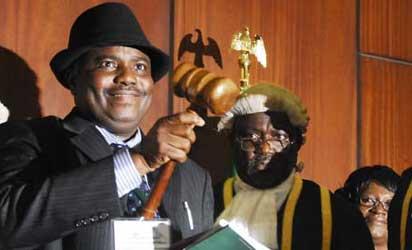
Speaker of the 7th National Assembly, Rep. Taminu Waziri Tambuwal taking oath of office while Clerk National Assembly Alhj. Salisu Maikasuwa and others look on during Swearing in of 7th National Assembly in Abuja. Photo by Gbemiga Olamikan
By Chioma Gabriel
Next week, both chambers of the National Assembly will resume from their recess which is an annual holiday that usually follows the conclusion of a legislative year.
In the case of the 7th Assembly, especially the House of Representatives, the break gave them the opportunity to organize themselves, sort out a few logistics matters regarding office accommodation for members, ruminate over the issues that confront the nation and set agenda for legislative action for the country in the current assembly.

Speaker of the 7th National Assembly, Rep. Taminu Waziri Tambuwal taking oath of office while Clerk National Assembly Alhj. Salisu Maikasuwa and others look on during Swearing in of 7th National Assembly in Abuja. Photo by Gbemiga Olamikan
Many expected that period to be an opportunity to form a strong team among the leadership and the new members who are still learning the ropes of law making.
Among the issues that will immediately seek the attention of the House as they resume is how to fill the remaining offices in the leadership which were left vacant due to clashes between majority members of the House of Representatives and the ruling Peoples’ Democratic Party (PDP) over selection of the members to fill these positions.
The most contentious is the post of majority leader of the House of Representatives. For most of the members, Hon. Ajibola Muraina who had withdrawn from the Speakership race just before inauguration in deference to the mood of the members should get it. But for the leadership of the ruling party, Mrs. Mulikat Akande, the only challenger to the emergence of Aminu Tambuwal as speaker of the House of Representatives is well positioned to clinch the job.
It is expected that reason would prevail and the person to fill the position would be announced at the first sitting of the House next Tuesday. From all indications, the emergence of Akande may have been sealed. She may have been favoured now for two principal reasons which include gender balancing and reaching out to the party hierarchy who had supported her ambition very vigorously in those days.
Similarly, the important position of deputy whip will go to one of the most ranking members of the House from the South South zone. The battle for who becomes the deputy whip from the South South has been hot following claims by several contenders including Ndudi Elumelu, Leo Ogor, Friday Itulah among others to that job. Efforts by the zonal caucus to resolve the matter have failed several times, but the healing hand of time appear to be moving in the direction of Honourable Ogor who is one of the oldest members of the House from Delta state.
Appointment into committees
However, resolving the tension over the appointment of members into standing committees would not be that easy. For a crowd of 360 people, managing them into committees of not more than eighty may be difficult. But that is where Tambuwal will have to score the critical point. Already, there is this talk of lobbying from within and outside.
Most of the lobbying are coming from those who either stood their grounds in making sure Tambuwal becomes Speaker and those who contend that ranking should determine largely how headship of these committees should go.
The truth is that not all ranking members are so good or very experienced to be made committee chairmen, while for practical reasons; it is not advisable to leave the new members out completely.
In the past, such overbearing attitude had sown the seed of instability that often defines the longevity or otherwise of the leadership of the House.
Besides, the considerations for placement into committees should reflect competence and experience and sometime localization of core interest. For instance, it may well not serve the interest of the Committee or even the aim of setting up committees to make as chairman of the committee on Niger Delta, somebody who is not from that area.
The same way, the committee on FCT needs to take into consideration the feeling of localities within the capital territory. The same consideration may also have to apply in other heavy spending sectors such as Agriculture, Health, Petroleum Upstream and Downstream, Water Resources, Works, Power and Education. Expectations are that square pegs will simply fit into the appropriate holes. Since these committees are tagged grade A, the selection committee is expected to distribute it evenly among the zones. It is expected that zonal caucuses should play a decisive role in the appointment of chairmen of these committees.
However, some of the committees like appropriation and House Services often are the preserve of the Speaker; expectations are that he will look for members who possess the necessary skills to handle the delicate and even difficult job of designing the fiscal framework for expenditure in the country. Already, the indication is that so many old timers including Hon. Farouk Lawan may be eyeing the job.
But many believe that Lawan Farouk being an old timer can fit into any committee well. As Chairman of two previous committees in the past sessions, he has shown depth and has done so much in those positions to inspire the confidence of members and the nation.
But seeking to be Chairman of Appropriation may be biting more than he can chew for this core bred politician. Besides, as a top member of the Economic Commission for West African States (ECOWAS) Parliament, he may not have the time and the concentration for a time – consuming job as that of appropriation.
Terrorism
Many expect that the coming days in the House of Representatives will see the House leadership enunciate on the agenda it said it was evolving as its contract with the electorates. Already, the Speaker has been speaking on it especially after the bomb blast which rocked the United Nations Building in Abuja. In a statement released from Saudi Arabia where he was performing the lesser hajj, the Speaker urged well meaning members of the Nigerian community to join hands to fight the scourge of insecurity in the land. In his words: “The House of Representatives is ready to help in the fight to stop this kind of violent crimes in Nigeria. We will do everything possible to provide the necessary framework for the fight to be executed.
For many, this statement means that the anti terrorism bill which though have been passed and signed into law by President Goodluck Jonathan, may have to be returned so as to give more teeth to the security agencies to ensure that a more effective regime of anti terrorism operation comes into place. Indeed, the security situation plaguing the nation today requires the cooperation of all arms of government to prosecute.
Besides, a lot of people believe that the administration of President Goodluck Jonathan is incapable of enforcing the tough battle required to bring about an end to terrorism in the country. What this means is that the House and its partner, the Senate should listen to the concerns raised by Security agencies and make amends in the general interest of the country.
Bad image
One other issue which the House may be tackling as it returns to work is the issue of bad image most of which have built up over the previous assemblies. The most troubling is the purchase of cars which led to the arrest and prosecution of its two presiding officers in the last House by the Economic and Financial Crimes Commission (EFCC).
Though the case is still in court, for many, that incident has combined to soil the image of the House and the best way to tackle such is to ensure openness and transparency by the leadership of the House of Representatives. The image problem of the House is so bad that conscious effort should be made to evolve a practice of fairness, openness and responsibility in the handling of the affairs of the House.
Related to the image problem is the perception in the party hierarchy that its conventions and understandings cannot be respected within the House. The new House of Representatives should design a programme of engaging the parties in the overall prosecution of the political agenda of the current administration.
It also in the best interest of the new House that the looming anger over the huge income accruing to members as salaries, allowances, and sundry benefits gets the attention of the new House. It is indeed, distasteful for a select number of citizens of the country to confer on themselves enormous welfare packages while the rest of the country wallows in abject poverty and destitution.
To sustain the reasoning for his ascension and preserve the cohesion that led to his emergence as Speaker in spite of the position of the PDP, the Speaker of the House should also ensure that the winners -take- all policy does not take place not only in the appointment of committee assignments but even in the raising of ad-hoc committees to carry out specific assignments for the House.
It is therefore, commendable that the leadership has raised a multi-party group to liaise with the media in the aftermath of the election of leadership in the House.
Bills and motion
In terms of bills and motion, the nation would be looking up to the House mainly to raise issues of concern to the average Nigerian. The Speaker has set the standard by speaking out against the spate of terrorist bombings in parts of the country and it is expected the house follows it up with action.
Other issues as the controversy over the legitimacy or otherwise of the Sovereign Wealth Fund, (SWF); the single tenure proposal from the President and his party should see the House taking a position of integrity and honour and one that will endure with time.
Perhaps this is the time to finally deal with Petroleum Industries bill (PIB) and the new revenue sharing formula which the Revenue allocation and fiscal commission appears ready to review. A situation where, the centre takes the lion share of the wealth of the nation while work and most responsibility lie with the states and the local governments ought to get the attention of the House as they resume.
The House of Representatives is known for its activism and nothing in the new dispensation should detract from this old time perception. And that is why the charge to the committees should be vigorous oversight not armchair criticism as often is the case.
The leadership should adopt a code of conduct for its members especially as it relates to oversight duties to ensure that its work truly affect the population who in the first instance, they are there to represent.
Finally, as the House resumes, Nigerians are expecting genuine effort to solve the issue of unemployment which has produced an army of job seekers, eager to take up jobs in the devil’s workshop. So far, Speaker Aminu Tambuwal has shown enormous capacity to meet up with the challenges, but the passage of time will surely put his leadership to test.
Disclaimer
Comments expressed here do not reflect the opinions of Vanguard newspapers or any employee thereof.