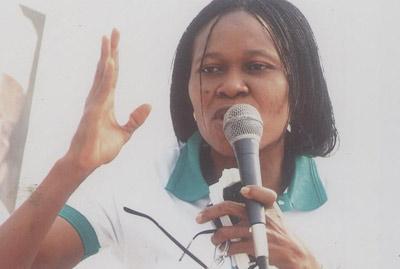
Dr. Joe Okei-Odumakin
Dr. Joe Okei-Odumakin has walked courageously where men fear to thread. She remains consistent without minding the hazards to her person in a society where critical voices are loathed by unjust system which rewards the crook and punishes the just.
She cut her teeth in activism as the Secretary of Women in Nigeria (WIN), Kwara State from 1988 – 1991 and the Coordinator of Women in Nigeria (WIN), Kwara State branch 1991 – 1996; Chairperson, Rethink Nigeria (1987 – 1992) and Chairperson, Committee for the Defence of Human Rights, Kwara State branch (1990 – 1996).

Dr. Joe Okei-Odumakin
Her foray into human rights activism was at a period when the Babangida dictatorship bared its fangs and locked up critical voices. She became one of the targets of the administration as she was arrested and detained for not less than 17 times at different locations: Division B Police Station Ilorin; Police Headquarters Ilorin; SSS Headquarters Ilorin; SSS HQ Maitama, Abuja; Panti Police Station, Lagos; Kirikiri Prisons in Lagos; and Alagbon Close in Lagos.
In this encounter with Esther Onyegbula, Okei-Odumakin explains what inspired her to become an activist, experience in detention, challenges and the poverty level in Nigeria.
What do you think is responsible for low level of women participation in politics?
Well, we are in a male dominated society and the issue of godfatherism is on the rise again. Most of the women are not really favoured because most men see them as threats or stumbling blocks, believing that perhaps if women occupy prominent political positions, they won’t play ball. Some women are very strict. Some of them will go to the extent of blowing the lead open.
Another issue is that of empowerment. In our society, without money, one cannot play real politics. In terms of financial empowerment, women have limited resources and because she needs to empower others via training, seminars, conferences, and education, all these things require money. Again, there is this belief, especially, in some cultures that women’s place is in the kitchen.
What inspired you as a woman to be an activist?
I had an inner inspiration, looking at my country and the military dictatorship it was undergoing at that time. Initially, I set out to be a nun. While in the university, a lecturer in my campus mentioned my matriculation number and asked me to see her. We had written a test and she realised I scored very high marks. When I got there, she asked me why they called me a reverend sister. I told her that because I wanted to be a nun. And then she asked me if I had heard of Martin Luther King, Mandela and other renowned activists. She gave me some of the books on her shelf to read. When I started reading, I realized that a lot of people have given their lives for the struggle.
When did you take the decision to be part of the struggle?
I became a born again in the struggle in 1985, and my idea of becoming a nun became a thing of the past. After that, my will was written. I only had a mattress and some few books, but I was prepared and ready to die for the struggle.
Were your decisions to be part of the struggle influenced by anyone?
When I started as an activist, for the first time, I meet Ransom Kuti, who was going to see Chief Gani Fawehinmi that particular day, and he took me to see Gani. From their discussion that day, I looked at all of them, and I realized that they had everything to live comfortably, yet they still tasted for justice, fair play. Thereafter, I also met Professor Wole Soyinka. For me, if people who were well to do could give their lives to the struggle, I decided I could do the same, by giving my life for the struggle. And since then, I have never looked back, despite all I have suffered, the number of times I have been placed on detention, and the gunshot on my leg.
What is the Women Arise project about, and how has it fared all these years?
The Women Arise started in 2003, to break the women’s culture of silence, to help mentor women. And I said, everywhere, all over the world women speak the same language, silence. Some of these women have never been mentored and they don’t even know what it is to have self confidence or to come out or to aspire.
Every Tuesday and Thursday are our clinic days where you will find women that have been battered. They come to our office and we help them to seek legal redress. We help to bring some of them together. If one fails at the level of family life, one has almost become a total failure.
We also have men that are our board members, like Professor Soyinka, and Pastor Bakare. We also have men who are supportive of our course; our national treasurer is a man. Men who believe in the course of women can also be members of Women Arise.
What would you consider as the greatest challenge you have faced through these years of struggle?
Getting more women involved in the struggle is a challenge on its own, except for a few women who feel committed. Again, the little resources that we have is also a challenge. And thirdly is the general insecurity of lives and property in the country. I still owe my life to God today because I would have died several times. I sustained gun shot injuries in the course of the struggle, four days later I landed in Kirikiri prison. Still, miraculously the gun shot healed. There was a time I didn’t bathe for like six months and I had skin rashes, because I was in detention at Alagbon with about 42 inmates.
Which military administration were you detained. What was your crime?
It was during the regime of Babangida. I was arrested for pasting posters, and they felt I was circulating inciting document against the government.
As wife and mother, how have you been able to balance your family life and the demands associated with the struggle without sacrificing one at the expense of the other?
Like I said, if one fails in the aspect of family life, one would have failed in all. As much as possible, I try to find a balance. When I had my first baby in 1997, I was to have a press conference. I didn’t know it was labour, till the doctor said it was labour signs. I had the baby like 9am in the morning after delivery. I left my baby in the care of my mother and I went for the press conference. I had the second one about eight years ago.
I always try to balance the two. When I am around, I attend my children’s Parent Teachers Association meeting and when I am not there, I make sure someone who is capable is there. I take care of the home front as much as possible. I cook when there is no soup and I learnt from my mum. I prepare everything and put it in the deep freezer. There is a microwave so that whatever anybody wants, they can have. I make sure that the children’s home works are done. I send texts to their teachers at times and I call them to ask them how my kids are faring in school, and when they have home work and I am at home, I help to put them through.
Disclaimer
Comments expressed here do not reflect the opinions of Vanguard newspapers or any employee thereof.