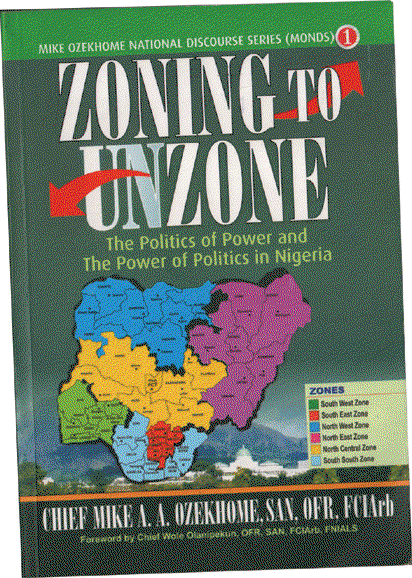
Zoning To Unzone: The Power of Politics and the Politics of Power In Nigeria; Chief Mike A.A. Ozekhome, SAN, Mikzek Law Publications Limited, Lagos, 2014,PP. 370
By PRISCA SAM DURU
It is doubtful if the historical records of both pre- and post-independent Nigeria politics would not be raped judging by the acts of its handlers and professional propagandists. Suffice to say that the lineage of Nigerian politicians have cowardly indicted the basic content of the manual of the past heroes who fought with all brands of determination to terminate slavery as engendered by the British colonists.

Zoning To Unzone: The Power of Politics and the Politics of Power In Nigeria; Chief Mike A.A. Ozekhome, SAN, Mikzek Law Publications Limited, Lagos, 2014,PP. 370
Unfortunately, at the heart of these problems is competition and rivalry among the major ethnic groups to take the lion’s share of the uneven distribution of national resources. As a result, fear of domination of one ethnic group over the others and cries of marginalisation resonate in the political space.
With this evasive ideological chaos, the concept of zoning entered the lexicon of Nigerian politics. In the course of bailing out the vagueness of records, “Zoning To Unzone: The Politics of Power And The Power of Politics In Nigeria” by Chief Mike Ozekhome, one of the finest brains in the country, takes its pride of place as a compendium of knowledge about the real issues in Nigerian politics.
The author, High Chief Mike Ozekhome, is a renowned Constitutional lawyer who has handled and participated in many epochal and sensational cases that have defined and shaped Nigerian Legal jurisprudence and enthroned a regime of Human Rights, Democracy, good governance and the Rule of Law.
In the book, the literary giant and legal luminary articulates and analyses the endemic problems causing disharmony in the country through a multidisciplinary approach of law, history, religion and politics. Relying on his wealth of experience and learning, he discusses elaborately the inherent variables playing out in the political system and reveals the secrets of different political calculations and permutations even to the point of predicting the dangers ahead of the country if adequate measures are not put in place.
In Chapter One, Ozekhome discusses how ‘Zoning’ became a buzz word in the political arena and among the political elite, and heightened by the death of President Umaru Musa Yar’Adua. In Chapter Two the author traces the history and analyses ‘zoning’ as a political concept in contemporary Nigeria and how the annulment of June 12, 1993 Presidential Election presumed to have been won by Chief MKO Abiola set the stage for zoning agitation and counter-agitation. In Chapter Three, he discusses the different shades of opinion of protagonists and antagonists on zoning.
The book traces the trajectory of the concept of zoning and posits that the entire hullabaloo about zoning is nothing but a ploy by the political elite to partition the country into fiefdoms to share her booty, more about sharing the national cake than baking it. He sees it as “bulkanisation of political offices and positions by way of compensation to satiate constituent interests.”
The author points the way forward. He submits unequivocally that the assumption that the principle of power rotation and zoning are mutually exclusive is patently fallacious. He insists that one actually presupposes the other, observing that the thought of giving every citizen and zone a sense of belonging and inclusiveness in the government of the country through rotation actually necessitated the concept of zoning.
Ozekhome submits that there is no zone in Nigeria that has the exclusive right to access the Presidency of Nigeria to the exclusion of all others. The author concludes by saying that rotational presidency and zoning help to unite the heterogeneous, religious, cultural, linguistic and ethnic diversity of Nigeria that consists of many nationalities.
He therefore recommends for all Nigerians of whatever gender, religion, language, ethnic group, state in life, circumstances of birth, academic and cultural backgrounds the philosophy of live and let live, and learn the principle of zoning to unzone. Included in the book are some useful appendixes and postscripts as well as the brief narration of his three week’s ordeal in the hands of kidnappers.
The book is very relevant in the contemporary politics of Nigeria. For students, teachers of Nigerian History, Politics and Government, any one aspiring to the leadership of Nigeria and all patriotic Nigerians,”Zone To Unzone” is a must read. It is a book every Nigerian or anybody for that matter that is interested in understanding ethnic politics and power play in contemporary Nigeria must have in his or her shelf.
Disclaimer
Comments expressed here do not reflect the opinions of Vanguard newspapers or any employee thereof.