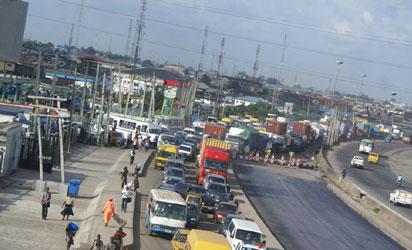
Oshodi/Apapa road
By Olasunkanmi Akoni
The Yuletide is over, but the traffic gridlock experienced by Lagosians, especially road users of the ever-busy Oshodi-Apapa expressway and the Apapa environs, remains.

Traffic gridlock on the Oshodi Apapa expressway…but when will this nightmare end?
Towards the end of last year, the perennial traffic snarl which crippled vehicular and commercial activities on the road worsened, as drivers of petroleum tanker and articulated vehicles heading towards and out of the Apapa ports, as well as tank farms located on the road, took over the road .
Road users’ hope for solace any time soon, may have been dashed, as Governor Babatunde Fashola of Lagos State has declared that the situation might continue unless the Federal Government takes certain necessary measures.
Bothered by the activities of tanker drivers and operators of articulated vehicles on the road, as well as the ongoing reconstruction of the road by the Federal Government, through the construction giant, Julius Berger Plc, the state government had over the years taken steps in collaboration with other agencies to find tangible results to the situation.
Fashola, severally gave ultimatums to oil firms to re-organise their operations by refraining their clients from parking on the highway which had continued to paralyse business activities in the axis, especially along Oshodi-Apapa and Ijora-Apapa axis.
Necessary measures were actually put in place to ensure compliance with the state Road Traffic Law 2014. Unfortunately, the horrible situation seems to have defied all solutions.
Fashola in company of some stakeholders visited Mile 2 and Apapa environs severally to assess the causes of the traffic gridlock in the area with a view to finding lasting solution.
Despite promises made to the governor by members of the Petroleum Tanker Drivers, PTD, and drivers of articulated vehicles to address the situation, they have not budged.
Comrade Tayo Aboyeji, the Zonal Public Relations Officer of PTD, who met with the governor, actually pleaded for time to change their ways with a pledge to free the roads leading in and out of Apapa.
Speaking at an interactive session with media executives, recently, in his Alausa, Ikeja office, Fashola attributed the problem to the failure of the Federal Government policy on distribution of petroleum products.
Fashola said: “The first thing to understand was that the responsibility of the state government is traffic management on that axis. But the problem on that road comes from the tankers and containerized trucks which come to the ports to lift fuel and others. I don’t manage the port and I don’t discharge fuel. So it is inaccurate to say that we are not doing enough to solve the challenges faced on that road or that we have lost the battle.
“The problem from the port was that vehicles that used to park inside the port have been driven out by the concessionaires and they have no option than to park on the road in order to gain access into the port.
“The information from within the ports was that there was no enough cargo handling equipment inside the port. So the turnaround time per vehicle is longer and slower. Anyone who puts that burden on us was doing that inappropriately.
“It is a Federal Government responsibility. The Tin-Can Island road that would have helped reduce the traffic belongs to the apex government. If they finish fixing it, it will bring relief. But we need to understand that the relief will only last for a short time. No nation delivers that kind of cargo by road. With the huge load transported on that road, there is no construction done on that road that will last, until we move those cargoes through rail. The rail tracks are available in that axis.
“The Europeans built them, but with coordinated plan, political will and clarity of purpose, we can move all these huge cargoes on rail. If you visit that axis today, you will still find the Agip, NNPC and other fuel wagons in the yard. So, we can do it if there was political will. But unfortunately, the rail the current administration embarked upon was for political demonstration,” explained Fashola.
Giving a breakdown of the number of users of the port, he disclosed that no less than 3, 000 tankers and at least 1, 000 articulated vehicles enter the ports daily, noting that their only mission is to lift fuel, diesel and kerosene, while the trailers visit the port to transport fish, rice, vegetable oil and others and the people are the ones consuming the commodities.
Continuing, the governor said: “That is not a bad thing. If you have 4,000 trucks daily visiting a place, any government that really loves its citizens must ensure that they move those things by rail.
It is bad economics because the Apapa roads had been constructed several times and after few months, the road gave way again.
“The fact that it is moving today is a credit to us because we are managing a very difficult situation. My hearts goes out to the residents and business owners in Apapa.
But when you see that traffic, one is only seeing the symptoms of a profound failure of port and oil management. And these are the responsibility of the central government,” he lamented
PTD reacts
However, reacting, the Zonal Public Relations Officer of PTD, Tayo Aboyeji, told Vanguard that the trailer park would not accommodate petroleum tankers as it was meant only for dry cargoes.
Aboyeji lamented the difficulty and the hostile environment the tanker drivers were operating in, in the absence of a convenient place to park their vehicles despite the essential services they were rendering to the citizens and the nation’s economy.
He however, blamed the situation on the failure of the federal government to properly manage the ports and the granting of licenses to private business concerns to site tank farms indiscriminately along the Apapa environ.
His words: “There are over 15 tank farms around the Coconut area alone all in Apapa. Our members have to drive long distances from different parts of the country to Apapa in Lagos to lift products. This shouldn’t be so. Why can’t we have depots in other places to free Apapa?”
The PTD image-maker stated that the union is currently discussing with a private investor for a land deal in Amuwo-Odofin area where they hope to jointly develop as parking lot for petroleum tankers. This he said would at least reduce the pressure on Apapa axis.
Disclaimer
Comments expressed here do not reflect the opinions of Vanguard newspapers or any employee thereof.