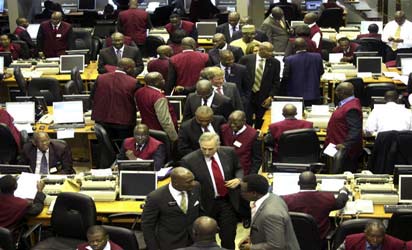
Nigerian Stock Exchange
BY NKIRUKA NNOROM
The challenge of determining the right price for new issues has been identified as the major factor hindering companies from raising fresh capital through Initial Public Offerings (IPOs) or public offers.
Managing Director/CEO, Trust Yield Securities Limited, Alhaji Ola Yussuff, who made the remark in a chat with Vanguard, noted that presently, almost all the stocks listed on the Nigerian Stock Exchange, NSE, are undervalued, saying that no company will want to raise new capital at a price lower than the real value of its stock.
He affirmed that the fear of such issues either being undersubscribed or not subscribed for at all makes rights issue a preferable option, saying, “As long as the market is depressed and the prices have not really rebounded, it is logically and technically right for a company do a right issue, with the hope that when the market fully recovers and the prices are closer to what the old price was, then the company can come with a public offer.”
While saying that dearth of public offers is not limited to Nigerian capital market alone, Yussuff said, “I find out that in America, they are complaining that not many companies are coming to do what we call IPO; what they have been doing is to raise money through right issues. You have to understand why and it is very simple. The market went through a very traumatic period for the past four years where most of the share prices went down.
“And when the share prices are down, and a company wants to raise new money, it has to answer certain questions like, at what price do I raise money? Do I raise it to attract new shareholders at a price they want it now, which is not the true price of the stock?
“If the share price is N1.00 when it is supposed to be N4.00 at the time a company wants to come to the market, it cannot sell such shares to new subscribers at N4.00 because nobody will buy and that is a signal of failure and no company wants to come to the market with public offer and fail.” He opined that raising money at a price lower that the fair value will make it difficult for a company to raise as much money as it will ordinarily want, adding that bringing in new investors at such time would not be fair to the existing investors.
“In the midst of this, you have to make a balance and the mid way will be, if the company is going to sell the shares at N1.00 today, it will need to give the existing shareholders preference and it is only when they said they don’t want that other people can now buy at that price. That is what is behind right issue. “It is to make sure that the people that have been holding the company’s shares, who have lost money and are still loyal to the company are given the right of rejection first. It is only when they reject it that other people can come in. So, what I am saying is that, it is the price that makes many people to prefer right issue to public offer or IPO.”
According to him, competition could also be a deterrent. “If you are coming into the market with an initial public offer, you need to consider the sector you are coming into. If you are coming into the manufacturing sector, you need to look at what the prices in the sector are like. If UAC and others are selling at N40.00 today, and you are saying, ‘I am going to produce something as UAC’ and you want to sell at N20, not that the people are not going to buy your share because it not worth it, but because of the competition in the market.
“Then you don’t price your IPO at a level that is going to be a receipt of failure. You have to be sure that the market is ready to accept your IPO at a price that you are coming with.
You have to look at the price at which your competitors are presently been priced and then you have to look at if you leave your IPO at that level, will it raise you sufficient money, are people ready to take it at that price,” he stated.
Disclaimer
Comments expressed here do not reflect the opinions of Vanguard newspapers or any employee thereof.