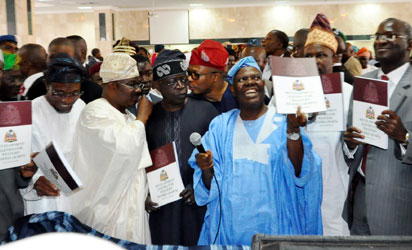
*THIS IS THE NEW DAWN: From left: Gov. Kayode Fayemi, Gov. Rauf Aregbesola, Gov. Abiola Ajimobi, Asiwaju Bola Tinubu, Mr. Fola Adeola, Founder, Fate Foundation and Chairman of occasion, Chief Bisi Akande, National Chairman of Action Congress of Nigeria, Gov. Ibikunle Amosun and Gov. Babatunde Fashola, chief host, at the event. Photo: Bunmi Azeez
Executive Summary:
It is safe to assert that it also reflects the fear of the central government to lose control of its over lordship of the country. The outcome is that the atomized states are saddled with important expenditure responsibilities, but the central government retains 52 percent of revenue accruing to the Federation account.
This is a paradox, given that independent Nigeria had historically been a Federal system until the advent of the military in 1966. The military retained the name “Federal Republic of Nigeria” as the official name for the country, but proceeded to re-structure the entire country along central command lines. This has persisted till the present.

*THIS IS THE NEW DAWN: From left: Gov. Kayode Fayemi, Gov. Rauf Aregbesola, Gov. Abiola Ajimobi, Asiwaju Bola Tinubu, Mr. Fola Adeola, Founder, Fate Foundation and Chairman of occasion, Chief Bisi Akande, National Chairman of Action Congress of Nigeria, Gov. Ibikunle Amosun and Gov. Babatunde Fashola, chief host, at the event. Photo: Bunmi Azeez
The extant political arrangement has constrained the development aspirations of not only the Region, but also the full realisation of the potential of all the other component parts of the Nigerian federation. The super-structure remains faulty and ambivalent in every respect. It therefore requires a new framework, otherwise the country will continue to flounder and sub-optimise, regardless of every good intention.
A composite Regional Integration and Development Agenda for the Southwest has therefore become imperative in order to fulfill the immense potential of the Region. Yorubaland has always been known as hubs of economic growth, demonstrators of 6 good governance and bastions of sophisticated culture for the entire African region.
The latent capacity remains and has indeed grown. However, the impact of governance in all spheres of life is abysmally low. Our Region is fast losing its competitiveness and falling short of its economic and social ambitions.
This scenario needs to be urgently arrested. A fundamental change is therefore required, not just in economic and social performance, but in retrieving our lost heritage, our values, our virtues, our norms, and indeed our future.
Irrespective of the different partisan platform in Ondo State, an integrated development strategy opens a new opportunity for deriving the benefits of economies of scale in the development process of this region. What are we going to make of this new opportunity?
The answer is to go back to what worked in the past and adopt the strong dimensions of it in the present context. Indeed, we need to chart what has now been adopted as the Development Agenda for Western Nigeria, DAWN.
The purpose of the DAWN is to foster regional cooperation and integration as a catalyst for decentralization. There are several models for validating the influence of the integration process in the evolution of result-oriented decentralization.
The European regional development policy for example makes provision for financing for the poorest regions in the EU. These also provide incentives to become a more competitive and efficient economy, and to require more policy and budgetary discipline.
It is apparent that given the tectonic shifts in global political economy and globalisation, a return to the halcyon days of regional governments in Nigeria, and particularly the trail-blazing administration of Chief Obafemi Awolowo may be unrealistic, nevertheless, a paradigm shift in the Nigerian political and economic order is imperative if the country is not to slowly waste away. 7
3. THE DEVELOPMENT AGENDA FOR WESTERN NIGERIA – DAWN
DAWN is both a document and a process. As a document, it sets out a clear Framework for the Region”s objectives, priorities and major policy thrusts. It also provides a Roadmap upon which Governments, Development Partners, the Private Sector and Civil Society can ride on to drive a development agenda for the Region.
It indicates where the Yoruba development agenda should focus on, what we need to do to get there, how we shall do it, what the journey is going to cost and how it may be financed. The strategy provides a short, medium and long-term framework for achieving the Region”s development goals and aspirations.
The DAWN is essentially an Agenda for Good Governance in the Southwest, taking into consideration the following:
The development of the Southwest along regional lines, i.e. Integration.
The Region is an economic block, and as such, a regional approach will be cost-effective and economically viable especially in the areas of infrastructure, industrialization, commerce, the environment and agriculture.
The proposed strategic direction or redirection suggested through the DAWN Framework has been developed through a rigorous process, led and supervised by the Afenifere Renewal Group (ARG).
The process has been inspired by the Yoruba people themselves, who clearly in public and private conversations, and indeed through their votes at the April 2011 general elections, and the ones preceding them in 2007 (rigged, but revalidated through the courts), determined and defined their obvious ideological preference.
The political leadership has also clearly demonstrated a determination to advance the development of the Southwest Region and in fact the old Western Nigeria, including Edo and Delta, transcending political lines, where necessary, to launch a composite development agenda for the Region.
Indeed, the Yoruba people gathered at a Yoruba Development Agenda Summit, organised by the ARG in Ibadan, on September 23, 2010, resolved among others ………….
(a) That Yoruba electorate must rise up as one nation under one God, and ensure the emergence of political office holders who will truly serve the people, and espouse the „Omoluabi’ ethics and values true to our heritage as a people.
(b) We reiterate the call for True Federalism to enable the constituent parts of the country develop at their own pace, and in accordance with their God-given potentials and capabilities, guided by the peculiarities of their history, cultural norms and inclinations.
8 (c) We call for immediate steps towards Regional Cooperation and Integration among the States in Yorubaland to boost social and economic development.
(d) That it has become imperative more than ever before for a composite Yoruba Development Agenda that will drive and guide our developmental process.
The ARG took a cue from all of the above, with the process culminating in the development of the DAWN Framework. This framework itself feeds largely from a commissioned study submitted to the ARG by the Yoruba Academy. The Academy, set up to provide the much-needed intellectual backbone for Yoruba development in all spheres of life, indeed provided the basis upon which further actions were carried out.
At a Retreat held on the 22 – 24 July, 2011, at the University of Ibadan Conference Centre, Ibadan, Oyo State, and attended by a conglomeration of some of the best intellectuals, technocrats and professionals in Yorubaland, the composite DAWN Framework, which also provided a Roadmap for action was developed.
The central plank of this development strategy is self-development and self-sustainability, with strategic focus on efficient and effective utilisation of all human, financial and material resources of the constituent States. This should be informed by a detailed audit and/or mapping of available resources to see how they can be best deployed and harnessed. The comparative advantage of the localities should be exploited in a holistic framework.
The Development Agenda seeks to encourage the Southwest States to develop a common set of integrated development strategies that enable the Region and its citizens to experience a well-managed process of development, across all spheres of existence.
It also encourages the pursuance of a political (and possibly constitutional/legal) consensus and framework across the Southwest Region, with possible collaboration with the national government, to enable its unhindered implementation and actualisation.
DAWN focuses on the development of a Yoruba identity drawing upon our heritage, history and talent. It is an Agenda for Social Transformation using well-defined Pillars of Development to create a scenario that ensures better living standards for our people irrespective of status, gender, demography or religion, on a sustainable basis.
It is indeed pleasing to see demonstrations of mutual commitment by the leadership of the States in the Region, indicated by the establishment of a 21-member Technical Committee, as well as dedicated Ministries and/or Special Offices for Integration in some of the States – these are optimistic indications of progressive buy-ins.
Continues tomorrow…
Disclaimer
Comments expressed here do not reflect the opinions of Vanguard newspapers or any employee thereof.