

Forex accruals: Finally, state governors remove their blinkers!!
Acknowledgements and gratitude (1)
Kill subsidy before it kills us!
“CBN Defended naira with $26.6bn in 2013”: True or False?
Keshi & EFCC as metaphor for false hope
CBN’S oil receipts may expose fiscal impunity
ALLEGED UNREMITTED $49.8BN: MISCHIEF, IGNORANCE OR DISTRACTION?
Senate’s ill-advised $76.5 crude oil benchmark
Paper to polymer to paper currency: They still don’t get it
Paradox of debt accumulation in spite of healthy reserves
Balance budget as the responsible platform for MTEF
The avoidable oppressive burden of fuel subsidy
The Blessing of Oil : A peculiar mess
Oduahgate: Who will cast the first stone?
Negative income from PHCN sale
Where do the brightest and fittest go?
Where Is Our Money?

Subscribe to our newsletter
Sign up for our newsletter, and be the first to get the latest news on Vanguard.
Subscribe
Guess who is dollarising the economy
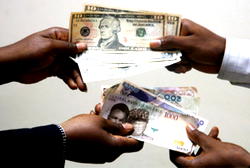
Any patron of Bureau de Change may find that a difference of about N10 per dollar now exists between the official rates of N155 per dollar ex-Central Bank, and about N165/dollar in the open market. This is in place of the permitted 1 per cent markup officially allowed to commercial banks on dollar purchases ex-CBN.
14 Nigerian banks to enjoy $7bn reserve
“The report of the 14 Nigerian banks which had been appointed as Asset Managers of Nigeria’s reserves was carried on the back page of The Guardian Newspaper of the 5th of October 2006. The report confirmed that “already deposits worth $7bn representing part of the apex bank’s share of foreign reserves estimated at about $38bn had been released to the consortium of bankers, according to the CBN Head of Corporate Affairs, Mr. Festus Odoko”.
Parable of the fool and his money…
The other day, a friend narrated a story, which I found stranger than fiction; the story related to the travails of a family who lost a successful and illustrious breadwinner, who, incidentally, died without a Will. The family’s elders were consequently entrusted with the responsibility of efficiently managing the estate of the deceased.
CBN’s management of surplus cash as economic sabotage
It is bad enough to ever be in a position where one borrows one’s money back, but for our Central Bank to have done so for so many years at rates of between 13 and 14 per cent, as admitted recently by Governor Lamido Sanusi, can at best be described as an unfortunate moral hazard, which may border on economic sabotage.
Is poverty the ultimate reward for pension contributors?
The consciousness of sensitive Nigerians is often assailed by the undignifying sight of senior citizens and other such retirees, who wearily wait in distress for verification of their identity or eventual payment of pension entitlements from government agencies responsible for disbursement. The unsightly juxtaposition of such horrid spectacle against the background of impunity in the misapplication of pension funds is obviously also lost on our current political leadership; worse still, in spite of the reforms enacted in the 2004 Pension Act, there has been no single conviction of anyone for the reckless looting of pension funds.
CBN as misguided Father Christmas
In view of the apparently ‘boundless’ funds at the disposal of Nigeria’s Central Bank for its independent interventions, observers, including the National Assembly have frowned at the proprietary and the shrouded protocol surrounding the values and the choice of beneficiaries of the apex bank’s bonanza.
Okonjo-Iweala perplexed by high interest rates
“The first thing I have to say is that we have a central bank that is autonomous and it is the best practice to make these decisions. We may not be happy about it and I am bold to say we are not happy about high interest rates! As I said before, it is tough for our entrepreneurs to function. Even before the withdrawal of this liquidity, they were already charging over 20% interest rates and I think that is alarming. …we need to interrogate why. Structurally, what is the issue? And we are not willing to ask our banks that question.
Heavens save us from our economic (mis)management team
In recent times, one of the causes of malfunctions in the Nigerian financial system is the paradox of substantial government deposits in Deposit Money Banks (DMBs) and high government borrowings from the deposit money banks; as at June 13, 2013, the three tiers of government had N2.384tn in the DMBs out of which about 90% are in zero interest-bearing Current Accounts. To mop up the liquidity at 14% will cost N301.33bn, which is more than the annual budgets of most states….
Nigera’s Economic Destiny: Trapped
In a recent interactive section with the House of Representatives Committee on Banking and Currency, the Governor of the Central Bank, Lamido Sanusi, noted that if the plan to redesign naira notes last year was successful, “it would have made it impossible for counterfeiters to cook”. He further noted that best practice currency management is that “Within a period of 5 – 8 years, you redesign the currency, after which counterfeiters tend to catch up with you”.
Naira: redesign, redenomination or revaluation?
In a recent interactive section with the House of Representatives Committee on Banking and Currency, the Governor of the Central Bank, Lamido Sanusi, noted that if the plan to redesign naira notes last year was successful, “it would have made it impossible for counterfeiters to cook”. He further noted that best practice currency management is that “Within a period of 5 – 8 years, you redesign the currency, after which counterfeiters tend to catch up with you”.
How banks make free money from government funds, by CBN governor
“First of all, you have got liquidity surplus in the banking industry; … there is over N1.3tn or so sitting in banks and belonging to government agencies. Now basically, they (these funds) are at zero percent interest and the banks are lending about N2tn to the government and charging 13 to 14%! Now, that is a very good business model, isn’t it? Give me your money for free and I lend it to you at 14%; so why would I go and lend to anyone?”
Sanusi’s tall story on high interest rates
Nigeria’s hope of early economic rejuvenation and growth may have been sadly foreclosed by Lamido Sanusi, in a recent presentation to the House Committee on Banking and Finance in Abuja, when he noted, in spite of the clarion demand by industrialists that “although the CBN has put in place several monitoring measures to ensure stability in the economy, it was not possible to guarantee the delivery of low interest rate, due to the harsh business environment in the country”.
Euro and China loans: A nation’s folly
The recent $1bn Euro loan is reported to be part of the federal government’s $8bn medium term external borrowing plan, which has already received the approval of the National Assembly (NASS) and the Federal Executive Council according to the DMO’s DG, Abraham Nwankwo. Incidentally, the interest payable on the $1bn Eurobond is within the same range of 6.75% as the initial $500m Eurobond issued in 2011, and similar to rates, which distressed economies like Portugal and Greece currently pay.
The man “Fashola” by Fashola
In the absence of the usual compliment of effusive media adverts, the special interview granted a select group of editors was probably the most public event in the recent celebration of Babatunde Raji Fashola’s (BRF) 50th birthday!
£3,000 UK VISA BOND: Is government huffing and puffing?
Nigerians were recently agitated by the British government’s proposed demand for a £3000 bond as prerequisite for the issuance of a six-month visa for visitors from Nigeria, and five other Commonwealth countries to the United Kingdom.

Subscribe to our E-EDITIONS
Subscribe to our digital e-editions here, and enjoy access to the exact replica of Vanguard Newspapers publications.
Subscribe