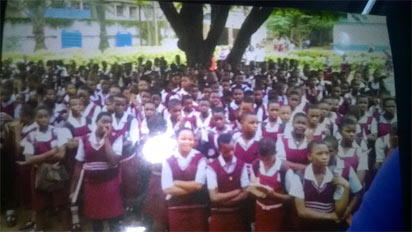
Young school girls
The UN Secretary-General, Mr Antonio Guterres has urged nations to end the bias preventing women and girls from taking up opportunities in Science, Technology, Engineering and Mathematics (STEM).
Guterres gave the advice in his message for the International Day of Women and Girls in Science observed on Feb. 11.
In the message made available to journalists in Lagos on Saturday, he said that for too long, discriminatory stereotypes had prevented women and girls from having equal access to education in STEM.
According to him, as a trained engineer and former teacher, it is a well known fact that these stereotypes are flat wrong.
”They deny women and girls the chance to realise their potential and deprive the world of the ingenuity and innovation of half the population.
”On this International Day, I urge commitment to end bias, greater investments in science, technology, engineering and maths education for all women and girls. ”I urge commitment to end bias in the opportunities for their careers and longer-term professional advancement, so that all can benefit from their ground-breaking future contributions,” he said.
In her message, Ms Irina Bokova, the Director-General of the UN Educational, Scientific and Cultural Organisation (UNESCO) said that the celebration was an opportunity for all to take a stand for girls and women in science. Bokova noted that girls continued to face stereotypes, social and cultural restrictions.

Young Girls Learning
She said that such stereotypes were limiting access to education and funding for research, preventing girls from scientific careers and reaching their full potential. According to her, women remain a minority in science research and decision-making.
”This throws a shadow over all efforts to reach the 2030 Agenda for Sustainable Development and the Paris Agreement on Climate Change, both of which highlight the key roles of gender equality and science.
”At the same time, girls and women shoulder the heaviest burdens of poverty and inequality; they stand on the frontlines of climate change, including the disasters resulting from natural hazards. ”Girls and women in rural and disadvantaged areas are hit hardest.
”Meaningful progress must start with the rights and dignity of women by nurturing their ingenuity and innovation,” she said. Bokova said that humanity could not afford to ignore half of its creative genius, “who are women and girls’’’.
She said that girls and women must be empowered at every level, in learning and research, from administration to teaching, across all scientific fields.
According to her, this goal underpins the manifesto for `Women in Science’ that UNESCO launched in 2016 with the L’Oréal Foundation, to engage governments and stakeholders in promoting the full participation of girls and women in science.
”We must inspire girls and young women by offering mentoring opportunities to young women scientists to assist in their career development.
”We must raise awareness about the work of women scientists by providing equal opportunities for their participation and leadership in a broad spectrum of high-level scientific bodies and events.
”The world needs science and science needs women. We invite everyone to sign this manifesto together, we can make a difference,” she said.
Disclaimer
Comments expressed here do not reflect the opinions of Vanguard newspapers or any employee thereof.