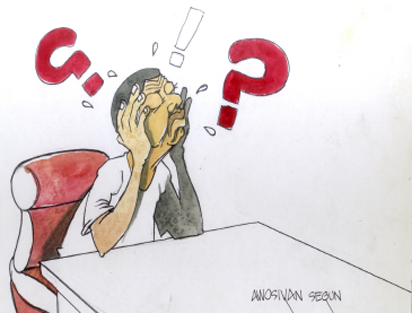
Runaway man
By Bunmi Sofola
Lots of men are living with prostate cancer today— which is a whole lot better than dying from it. If the cancer is caught while still localised within the prostate, experts believe the chances of it killing you within the following five years are practically nil. However, if the cancer spreads, your chances of surviving five years may be as low as one in three. For this reason, scientists have been desperate to identify factors that help cause prostate cancer to spread. These include:
Eggs and poultry: Harvard University researchers recruited more than 1,000 men with early-stage prostate cancer and followed them for several years. The results were astonishing. Compared with men who rarely eat eggs, men who ate even a small part of an egg a day appeared to have twice the risk of their prostate cancer spreading— for instance, into the bones. The only thing potentially worse than eggs was poultry. Another trial found that men with more aggressive cancer who regularly ate chicken and turkey had up to four times the risk of prostate cancer progression.
Scientists suggest that the link between consuming poultry and cancer spread may be due to carcinogens in cooked meat. For unknown reasons, these carcinogens build up more in the muscles of chickens and turkeys than in those of other animals. But what about eggs—how could eating less than one a day double the risk of cancer spreading? The reason may be choline, a compound found in eggs. Indeed, higher levels of choline in the blood have been associated with an increased risk of developing prostate cancer in the first place. Another study discovered that men who consumed two-and-a-half or move eggs per week —basically an egg every three days—may have an 81 per cent increased risk of dying from prostate cancer.
Milk: It contains growth hormones designed by Mother Nature to put a few hundred pounds on a baby calf within a few months. But are they good for us? Leading Harvard University nutrition experts have warned that the hormones in doing products could stimulate the growth of hormone—sensitive tumours—such as prostate cancer. Not only that, but experimental evidence suggests that doing may also promote the conversion of pre-cancerous lesions or mutated cells into invasive cancers. To date, there have been 14 studies in which organic cow’s milk was dripped into human prostate cancer cells in a laboratory Petri dish. In each experiment, the milk stimulated the growth of human prostate cancer cells, producing an average increase in growth rate of more than 30 per cent.
In contrast, almond milk suppressed the growth of the cancer cells by more than 30 per cent. What happens in a test-tube or Petri dish, though, doesn’t necessarily happen in people. Nevertheless, a compilation of studies has concluded that cow’s milk consumption is a risk factor for prostate cancer. But, you may be wondering, if you can’t drink milk, what will happen to your bones? Doesn’t milk help prevent Osteoporosis? It turns out that the promised benefit may be just another marketing ploy. An analysis of many studies shows no significant protection. Even if you were to start drinking milk during adolescence in an attempt to bolster peak one mass, it probably wouldn’t reduce your chances of fracture later in life.
Can you reverse prostate cancer?
Experts believe eating a varied plant-based diet, and avoiding all meat, fish, chicken and dairy products—may have much to recommend it, but it’s certainly not for everyone. With this in mind, a group of researchers at the University of Massachusetts did a study on prostate cancer patients who agreed to get only half their protein from plant sources. Happily, this half-vegan diet did, indeed appear to slow down the growth of cancer. Instead of doubling in size within 21 months, their tumours took 58 months to grow to the same dimensions. So, even tweaking your daily diet is well worth the effort.
Half a serving a day of broccoli, brussels sprouts, cabbage, cauliflower or kale, for instance, can cut the risk of cancer progression by more than half. For another study, a research team recruited 93 men with prostate cancer who had chosen not to undergo conventional treatment. One group wasn’t given any diet or lifestyle advice. The other prescribed a strict diet centred of fruit, vegetables,
whole grains and bears, and told to walk 30 minutes a day. Cancer progression was then tracked using PSA levels (a protein in the blood.) So what happened? In the people who did nothing, PSA levels increased by 6 per cent in a year. That’s what cancer tends to do—grow over times. But healthy-living group, PSA levels decreased by 4 per cent, suggesting their tumours were shrinking.
A year after the study ended, the cancers in the control group patients had grown so much that 10 per cent of them needed surgery. By contrast, none in the plant-based diet and life-style group ended up on the operating table. Does that mean men suffering from prostate cancer merely need to change their diets? No—it is not recommended that they ignore medical advice. They have nothing to lose and much to gain however, by also changing what they eat. Other research has shown that the blood of people on plant-based diets are able to fight cancer eight times better than the blood of people of a typical Western diet.
But what if the benefits are down to exercise? To find out, a research team compared three groups of men: a plant-based diet and exercise group, an exercise— only group and a group of sedentary people eating standard fare. Would people who exercise hard enough and for long enough develop cancer-fighting abilities that rival that of strolling plant-eaters? To find out, blood from each of the groups was dripped onto human prostate cancer cells growing in Petri dish. Well, the blood of the sedentary lot wasn’t completely danceless. Even if you’re a chip-eating couch potato, your blood may still be able to kill off 1 -2 per cent of cancer cells.
But the blood of those who had exercised strenuously for 15 years killed 2,000 per cent more cancer cells than the blood of the couch potatoes—a fantastic result. Even better was the blood of those in the plant-based diet and moderate exercise group, which wiped out an astounding 4,000 per cent more cancer cells than that of the blood of the couch potatoes. In other words, thousand of hours in the gym appeared to be no match for a plant-based diet.
Giving your confidence a boost
In her book: How to shine in a crowd, Susan Roane gives the following strategies to help you work the room when you find yourself alone in a huge crowd, where no face looks familiar.
The entrance: There is no such thing as being ‘fashionably late’ for a meeting. Arrival is based on the start of the event, not making a conspicuous entrance. Take a deep breath, stand tall and walk in. If you stand in the door-way, people think you’re scared.
Give the room a quick once-ever. Check out the bar, the food, where most people are congregating. “One man I know who has difficulty talking to people always positioned himself between the door and the … buffet,” says Susan. “Everyone has to walk by him to get to the food and he is always surrounded by people”.
First contact: Look around for people you know. If you see someone who looks even vaguely familiar, go and introduce yourself. Only two things can happen—either you’ll be right and renew an acquaintance, or you’ll meet someone new to chat to.
Use your friends: One of the main advantages of going to an event with a friend is that you can introduce one another around the room. You will know people he or she doesn’t and vice-versa. Give people enough information about your friend and be positive. If neither of you know anyone, split up and start chatting until you do.
Get moving: If you are on your own and don’t recognize anyone, do not be tempted to melt into the wall. Look out for what Susan calls the “hard knuckle drinker.” They are clutching their cup or glass so tightly that their knuckles are really hard. They’re scared to death and they’re always alone. They will usually welcome your conversation because it saves them from anonymity.
Opening lines: Don’t hang around waiting to make the perfect opening gambit. Even if what you say isn’t going to bring the house down, do not lose the chance to start a conversation. The best opener may just be a smile and the word, ‘Hello’, other areas for easy comment are the event, the food, the organization, the traffic, even the weather. Avoid negative comments such as: “The food looks pathetic,” because people will think you are a whiner.
Disclaimer
Comments expressed here do not reflect the opinions of Vanguard newspapers or any employee thereof.