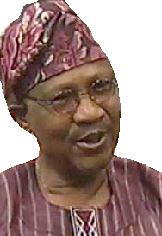
—Femi Odekunle, member Presidential Advisory Committee on Corruption
Professor Femi Odekunle is a member of the presidential Advisory committee on Corruption headed by Professor Itse Sagay. In this interview with Ben Agande, he speaks on the anti corruption problem in the country and other topical national issues.
Sir, you have been a member of the presidential advisory committee on corruption, what has been your experience so far?
Before we talk about success it is good to inform you about things we have done; we have engaged virtually all those agencies involved in corruption prevention and control. We have managed to engage them in an interactive session. We go to an agency and we ask, this is the situation on ground, why have you not done this or why is this like this or like that? We try to assess their problems and we put in an advisory to them because when we give an advice it is like an advisory from the Presidency, whether it is ICPC or EFCC, whether they are judges, police or customs.
Take the EFCC for example. we have been able to advise them on how to upgrade the state prosecution for example in liaising with the federal ministry of justice. They now have prosecution teams which involve federal government ministry of justice lawyers and private sector lawyers whereby for every case there will be a team of four.
The problem it solves is that two heads are better than one. If a member of the team travels or is sick, there would be no need of postponing the case because the prosecutor is not available.
We have had workshops with judges in the FCT, federal high courts all over the country; we did in Jos, Kaduna, Kano, Owerri, Port Harcourt, Ibadan and Lagos. we had a full day workshop with the judges to let them know the powers they have because part of the problems of dealing with corruption cases has to do with senior lawyers who use their clout to delay and frustrate cases.
Do you think that at this point in time of our democracy it is right for people to steal money and then return few amount and then they are let off the hook in the name of plea bargain?
Plea bargain is a legal position which is to avoid the labour and the loss of a case you are not able to handle. We are in a colonially inherited judicial system that is in favour of the bourgeois who have the money and the resources and the knowledge to turn an allegedly impartial system to a partial one because they have the resources to do so.
Now going into our history in the fight against corruption, you will realise that a lot of cases are either dead or virtually dead because they have been there for 8-10years. Basically as a person, despite the argument I have just given, I am against plea bargain because it is an admission that the state is incapable of doing its job. But in a committee system, you listen to the arguments of your colleagues and that is the argument I have given which is also understandable.
But now what this plea bargain manual has done is to take care of objections of people like me and like you to say that if there is going to be plea bargaining, first the interest of the state must be taken into consideration, the interest of the society as a victim must be taken into consideration, the money must be forfeited or most of it, and most importantly, there must be a term of imprisonment.

In other words, there are legitimate questions that could be raised against plea bargaining. I have told you that as a criminologist I am against plea bargaining because where it originated like in the US it was met to take case of minor cases like traffic offences, two fighting that used to clog the system, not for cases in which the society has been massively defrauded.
But considering the problems we are having in processing the cases, plea bargaining can be an element of processing the case. All we have to do is now try to reduce the disadvantages that can come on board and that is why we say substantial amount of money must be forfeited, the person must be punished with imprisonment, that is the interest of the state, of the society, of the people who have lost either her by suffering a bad road, by not getting the hospital they desire, by having collapsed school building, their interest must be taken into consideration whenever you are using this bargaining system.
In your interaction and consultations with all these agencies did you come across situations whereby agencies that are supposed to be fighting corruption being neck deep in corrupt practices?
Nigeria is a society and like any society it is run on a system. We know the kind of corruption that goes on in the university; there is monetary corruption, sexual corruption, academic corruption which students are given grades they don’t deserve because of sex or money, people are promoted with fake certificates, there are cases of plagiarism, there are admission rackets. So similarly whether in EFCC or ICPC, there would be such cases.
As a criminologist, there is nothing wrong with deviance. that is part of life. But when it becomes serious, when it is endemic, pervasive particularly in certain organisations that are crucial to the survival of the society as an organism, then there is problem. For example it is not good, even if there is corruption, corruption should not be in the judiciary, and if it is there at all it should be minimal because of the importance of that organ of society in the matter. If there is corruption, it should not be among police men because they are people who are supposed to be the enforcers of the law and it is said that when law enforcers become law breakers the society is doomed.
So when you ask whether or not there is corruption in the anti corruption agency, of course there must be.
But remember that our committee is not an investigative one, we just go there and say we heard this, are you doing this? The fact that we even show up and even mentioned it at all is enough to put some fear into the minds of the agencies in charge of fighting corruption.
One of the trending things in recent times is between the President and the National Assembly on the suitability or otherwise of Ibrahim Magu as the chairman of EFCC.
It is in the interest of Nigerians to give back confidence. On the day that the Senate said they are returning his name back to the President, our committee considered the case and on the basis of our knowledge we wrote a letter to the President that Magu has been doing a good job, he has shown commitment and he has also shown diligence and we strongly advised that the name of Magu should be re-submitted for confirmation. In addition we said that if the Senate does not, he should continue to appoint him as acting chairman ad infinitum.
On a personal note, the two cases that had to do with the Secretary to the Government of the Federation and Magu, I take the position that it is good for the Senate to do its job, even if occasionally. Secondly I am not against thieves pointing out another thief because it is in that situation that we the Nigerians will get to know the truth.
In the case of the SGF, it is clear even from the conflict of interest positions that he has engaged in wrong doing. It may not have been a wrong doing under Jonathan but for an administration that claims anti corruption as its major mantra, the man should resign and if he refuses, the President should have asked him to step aside. And it is not actually appropriate for the President to ask the Attorney General to look at it.
But let’s give it to the President that he must have his reasons for going that way but the man should have been told to step aside. You may call it step aside, you may call it suspension but the President should have done that. That is my position.
In fact, what is being done is denting the work of our committee; it is denting the image of the administration by that man retaining his seat.
And I find the letter allegedly sent by the President thoroughly inappropriate to say that well your report is interim, only three of you signed it; it appears therefore to the population that the President himself is appearing guilty of what we are accusing the judiciary by using technicalities to cover up wrong doing because to say that only three people signed and that is an excuse for you to turn down the findings is wrong.
On the issue of Magu, I have pointed out that looking at the nature of corruption in Nigeria, the extent of corruption in Nigeria, what they accused Magu of does not have facts. They didn’t say that they found money under his bed like we did with judges; they didn’t say that he has these other properties; they didn’t say he has money in foreign countries. They said at one point in time they found files in his house.
Most chief executives must take files home to be able to complete their work. A good executive actually in Nigeria or in any good organisation will only sleep for 3 or 4hours a night because during the office hours, you are doing meetings, you are receiving visitors, you are signing things and may not have the time to study documents. Most people who know their onions as chief executives must take papers home. As ordinary head of department, I used to take papers home otherwise the work would not be done. So that is neither here nor there.
Secondly, they said he rented a house, they didn’t say he rented the house and paid with his own money. it came out that it is an FCDA property. The summary of my position is that what they have hung on Magu in order not to confirm him is simply a case of calling a dog a bad name so that you can hang it.
The problems that fuel the crisis in the country, how do you think they can be resolved in a situation where we have a high rate of unemployment and job loss?
I am not an economist but I have had this idea commonsensical for about two years and I have put it forward to the highest appropriate authority that paying N5,000 to unemployed youths as a palliative amounts to bribery and that even the amnesty for the south south militants amounts to a kind of ransom for blackmail or kidnapping because you did it many years back and the money has dried up, a new government has come in, militancy has started and then you want to continue the amnesty, that is like blackmail. When another government comes in the same thing is likely.
The best way to solve our youth unemployment problem is through infrastructure development.
As a teacher what do you think is the panacea for the continuous fall in the standard of education in the country?
So far, I have listed about five or six types of corruption but the emphasis in Nigeria is the financial, the economic.
Going back to the university system, I pointed out to you that the thing has gone down out of different kinds of corruption that I have pointed out. How come somebody will score 260 but they cannot enter the university but the one who scores 180 can enter the university.
How come people who are brought in to the lecturers, some people who have first class or second class upper will not be admitted in the same federal university system but somebody with a second class lower would be admitted to be a graduate assistant.
How come that at the end of the day even some professors in one university will not be qualified to be a professor in another university?. How come the best man is never the Vice Chancellor (VC)? It depends on election and other outside manipulations before somebody becomes a VC. And yet a VC is supposed to be an intellectual academic and administrative manager than just a manager sponsored by some people inside and outside the university.
Disclaimer
Comments expressed here do not reflect the opinions of Vanguard newspapers or any employee thereof.