By DOTUN IBIWOYE- Book Review
What is the art of transferring risks from parties that cannot manage them to those more equipped to manage them in a manner that ensures the automatic reimbursement of the financing through the underlying transaction assets, called? What is the origin of Structured Trade Finance, these and other complex issues relating to structured trade finance are what Dr Bennedict Oramah addressed in his new book titled ‘Foundations of Structured Trade Finance’.
Oramah, in the 230 page book, published by Ark Group in 2015 affirms that STF as it grows and becomes more complex in an increasingly risk-based regulatory environment, there is a need for more detailed guidance on the subject.
According to the author, STF is a highly specialised area of trade finance that has evolved directly from practice. It is an instrument that is generally believed to be appropriate in financing trade in difficult environments.
The book explains how STF has proven itself as an effective instrument for attracting trade finance to those regions that receive limited trade finance and which lag behind in trade and economic performance.
The eleven chapter thoroughly researched book unearths the origins of STF in the 1980s “when the debt crisis made many international banks cut their credit lines to many developing countries”.
According to the author, with STF, lenders no longer look to borrowers as direct sources of repayment, but rather to the underlying assets arising from the financing, namely the goods financed and the receivables arising therefrom.

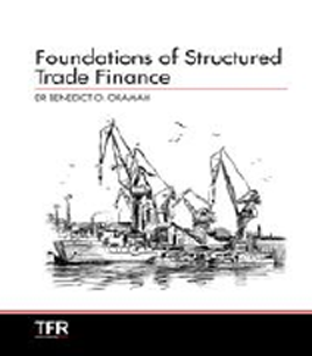
Foundations of Structured Trade Finance; Dr Bennedict Oramah; Ark Group; 2015; PP. 230
The intent of the book is to introduce readers to the fundamentals of structured trade finance, which is an instrument that is generally believed to be appropriate in financing trade in difficult environments.
The author Dr Oramah, who had spent over 22 years in the trade finance industry, with over 20 years at the African Export-Import Bank (Afreximbank) has informed his understanding of the difficulties faced by international banks in financing trade deals in developing countries, and underpinned the preparation of this book.
As an executive vice president responsible for business development and corporate banking at Afreximbank, Oramah has been at the forefront of designing and implementing the structured trade finance instruments used to good effect by Afreximbank today.
Over the years, he has shared his knowledge with hundreds of trade finance practitioners across Africa.
The reader is also provided with detailed insight into how deals can be structured, supported by several real life examples from which important lessons are drawn. Operational risks and pricing issues are also discussed extensively.
Oramah also noted that STF has proven itself as an effective instrument for attracting trade finance to those regions that receive limited trade finance and which lag behind in trade and economic performance.
The book elucidates that the aftermath of the implementation of an export-led structural adjustment programme (SAP) under the auspices of the Bretton-Woods institutions in the 1980s and 1990s, trade began to recover in Africa and other developing regions in 2000.
The book also reviews the genesis of trade finance difficulties faced by some developing regions , using Africa as a case study.
It also prepares the reader for an understanding of the basics of trade finance structures by providing a quick overview of payment methods and instruments normally used in international trade.
The book is a major contribution to knowledge and practice in the new and rapidly evolving field of structural trade finance.
Disclaimer
Comments expressed here do not reflect the opinions of Vanguard newspapers or any employee thereof.