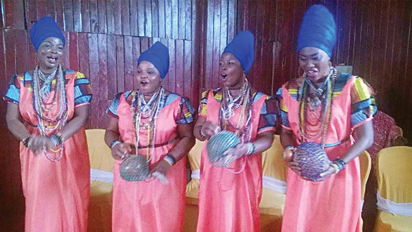
• Performance by Nerfetiti group at the festival
By PRISCA SAM-DURU- literature
Although the 2016 edition of the Ake Arts and Book Festival has come and gone, memories of exciting events coupled with conversations with writers across the continent, particularly, Kenya’s Literary Icon, Ngugi Wa Thiong’o who was the festival’s headliner, will linger for a very long time.
Theme ‘Beneath This Skin, the festival which in its customary nature, celebrated arts, literature in addition to performances held in ancient city of Kuto, Abeokuta, ended with a reverberating Poetry and Palmwine Party. In as much as there were visual arts exhibitions by Fati Abubakar, Ayobola Kekere-Ekun’s etc, one wouldn’t be wrong to say that the festival was all about books considering the number of book chats that held. It also served as platform for publicising the newest works by African writers.
Kicking off November 16 with performances from Falana, Adunni and Nefertiti and Brymo, the performers raised the roof with different interesting renditions. Nefertiti in their usual style held the crowd spellbound with different songs from each tribe across Nigeria, going as far as Delta.
The opening ceremony which was hosted by media personality, Wana Udobang, witnessed the attendance of Alake of Egbaland, Oba Adedotun Aremu Gbadebo and a host of several dignitaries. Titilope Sonuga’s spoken word performance will never be forgotten in a hurry. She chronicled the hardship biting hard on Nigerians and other topical issues.
Welcoming guests, festival’s director, Lola Shoneyin highlighted the opportunities for collaboration, networking and relationship-building the festival has created since inception. She stressed that it has become a good platform for Africa to interact and co-produce, as evident in the large gathering. “I’m delighted to see how Ake festival has grown both in size and significance, she said adding, “We would like to believe that Ake Festival is where African creatives feel safe, valued and appreciated, where they get an opportunity to network with people who share their interests and where they get the best palmwine. We, at the Book Buzz Foundation, get a very warm feeling when we see photos of Ake Festival guests attending each other’s weddings, stopping by at each other’s events or just meeting up somewhere in the world for a coffee.”

• Performance by Nerfetiti group at the festival
Paying tribute to two writers who transited to glory, Shoneyin said, “But there are times of great sadness, when our hearts are broken. We were all shocked to hear of the passing away of two great friends of Ake Festival: Oyebade Dosunmu, we lost last November, and Ken Saro Wiwa Jr, who passed away last month at the age of 47. Both of them had so much to give.”
Aside the Poetry and Palmwine party moderated by Prof. Remi Raji-Oyelade, which was a major attraction, the conversation between Prof. Okey Ndibe Kenyan’s veteran writer, Professor Ngugi wa Thiong’o, was one of the best things that happened at the book feast. Most importantly, the conversation re-echoed the importance of preserving African languages through literary works written in mother tongues. This Wa Thiong’O insisted must be done before the literary work is translated to English and other foreign languages.
During the session tagged “Life and Times Series”, the celebrated Kenyan writer decried the fact that African languages have been replaced with those of the Europeans due to colonialisation. Wa Thiong’o whose short, folk story, “The Upright Revolution” has been translated into 55 languages, harped on the need for African writers to begin writing in mother tongues before translating to other languages.
Interestingly, Yoruba language translator expert, Kola Tubosun did justice to translating the work into Yoruba. The story was read in about six African languages to which the story has been translated including three Nigeria languages.
Earlier during a Panel discussion tagged, “Prison Stories and Literature of Resistance”, moderated by Molara Wood, Prof Wa Thiong’o recounted experiences during those painful days in prison during the time when Jomo Kenyentta was Kenya President. According to him, “when they conquer you, they impose their own ideas, languages and cultures on you. Japan did it to Korea. England did it in Africa so that you would hate your names and assume new ones. It is a way to subdue your culture and retain their own naming system. By this, your memory of what you have been will soon belong to the dustbin of history. Indeed, part of the Slave Trade was to disconnect Africa from their people and it is still happening today. It is part of mental and psychological torture.”
About 9 Book Chats were held. The sessions provided platforms for indept discussions and analysis of issues relating to the festival theme. For the first time, Erotica was given a space like never before. With “ Legs Open, Eyes Closed: Sensuality in New African Writing”, as theme, the session had Chinelo Okparanta, Toni Kan, Kiru Taye and Nana Darkoa on a panel that was moderated by Kolade Arogundade. Writers of this genre as much as they could, left nothing out during talks on erotic writing.
Another book chat centered on Boko Haran, had two US-based Nigerian writers; Teju Cole and Helon Habila interviewed by Kadaria Ahmed. They both read from and had discussions based on their new non-fiction books, “Known and Strange Places” by Cole and “The Chibok Girls” by Habila.
‘Hissein Habre: A Chadian Tragedy’, a documentary film by Mahammat Saleh Haroun was among the movie screened. It was such an emotive documentation that exposed the effects of the tyrannical period of ex Chadian ruler, Hissein Habre. His reign as recorded, killed over 40,000 people.
“Iyalode of Eti, an adaptation of The Duchess of Malfi by Debo Oluwatuminimu, was staged courtesy of Etisalat Nigeria, at the Hubert Ogunde Hall of the Cultural Centre. The drama tells a bloody tale of love, betrayal and revenge that employed music, poetry and dance to transport the audience to pre-colonial Yorubaland.
File:29/11/2016\Ake festival (pix) 2016/11/2016\Ake festival 1, 2, 3
Disclaimer
Comments expressed here do not reflect the opinions of Vanguard newspapers or any employee thereof.