By Dele Sobowale
“Nigeria regains Africa’s top oil producer status.”
PUNCH, December 15, 2016, p 30.
While others had their eyes glued to the pages carrying the President’s budget address to the joint session of the National Assembly, NASS, some of us were paying greater attention to movements in the global oil sector. Like it or not, the volume of oil exported next year and the average price per barrel will still be the major determinant of how the Nigerian economy performs next year – just as it was in 2016 and years before it.
The Nigerian economy has not been sufficiently diversified to ignore oil in our forecasts of future economic estimates. That report had a mixture of good and bad news for Nigeria and the 2017 budget – but mostly good. According to the report, “OPEC in its Monthly Oil Market Report for December put crude production from Nigeria at 1.782 million bpd in November…up from 1.390 million bpd in October”. Thus, in one month, Nigeria has experienced a 28 per cent increase in the volume of crude oil produced heading into the New Year when the new agreement by the Organisation of Petroleum Exporting Countries, OPEC, takes effect.
That agreement leaves Nigeria’s quota of 2.2 million bpd untouched while cutting the quotas for other nations. The nations which were expected to kick against that exemption – Iran, Iraq and Libya – were surprisingly the most supportive of the motion to exclude Nigeria from production cuts. That decision immediately raised the global price of crude over $50 per barrel and gave Nigeria considerable margin to go through the entire 2017 without suffering a negative variance between the $42.5 per barrel on which the budget was based and the actual. The era of Excess Crude Account, ECA, might be returning faster than we expected.
The second life line came from India, the fastest growing major economy – which for reasons yet unknown – has opted to buy more Nigerian oil in a crude-for-dollar deal. If the deal goes through, it would at least provide a floor below which our monthly sales cannot go and certain dollars which we badly need.
Every commentator on the 2017 Budget must be honest enough to admit that those two elements have changed the outlook considerably because they have changed the metrics with which we assess the viability of the new budget. It is not merely a continuation of the old budget with new figures padded on, it is a budget taking into consideration the new life lines granted to Nigeria and which will vastly increase the dollar revenue of the Federal Government and ease the pressure on the exchange rate. Perhaps, this is the place to start by looking at the assumptions one by one.
The 2016 budget assumed exchange rate of N197/$1, but, today, the official rate is N305/$1 0r 55 per cent higher and the parallel market rate is N485/$1 or 146 per cent above. Obviously, there is a wide margin between the official rate and the actual market rate creating rent seeking and distorting the operations of the market. Any regulatory body loses credibility when there is such a wide margin between its figures and the actual figures. In 2016 the CBN estimates were totally out of line with the realities.

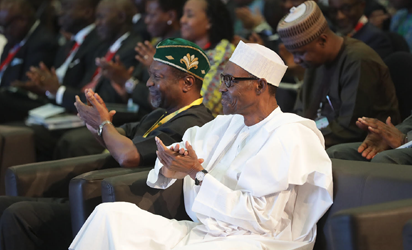
President Buhari
The 2017 budget had assumed N305/$1 as the exchange rate even as we enter the New Year with higher rates. At the moment, it is between N480 and N485 per $1 or between 55 per cent and 59 per cent of current market rates. Clearly, something must be wrong with the assumption. The Central Bank of Nigeria, CBN, by maintaining this artificially low exchange rate is cheating the states out of Naira funds they badly need to pay salaries, pensions and contractors. It is doubtful if the NASS will allow this figure to remain untouched.
Even if the NASS did not want to act, the public query issued to the Monetary Policy authorities by the former Governor of the CBN, His Royal Highness, Sanusi Lamido, regarding multiple exchange rates should force them to call for a public inquiry into the matter. The question is simple: what is the operative exchange rate? What can a foreigner coming into Nigeria with his dollars expect to get in exchange?
The next and most important of all the assumptions is the retention of the 2.2 million bpd estimate for the 2017 Budget. Even the greatest optimist must worry about this figure which had been used since 2012 for annual budgets and had never once been achieved. Even when there were no militants’ attacks anywhere, the best we ever did was 1.95 million bpd. At that time the global economy was also growing at 3-4 per cent per annum and China was chugging along at 7-8 per cent. Today, many of the countries growing fast at the time had slowed down. Additionally, oil exporters now include the United States – once the largest importer of crude oil – and many of them have increased their capacity for production. Lastly, as the price of crude goes up, it makes it profitable for American producers to enter the market with oil from other sources.
Unless a permanent peace is soon negotiated with the militants, even the 1.782 million bpd achieved in November might not be sustainable for the entire year. Obviously, to base a budget on a production figure, never attained, and unlikely to be achieved amounts to extreme optimism which should be avoided when writing a budget. Cautious optimism would suggest a figure like 1.85 million per barrel for 2017 – and even that with our collective prayers.
The President’s Economic Management Team, EMT, continue to surprise those who have been studying their tendencies since 2015. They are either too optimistic in one area or they become pessimists in another. Just as the world is settling down to crude oil selling at $45-50 per barrel, and Nigeria had been handed two life lines, they project benchmark of $42.5 per barrel. Why? There might be a catch there. The Federal Government might be deliberately trying to start funding the ECA once again. It is almost certain that short of a major economic crash in the USA, China and Europe nothing foreseeable can drive crude down to under $42 per barrel in 2017. So, that assumption is low compared with what is generally expected.
The real problem regarding the expected revenue from crude oil arises from the interplay of volumes and prices. As long as exports remain at 1.7-1.8 million bpd, even a price level of $50 per barrel will leave Nigeria short by approximately $2 million per day or $60 million short per month. At CBN’s low N305/$1, that means N18 billion to be sourced elsewhere.
Still on monetary policy, the budget is silent on interest rates and inflation – two key measures of the investment climate. The last figures we had were provided by the National Bureau of Statistics, NBS, which indicated that inflation was raging at 18.4 per cent per annum. Interest rates averaged the same. Given the rise in government spending next year, it is unlikely the two economic indices will remain the same. Uncertainties scare investors.
However, it is the sudden increase in government spending, N4.94 trillion which “is 28% higher than 2016 full year projections.” In short, the Federal Government plans to spend its way out of the current recession. This is the classic way governments have handled recessions which are caused by low aggregate demand. It had worked elsewhere and there is no reason why it cannot work here. A good part of the funds will be borrowed in the hope that a revived economy will generate the funds to repay its debts. The problem is, economic policies which work elsewhere had often failed to work in Nigeria on account of the Nigerian Factor, meaning pervasive corruption. The Buhari administration will succeed only if it can secure the benefits of the investments it is making for the common good instead of allowing them to flow into private pockets as they have done in the past. Still, 28% increase in one year is a great gamble which will reverse the downward trend if the funds are available as and when needed – generally in the first half of the year.
There is no need at this point to analyse all the allocations to various Ministries, Departments and Agencies, MDAs seriatim. The funds allocated for 2017 are in tandem with the narrative. Whether or not the funds will be available is yet to be seen. Most Ministries, Departments and Agencies, MDAs, were not fully funded in 2016. As a matter of fact, virtually all of them were under-funded resulting in poor performance all around. Nothing new can be written about MDAs failing to deliver on the promises made on their behalf.
However, there was one programme which marked the difference between the Buhari administration and others before it. It was the Social Protection Programme, SPP, to which N500 billion was allocated last year – despite warnings by well-meaning Nigerians that the promises were too bogus and the programmes were not well-planned.
SPP suffered from poor funding and poor planning in 2016 as a result of which none of the projects under it was fully executed; some not at all. Once again, N500 billion had been allocated to SPP in 2017. Observers can only hope that the managers of SPP had learned from the 2016 experience; that they would not again promise what cannot be delivered. Because if only twenty per cent of SPP is delivered, it would have had a more positive impact on the economy and the lives of Nigerians than any programme since the price of crude jumped up by 300% in one day in 1973.
The major problem is funding. Talk is cheap; but will the funds be there to turn our current despair brought about by recession to hope for sustainable recovery? I think so. The willingness of the Federal Government to approach the World Bank and the International Monetary Fund, IMF, suggests that Nigeria might perhaps be thrown a third life line – this time from both sources. Just emerging from the Boko Haram conflict, the last thing the global community wants is the “giant of Africa” disintegrating on account of prolonged economic recession. They will help us. Call it tyranny of the very weak or what you will. The global economic community cannot afford for Nigeria to go down now.
That is the secret source of hope at this time.
Disclaimer
Comments expressed here do not reflect the opinions of Vanguard newspapers or any employee thereof.