By Oboh Agbonkhese
Jumai (not real name), while, in secondary school, loves a particular statement so much, she would decorate all her notebooks and textbooks with it. Turn the pages and “Simile, Jesus loves you” welcomes you.
Another, John (not real name) did same with “May God be the glory.” Both, arts and science student, respectively, came out with very good O’Level results. And it happened in Edo State! Imagine the number of such “illiterates” a system failure inflicts, yearly, on a people that have given up on their leaders and look up to the youths. So, when the Corruption, Not in My Country campaign turned to secondary schools, it was a move Mary, a teacher, called “a light that will blind the corrupt.”
Although the brain behind the campaign, Akin Fadeyi, has huge anti-corruption visions, his ambition is of a gradual re-orientation that “begins with deploying strategic platforms to engage impressionable teenagers so that we can evolve a society that is predicated on mutual respect, sense of dignity and capability to positively influence one’s environment.”
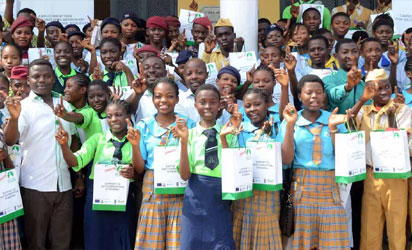
He was speaking at a capacity-building programme for students of 10 secondary schools in Surulere, Lagos, an event that had movie stars and TV personalities demystifying the glamour of the entertainment world to wide-eyed students.
Morayo Afolabi Brown and her gang of delectable presenters of Your View on TVC, combined intelligence, beauty and elegance as, one after the other, they shared ideas on how to pursue dreams without compromising on morals. They even took part in a dance-exercise session to loosen up the students.
The movie producer, Lucy Glover, Kelechi Udegbe and Greg O. J., of the popular Officer Titus TV series, where also at the Surulere event. It was Mr. Afeez Ayetoro, a lecturer and thespian (theatrical actor}, who told the students that their destinies were in danger.
Going in and out of the Saka character, Mr. Ayetoro told the students to beware of Nigeria’s social systems that no longer ask questions. He said in his days, his parents made him account for anything they didn’t buy for him, even if it was an eraser. And when his mother found on his body signs of beating by a teacher, she asked “What was your offence?” Simple question.
But it was accompanied by beating on same part of the body in time with every syllable of the question. Saka pointed out that today, religious bodies, communities and organisations run after politicians and the rich with titles and front seats, not minding the source of their money. He said if many organisations follow the Akin Fadeyi Foundation example, the much-wanted change will be a reality sooner than expected.
By the time Not in My Country campaign launched on May 4, Fadeyi had put in about eight years of research into the project. This must explain the glow that lights up his eyes every time he has a chance to speak on what a generation of corruption-conscious youths can do for the country. The impact of the anti-corruption campaign might not be immediate or even measurable.
But the response of schools and authorities has been massive. Before the Sululere event, the one held in Agege was equally packed. The European Union, United Nations, among others, have bought into the vision. Recently, the MacAthur Foundation sent Fadeyi to Harvard to study Behavioural Insights to Public Policy Design.
In an encounter with the Ooni of Ife, Oba Adeyeye Enitan Ogunwusi, Ojaja II, the monarch said: “Akin, you don’t even know the meaning and magnitude of what you’ve started. The vision is great and you shall soon see what it means to be a CHANGE AGENT.”
“Our plan is to reach as many schools as possible all over the country and my passion is fed by patriotism,” says the soft-spoken Fadeyi. In fact, you can have the Corruption, Not in My Country T-shirt on and walk past the unassuming Fadeyi, without knowing he was there. But physical size and volume has nothing to do with visions, and patriotism is not engendered by the irritating political demagoguery politicians and leaders rotate among themselves.
It is bred on the realisation that each one can change his/her immediate environment, since the practical care that governments in other climes use in “buying” patriotism exists only in words in Nigeria.
Transparency International, United Nations and many other world bodies might have their definition of corruption. But in Nigeria, corruption is lack of potable water, electricity, roads, security and so on.
Corruption takes on an ingenious, or even a miraculous, dimension when, for instance, a four-lane road becomes two lanes across a river. Immediately after the bridge, it turns to four lanes again. It becomes sorrowful when it is in the public domain that somebody turned the other two lanes into money in personal pockets, yet drives freely in the best of rides. So from being 52nd in the corruption index in 1997, Nigeria is now 136th among 168 countries.
“If a handful of students from each school we reach buys into our campaign, do you know what revolution can begin?” Fadeyi asked, with so much passion that makes him loom larger than life.
When one of the TVC beauties asked students to volunteer a definition of corruption, a dimunitive boy piped: “It is a situation whereby someone uses his/her position or privilege in an unethical way.” It just brings a smile of hope to one’s face set against the terror of Jumai and John’s simile and metaphor. Today, both are liabilities to parents and family members.
Disclaimer
Comments expressed here do not reflect the opinions of Vanguard newspapers or any employee thereof.