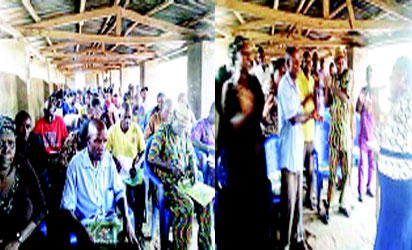
Participants in one of the training centres at Ayamelum LGA. and The communication officer (right) addressing the participants.
By Vincent Ujumadu
Awka — NO fewer than 500 people from five local government areas of Anambra State have been empowered by the United Nations Children’s Fund, UNICEF, to carry the campaign on how to avoid the dreaded Lassa fever to five local government areas of the state. The local government areas are Orumba North, Ayamelum, Anambra East, Anambra West and Anaocha.

Participants in one of the training centres at Ayamelum LGA. and The communication officer (right) addressing the participants.
Those who received the intensive training and the empowerment include leaders of women groups, youths, community leaders, among others.
Officials of UNICEF said the campaign became necessary in the view of the fact that the three Lassa fever casualties, who were of Anambra State origin, might have made contact with their relations or friends before the disease claimed their lives.
South East Voice recalls that a medical doctor from Orumba North died of the disease while receiving treatment at the Nnamdi Azikiwe University Teaching Hospital, Nnewi, just as two women who hailed from Ayamelum and Anambra West respectively died from the effect of the disease at Asaba, Delta State.
As soon as the deaths were reported, the state government and UNICEF stepped up enlightenment campaign in the state and ultimately selected 500 participants from all the communities in the five local government areas.
Those who participated in the training programme were expected to further educate their people at the grass root level on ways of avoiding the spread of the disease.
The UNICEF –assisted Communications Officer (SOMTEC) in Anambra State, Mrs. Chineze Ileka, who led high –powered oficials that trained the participants, said the world body was worried about the loss of lives through Lassa fever in the state, even when there was no outbreak of the disease in the state.
According to her, the easiest way to avoid Lassa fever was to ensure that rats were not found in human surroundings by keeping the surroundings clean, disposing wastes properly, covering all food items, throwing away foods partly eaten by rats, avoiding eating uncooked garri and other food items usually eaten raw, avoiding eating rats and avoiding contact with Lassa fever- infected persons or corpses.
Ileka listed symptoms of Lassa fever to include fever, sore throat, difficulty to swallow, cough, headache, chest pain, swelling of the face, eye and neck, bloody diarrhea and bleeding from the nose, mouth, ears and eyes, advising those who noticed such symptoms to visit the nearest health center for treatment.
Disclaimer
Comments expressed here do not reflect the opinions of Vanguard newspapers or any employee thereof.