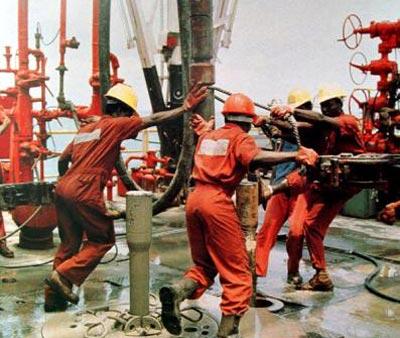
*Oil rig
…Experts worry over Nigeria’s ability to benefit from rebound
By Sebastine Obasi & Michael Eboh
At the backdrop of silver lining in the oil price and output levels industry experts are giving notes of warnings against any slip into actions that have put the economy in stress.
Current economic statistics points to worsening impact of oil sector woes on the economy.
Oil is the mainstay of the nation’s economy, which explains why the rumbles in the sector have negatively impacted on the economy.
Figures from the National Bureau of Statistics, NBS, indicated that oil sector decline was still the leading cause of the three consecutive quarter decline in the economy’s output level.
In the third quarter of 2016, Nigeria’s Gross Domestic Product, GDP, contracted by 2.24 percent (year-on-year) in real terms.
NBS explained that oil production averaged at 1.63 million barrels per day (mbpd), lower than the level in second quarter of 2016. Oil production was also lower relative to the corresponding quarter in 2015 by 0.54 mbpd when output was recorded at 2.17 mbpd.
Real growth of the oil sector declined by 22.01 per cent (year-on-year) in third quarter of 2016. This represents a massive decline compared to 1.06 per cent growth recorded in same quarter of 2015.

Growth declined by 23.07 percentage points and 4.54 percentage points relative to growth in third quarter of 2015 and second quarter of 2016 respectively.
As a share of the economy, the Oil sector contributed 8.19 per cent of total real GDP, down from10.27 per cent recorded in the corresponding period of 2015 and 8.26 per cent recorded in the preceding quarter of 2016.
Nigeria’s 2015 and 2016 budgets were hinged on a crude oil output of 2.2mbpd, but had struggled to produce about 1.6mbpd on the average this year. It was just two weeks ago that the Minister of State for Petroleum, Dr. Ibe Kachukwu, raised hopes that recovery is underway with a recent increase in output level to about 1.9mbpd.
Exports and revenue dip
Also data obtained from the NBS, showed that Nigeria’s crude oil export in the first half of 2016, dropped by 58.06 per cent or N1.344 trillion to N2.315 trillion, from the export of N3.659 trillion recorded in the first half of 2015.
When compared with the previous half, Nigeria’s crude oil export in the first half of 2016, dipped by 26.51 per cent or N835 billion, compared with the N3.15 trillion recorded in the second half of 2015.
Recent data obtained from the Central Bank of Nigeria, revealed that oil revenue inflow into the federation account for the first half of 2016 stood at N1.203 trillion, dropping by 36.88 per cent and 41.32 per cent from N1.906 trillion and N2.05 trillion recorded in the second half of 2015 and first half of 2015 respectively.
On its own part, the Nigerian National Petroleum Corporation, NNPC, disclosed that from August 2015 to July 2016, it remitted $48.99 million to the Federation Account from crude oil export sales, compared to $607.83 million remitted between December 2014 and July 2015.
On the other hand, the NNPC added that from August 2015 to July 2016, N881.933 billion was remitted to the Federation Account from the domestic sale of crude oil and gas, compared to N774.467 billion remitted to the federation account from January to June 2015.
In the month of August 2016, from the proceeds of crude oil and gas export, the NNPC remitted $23.885 million to the Federation Account, dropping by 45.87 per cent from $44.125 million remitted to the Federation Account in July 2016.
In addition, Minister of Finance, Mrs. Kemi Adeosun, said that oil revenue declined by N23.3 billion to N135.4 billion in September 2016, compared to N158.7 billion recorded in August.
Creative deals
Signs of a rebound in the country’s oil and gas fortunes, and subsequently, a rebound on the economy, had gone bleak, forcing some creativity in the oil authorities’ strategies.
Consequently, industry observers believe this necessitated the signing of memoranda of understanding, MoUs, between Nigeria and two Asian giants, China and India.
In the case of China, MoUs worth over $80 billion were signed with various Chinese firms to be spent on investments in oil and gas infrastructure. The money is expected to be spent specifically on pipelines, refineries, power facility refurbishment and upstream sub-sector of the oil and gas industry.
Kachikwu who led a team of top management of NNPC and key industry stakeholders to showcase the investment opportunities which abound in the oil and gas value chain in Nigeria to the investors in China, said it is with a view to attracting funding and partnerships that would turn around the sector and place it among the best in the world. Speaking during the plenary of a special investors’ roundtable which had in attendance over 200 Chinese investors with key focus on the oil and gas sector, the minister reiterated that the road-show was organised as a follow up to the working visit of President Muhammadu Buhari to China in April, 2016.
Similar cash-raising deal worth $15 billion was signed with India with terms to be agreed, where the Indian government would make an upfront payment to Nigeria for crude purchases.
Path to recovery
Major part of Nigeria’s oil-related economic woes was the crash in oil price in the international market. The price had fluctuated mostly below $50/ per barrel for most part of the second half, 2016.
However, respite appears to have come the way of the country as oil price has risen by more than 8.0 percent to a five-week high following the decision of members of the Organisation of Petroleum Exporting Countries, OPEC, last week, to cut production by 1.2mbpd.
Consequently, Brent crude futures for delivery in January were up $3.86, or 8.3 percent, at $50.214 a barrel, recovering from a drop of nearly 4 percent and on course for their biggest one-day upwards move in nine months. Brent crude for delivery in February was up $3.94 at $51.26 a barrel. United States, West Texas Intermediate (WTI) crude futures were $3.66 higher at $48.89 a barrel, a one-week high.
Moreover the OPEC production cut exempted Nigeria, thereby giving a head room to benefit more from the production cut agreement.
Future strategies by experts
Though the oil industry seems to be on a gradual recovery path, industry stakeholders and economic experts are of the opinion that caution and prudence should be applied in the management of the nation’s economy.
Chambers Oyibo, former Group Managing Director of NNPC, told Sweetcrude that it is too early to rejoice as we do not know how much Nigeria is going to produce yet.
“We don’t know how much we are going to produce yet. This is because we need to sort out the issue of militancy and pipeline vandalism before making any projection on the nation’s budget,” he said.
Also Barry Esimone, Chief Executive Officer, Crusteam Group, an energy and infrastructure company, said though it is good news giving the fact that oil is the mainstay of the nation’s economy, how we handle it determines how we reap from it.
According to him, “It is good news that oil price has appreciated. It is also good news that OPEC exempted Nigeria from the production cut. Can we handle the situation? It is important that issues that militate against production are properly handled.
“Production increase must be dealt with in relation to the issue of militancy in the country. If price increases and Nigeria’s production still remains below expectation, there is no way we will meet our budget needs.”
For Akpan Ekpo, a professor of economics and Director General, West African Institute for Financial and Economic Management, Lagos, it is a good development because government will earn more revenue but there should be less focus on oil.
Disclaimer
Comments expressed here do not reflect the opinions of Vanguard newspapers or any employee thereof.