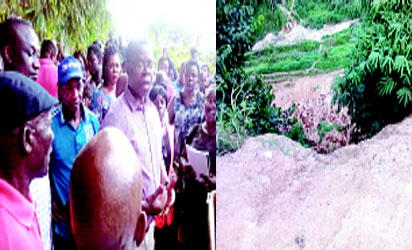
•Dr Amos Abu and Nyahasang people and devastated Nyahasang
•Knocks down Assemblies of God Church, residential buildings
•Residents flee; beg World Bank to intervene
By Emmanuel Una
CALABAR—SOME residents of Nyahasang, a suburb of Calabar, Cross River State, have relocated from their houses, after a rampaging ravine, which carved the community into three sections, swept away their homes.

•Dr Amos Abu and Nyahasang people and devastated Nyahasang
The latest disaster was the annihilation of several residential and corporate buildings, including the Assemblies of God Church complex by erosion, which surfaced in the area after years of unrelenting torrential downpour in the city.
The gully, which stretches several metres inflicted sorrow and pain on inhabitants and the environment, as it not only devastated vast portions of land and economic trees, but access road in the community.
Inhabitants run to World Bank, NEWMAP
Residents of the area, gripped by fear of the unknown, have appealed to the World Bank Task Team Leader for Cross River State, Dr Amos Abu, and officials of Nigeria Erosion and Watershed Management Project, NEWMAP that visited the area to come to their rescue, saying that unless there was immediate intervention, the entire landscape would be swept away by subsequent downpours.
“I have lived here for three decades and life was peaceful until this gully emerged and started taking away our houses, old women, school children every time there is rainfall. If nothing is done, very soon, our entire land will be carried away leaving us with nothing,” Effiong Etim, a community leader told the team
Victims relocate
He said several people have relocated back to their villages after the ravine eroded their homes, adding that the ravine spreads each time there was rainfall, making living in the area frightening, as any part of the village could be carried away at anytime.
‘The ravine has three lanes now: lane A, lane B and lane C and each of these lanes has been causing havoc by carrying away people and our property apart from cutting off the village into small units, which cannot be accessed easily, “ Etim said.
He said the Assemblies of God church was swept away in the night, which was fortunate as there was no one inside the church besides the property and church materials that collapsed into the ravine.
World Bank likely to intervene
Dr Abu told the community leaders that the visit by the team was based on the havoc the ravine was palying on the envionment and the outcry from the community occasioned by the letter sent to the World Bank asking for intervention of the bank.
“We have several other communities in need of intervention and they have also sent in their requests, however, we shall look into your case based on its merit alongside those of other communities,” explained.
He disclosed that the bank intercedes on erosion sites in partnership with the Federal Government and the Cross River State government, which had both paid their share of counterpart funds and assured that the World Bank would continue to intervene to save the environment.
“Your governor has paid the state’s counterpart fund for the execution of additional projects in addition to the five already executed and we are happy to tell you that God willing, when next we visit, it will be to bring in the bulldozers so that the pain and sorrow the ravine has inflicted on you will be stopped,” he said
The team also inspected the Atakpa, Ikot Ekpo, Edim Otop erosion, Ikot Awatin erosion sites where intervention work was ongoing.
The state director of NEWMAP, Dr Fidelis Anukwa, said more erosion sites were being worked on in phase two of the project and assured that Nyahasang site and Edim Otop gully would be considered for intervention.
Disclaimer
Comments expressed here do not reflect the opinions of Vanguard newspapers or any employee thereof.