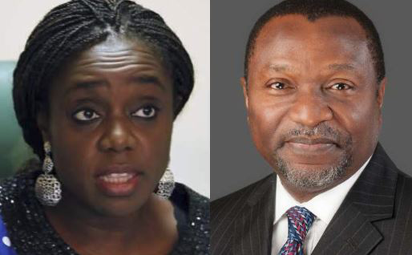
Minister Finance, Mrs. Kemi Adeosun, and Budget and National Planning Minister, Senator Udoma Udo Udoma
Is this the best government can do?
By Dele Sobowale
The request by the Federal Government for approval to borrow $29.96bn might have come as shock to most people. But, to Sunday Vanguard’s economic team, it was long expected. It is the final admission by this administration that its 2016 budget was unnecessarily over-ambitious and not well considered. It couldn’t be otherwise when the Minister of Budget had only one month to accomplish a task which had defeated all his predecessors who had five or six months to get the job done.
The truth is national budgets are very complex tasks; even a Minister who had been on the job for more than four years still finds the next one a tough challenge. Embedded in them are several thousands promises made to groups and individuals – whose lives depend on them. Even a genius and one in the service could not have delivered a credible budget in one month. Nigerians, today, are collectively suffering the consequences of that rush-job.

Minister Finance, Mrs. Kemi Adeosun, and Budget and National Planning Minister, Senator Udoma Udo Udoma
A second reason we anticipated this situation, had to do with the fact that most of the members of the All Progressives Congress, APC, had never been in the Federal Government, and the one or two who did left office so long ago they could be considered strangers to the central office in 2015. They came armed with nothing but their campaign slogans and promises and no economic blueprint for governance.
Take, for instance, the Social Welfare Package, SWP. It summarized APC’s attempt to deliver on the promises to the poor. The 2016 budget allocated N500bn to it – or eight (8) per cent of the budget.
Sunday Vanguard, at that time, warned that the funds might not be available; this medium was ignored. By the end of September, only N70bn had been released to the co-ordinator, Mrs Uwais, wife of the former Chief Justice of the Federation, to cover all the programmes. She might not get more till the end of the year. The SWP demonstrates the situation with Budget 2016.
So much more was promised than could possibly be delivered. And, now, at the last lap, the Federal Government is asking for an unprecedented huge loan – without which some aspects of the Federal Civil Service might shut down.
Nobody mentioned that possibility when the budget was presented.
The first fatal step was taken with the proposal of the N6.06tn budget for 2016. By the time the Minister of Budget sat down with his team to cobble together that document, it was clear to experienced economic forecasters that the aggregate revenue generated for the full year 2015 could not exceed N3.8tn or a 60% increase over the year about to end in one month. Furthermore, by November 2015, just as in every November, the expected revenue from crude oil sales for January of the next year, because the prices and volumes had been agreed by then, is as good as a known figure. Had Buhari’s budget team consulted the Nigerian National Petroleum Corporation, NNPC, it would have been told that shipment of 2.2 million barrels per day for January 2016 was impossible and perhaps for February as well. Thus, the budget was defective even before it reached the National Assembly, NASS. The NASS bought the monumental error and approved the budget, after padding, of course, and sent to the President, who is not an economist and who had admitted to being confused by economists, for his signature. Buhari signed-on the closest thing to economic self-delusion by any Head of State, military or civilian, ever in Nigeria’s history. Consider the evidence.
Proposal was for N3.86tn to come from revenue, or 64%, and N2.22tn, or 36% from deficit spending.
That percentage for deficit spending is the highest in living memory.
Specifically, the budget, on paper only, increased the capital budget from N557bn in 2015, to N1.8tn or 323% increase in 2016.
At that point, serious-minded individuals in the Executive branch, the Economic Management Team and the NASS should have asked how this unprecedented leap in capital allocation would be possible. They, also, should have queried where the money was going to come from.
Today as you read these pages, the Federal Government had released only N700bn, up to the end of September and there is very little prospect of a lot more than perhaps N100bn being made available for the balance of 2016’s much-vaunted capital expenditure. So, N800bn or a mere 44% out of budgeted N1.8tn for capital appropriations demonstrates the degree of carelessness, lack of deep thinking and incompetence that went into the preparation of this budget.
Make no mistake about it; all budgets are forecasts and individuals are hired and paid to make good projections. When the gap between forecast and actual is so wide, it is proof beyond reasonable doubt that the forecasters should no longer be trusted with the task. That is bad enough. Yet, that is not all the bad news there is.
The problems now facing the Federal Government, and the rest of us, which had now forced the President of Nigeria to write a desperate letter to the NASS requesting for approval to borrow $29.96bn, stem, largely, from the failures of the 2016 budget and the EMT to think ahead and “outside the box” to forestall a situation in which the self-acclaimed largest economy in Africa is rapidly becoming its biggest economic basket case.
Already, the Federal Government had borrowed this year more than the budget called for. The country’s external reserves are down. Nigeria is negotiating a $15bn loan agreement with India – a loan disguised as oil for money swap deal. We are on our knees at the African Development Bank, ADB, for $1bn loan which will disappear in one day – given the backlog of unpaid salaries, pensions, contracts and other entitlements. The Federal Government had now broken down and confessed that it must raise the largest single loan package in the nation’s history – to fund operations for the balance of 2016 to 2018.
DESPERATION THEY WROTE
“There are no desperate situations, only desperate men [and women]”, Joseph Goebbels, 1897-1945, Hitler’s Chief of Propaganda. (VANGUARD BOOK p38).
Buhari’s men and women managing Nigeria’s economy are now desperate. Read part of the reasons for the loan request.
“In the course of implementing the 2016 Appropriation Act, , several MDAs have presented issues pertaining to salary shortfalls, the settlement of which has led to the depletion of the public service wage adjustment. The vote which had a provision of N33,597,400,000, now has a balance of N2,758,296,000.”
In other sections of the request for approval we read about public servants that “would soon be locked out of the IPPIS platform as their personnel cost budgets would not cover salaries for the rest of the year.”
Elsewhere we read that “The contingency vote of N12bn has a balance of only N1,827,570, 443”.
More ominous, we were told that “the allowances to the ex-militants have only been paid up to May 2016…provisions for the NYSC…in the 2016 budget is inadequate to cater for the number of corps members…. Similarly, the provision for meal subsidy for the Unity Colleges is inadequate for the number of students in the schools.”
There is no need to list, seriatim, all the other inadequate provisions made in this unfortunate budget for so many sectors. In fact, so total is the failure of the budget that the first question that should come to anybody’s mind is: could all or most of these have been foreseen earlier instead of waiting to the final two months of 2016 to send-in a budget review disguising as a loan request?
That is another problem with this team. Its members don’t even understand the meaning of what they are doing. All the shortfalls could have been foreseen if only the people running government were not wedded to their campaign slogans and promises; if only they had attempted to study the economic trends, which though unfavourable, can nevertheless be wished away.
For instance, the revenue budgeted for crude in the 2016 budget was already unrealizable as early as June; the situation got worse every month. So why wait until late October to start pressing the panic button? It is even more self-delusive for government officials to imagine that there are $29.96bn sitting around to be picked up by Nigeria in the two months left this year.
A FUTURE MORTGAGED?
Looking at the whale of a loan itself, it is remarkable that it represents ten times the $2.8bn loan taken by Obasanjo’s administration, which we were told could be easily repaid, and which then grew to $36 billion in 2000 – which the same Obasanjo wrong-headedly had to repay, with $24bn cash down and the rest forgiven. It took the nation almost 26 years to get out of the first debt trap – at a time crude oil was still a prime commodity. And, the loan stock built up over that time.
This proposal, which comes with no schedule or means of repayment should scare every thinking – right-thinking Nigeria. In one go, the NASS is being asked to approve the quantum of loan which had taken us over twenty years in the past to pile, in one day.
Furthermore, in 1978 and until 2012, crude oil was a prime commodity; in fact the first global commodity. But, another oil boom appears most unlikely in the next five years and our inability to export 2.2 million barrels a day will most probably persist. How then is Nigeria going to repay this loan without irreparably damaging the future?
The incumbent government will spend the funds and leave posterity steeped in debt for decades.
Only a government which had induced confidence can demand that sort of sacrifice from the people.
This one has not and the revelations made in that request should give any member of the NASS a pause. This is not a partisan matter; no APC versus PDP. It is a Nigerian problem.
At the moment the Federal Government allocates close to 45 per cent of its revenue to debt servicing without the ADB loan and without this mind-boggling request. What percentage of its revenue will then be required to service loans if this request is approved by the NASS? Certainly, there will be a sudden jump. How much of a jump? Nobody knows, but, given this government’s penchant for not doing its homework well, it is safe to assume that it p, too, doesn’t know. Because this vital information that can guide Nigerians is not available, the NASS should insist on having the information – among others.
It is not difficult to determine the prospective lenders of this loan. But, there is one characteristic lenders globally have in common – they detest granting loans to anybody to pay salaries. The reason is simple. The prospective borrower had engaged his own staff. He should have made sure he can pay them from the proceeds of its operations. It amounts to self-confessed mismanagement of the affairs of state for any government to go about borrowing to pay salaries and to announce to the whole world that some of its staff might be locked out of the payment system. What then are the functions of the Finance and Employment Ministers as well as Head of Service? And why should anybody presume they will become more competent simply because the Federal Government had gone out to borrow more money to pay its over-bloated staff? It also means that the government has not fully examined all its fiscal options. Nobody is forcing the Federal Government to keep so many people on its payroll. That is a choice governments make everywhere and their people suffer the consequences – for good or for ill.
Furthermore, in any country, a $29.96bn loan is a monumental request to make at once. For the legislators and the people of Nigeria, ability to manage that colossal sum is as important as the amount itself. When we turn to the Economic Managemnent Team as now constituted, we search in vain for one single individual who had either led a team or individually managed such a large sum The human capacity is suspect. In addition, the Buhari government had, in the last seventeen months, carved the image of a “borrow-and-spend” administration. Even the party’s manifesto, while specific on its populist programmes (5.5 million kids to be fed daily, N5000 per month to 5 million unemployed, hiring of 500,000 teachers etc), had been less than specific about how to raise the funds to pay for all these extravagant election promises. It still has not told Nigerians how it intends to pay for those programmes – until now. It would appear that this government is proposing to borrow heavily to fund these programmes and to pay the salaries and entitlements of its workers without outlining how the loans sought will be repaid. That is a recipe for national disaster.
A government which failed to predict accurately in June the predicament in which the nation finds itself in October this year, is asking Nigerians to rely on its expectations for 2017 and 2018 in approving this mammoth loan. Experience, and bitter experience at that, had taught Nigerians that in less than twelve months we will be back in a worse debt trap than the one we got out of in 2004.
Finally, has the economic management team examined all the other options available for raising revenue without making the nation a slave to debt once again? Nigeria is the only nation known on earth whose expressways have no toll gates to raise the revenue for their construction and maintenance. The millions of cars, buses, trailers and tankers plying the roads are destroying them and should provide more than sufficient funds for roads without burdening non road users. Concessioning, which was applied to the Murtala Mohammed 2 air terminal in Lagos can be expanded to the rail lines going anywhere. For decades global financial institutions have pointed out that at five (5) per cent Nigeria’s Value Added Tax, VAT, is one of the lowest in the world. Getting VAT introduced in the l990s was a war which left some of its proponents bruised and discouraged. But, without VAT, both the Federal and all the state governments would have been insolvent long ago.
The option of increasing VAT from 5% to 7.5% for essential commodities, to 15% to other categories of goods and services and 50% for really luxury goods had not been explored. Outright sale of non-essential assets e.g shares in Sheraton and Federal Palace Hotels which had yielded no dividend from the beginning, have not been tabled for NASS approval. Pegging the cost of governance remains unexplored. This means that the Federal Government, the NASS and the judiciary, as well as state governments being held to no more than 5% of annual budget to run their affairs. At the moment there is no limit to executive branch expenditure. That explains why some state governors buy private jets and the President maintains a fleet of eleven aircrafts. Our regime of fines for various crimes and infraction of the law are completely outdated and sometimes invite corruption. Where a public servant or a notorious fraudster embezzles N5 billion and the maximum fine is N500,000, even the man of God will be tempted to steal. The fine for selling fake drugs is still less than N1000 irrespective of the value of the products and the cost of prosecution. The time has come to make criminals as well as others who use the courts to bear the cost of operations instead of waiting for crude money to pay for cases arising from the theft of previous crude money.
The truth is, granting this request by the NASS without a comprehensive review of
the nation’s cost of governance will amount to throwing good money after bad money. By December 2017, this government will be back again asking for more.
Disclaimer
Comments expressed here do not reflect the opinions of Vanguard newspapers or any employee thereof.