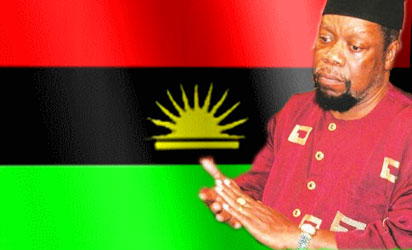
Late Igbo Leader, Dim Chukwuemeka Odumegwu-Ojukwu
By Douglas Anele
However, Ojukwu had been under tremendous pressure: he tried to calm separatist agitations in his region, which became more stringent and vociferous after the pogroms of May, 1966; he also struggled with the huge task of resettling over one million refugees that poured into the east from different parts of the country, especially from northern Nigeria.
The issue of payment of salaries to workers displaced because of the disturbances was also pending. Unfortunately, Gowon and his advisers in Lagos were not interested in assisting Ojukwu to resolve the myriads of problems facing the east.
After Aburi, there was a last-ditch effort to prevent the impending catastrophic clash between eastern Nigeria and the federal military government. In May 1967, the National Reconciliation Commission (NRC) led by Chief Obafemi Awolowo visited Enugu to reconcile the two sides and encourage Ojukwu and other eastern leaders to attend peace talks at a venue suitable to the easterners. Inspite of the friendly reception given to the NRC when they arrived, the fence-mending attempt was unsuccessful.
According to Prof. Achebe, many Igbo leaders were sceptical and disdainful of the NRC because, in their estimation, it was a “chop, chop, talk, talk” commission. A sizeable percentage of easterners at that moment had become cynical towards Gowon’s administration for its failure to bring the culprits of the mass murders in the north, including ringleaders of the July 29 coup, to justice, and they saw the NRC as the latest in a series of insincere gestures from the federal government.
Meanwhile, Ojukwu and other senior Igbo military officers insisted that Gowon was not entitled to be the head of state: in their opinion, he was an illegitimate leader because only the officer directly behind Ironsi in army seniority could replace him as supreme commander. It must be admitted that the NRC comprised a number of well meaning and distinguished Nigerians, but they were dealing with an emotionally traumatised and disillusioned Ndigbo whose leaders actually championed the case for “One Nigeria.” Given the prevailing psychological ecology in eastern Nigeria after the pogroms, revenge coup and Gowon’s non-implementation of the Aburi agreement, it was almost impossible for the NRC to succeed and halt the movement for secession in the east.
A lot has been written from different angles on the causes and disastrous repercussions of the Biafran war. But there is a malicious falsehood accepted by historical revisionists keen on standing the facts of history upside down that must be refuted here, namely, the argument that Ojukwu led the Igbo into an unnecessary conflict merely because of his desire to lead a sovereign nation.
Now, it would be disingenuous to claim that personal ambition did not in any way influence Lieutenant-Colonel Ojukwu’s responses to the crises between July 29, 1966 and July 6, 1967 when the federal government attacked Biafra with an artillery barrage against Ogoja. But, as we adumbrated earlier, of all the major actors Ojukwu had the most to lose in the event of a civil war.
Among members of the SMC, he was by far the wealthiest and most educated: if Ojukwu wanted, he could have lived a life of opulence and influence as a rich, Oxford-trained historian. Moreover, his father had huge investments in Nigeria outside Biafran territory, which he would certainly lose if war broke out. Those who knew him personally testify that Ojukwu had tremendous affection for his region. Consequently, it is nearer the truth to say that the Biafran leader was motivated more by the desire to serve his traumatised people than by the allure of being head of state.
Gowon and other members of the SMC, especially Hassan Usman Katsina, were blissfully unaware of the depth of feeling in the east after the revenge coup and pogroms, the feeling of alienation, frustration and disillusionment arising from the ethnic cleansing in northern Nigeria.
That was why when Gowon declared war against the secessionist eastern region, the young and inexperienced leader described it as a “short, surgical police action” to “restore federal government authority in Lagos and the breakaway eastern region.” Rivalry and conflict of egos between Gowon and Ojukwu, sycophantic advisers on both sides and failure of both Nigerian and Biafran leaders to work for compromise when opportunity for it became available during the conflict prolonged the civil war unnecessarily.
Superficially, it is ironic that Britain supported the Nigerian government against Biafra, considering that Biafra was a predominantly christian state fighting for liberal democratic values such as self-determination, freedom, social justice and egalitarianism. However, Britain’s attitude to Nigeria has always been motivated not by morality or desire for good governance in the country but by its national interest right from the unilateral amalgamation of northern and southern Nigeria in 1914.
It is in line with British imperialism to have a dependent Nigerian state, irrespective of how undemocratic or unjust it might be, as long as her strategic interests were secure. Moreover, some racist members of the British establishment were afraid that if Biafra was allowed to stand, she might eventually develop into the greatest black nation in the world given the impressive intellectual capital and natural resources in the fledgling country. A developed and industrialised black nation would showcase the ingenuity of black people and explode white supremacist ideologies which for centuries had profoundly influenced the way Europeans saw black Africa. For British leaders, Biafra must be destroyed to stop the possibility of a black nation becoming a key player in the international scene.
The Biafran war devastated Ndigbo and Igboland, and its horrible repercussions are still visible forty-six years after it ended. But since our analysis focuses on the revenge coup of July 29, 1966, we will not discuss the war any further. Rather, we pose the following questions: Have Nigerians, particularly the leaders, learnt any useful lessons from the coup d’états of January 15 and July 29 1966? What eventually happened to the ringleaders and supporters of the revenge coup? Judging by the fate of some of the military officers that executed the revenge coup and the crises that followed afterwards, is revenge rationally justified without exhausting avenues for peaceful resolution of differences?
To the first question, my answer is – No. Corruption, ethnic rivalries and poor leadership that triggered the first two military coups have metastasised into forms that are extremely pernicious in the last four and half decades. Again, the quest by the north to dominate and dictate has continued to the extent that presently a broad section of Nigerians believe that Muhammadu Buhari is more a northern President than the leader of all Nigerians.
Buhari’s one-sided approach to governance has encouraged agitations for self-determination in the south east and Niger delta region. On the second question, the bloodthirsty revenge coup was a missed blessing to those involved. Whereas the coup enhanced the political and military careers of Gowon, Danjuma, Abacha, Babangida and Buhari, others such as Murtala Mohammed, Mamman Vatsa, Bukar Suka Dimka, Ibrahim Bako, Isa Bukar, Sabo Kwale, and Ibrahim Taiwo became casualties in future coups which cut them down at their prime. It is instructive to note also that whereas Gowon was overthrown in July 29, 1975 through a bloodless coup in which some of the active participants in the revenge coup that brought him to power nine years earlier were involved,
Murtala Mohammed was also kicked out of office and lost his life in an abortive coup executed by a few military officers who took part with him in the same bloody coup of July, 1966. Buhari had a taste of his own medicine when Babangida, Sani Abacha and others removed him as head of state on the very last day of December, 1983. From the foregoing, one can say that the law of karma eventually caught up with most of the officers who participated in the revenge coup.
It also implies that revenge actually exacerbates problems: although difficult and frustrating most times, it is more rewarding in the long run to explore all avenues for peaceful resolution of disputes between individuals and communities. In my view, Nigeria would have been a much better country if key actors in the revenge coup, as christians and muslims, had complied with the religious injunction of forgiving “those who trespass against us.” CONCLUDED.
Disclaimer
Comments expressed here do not reflect the opinions of Vanguard newspapers or any employee thereof.