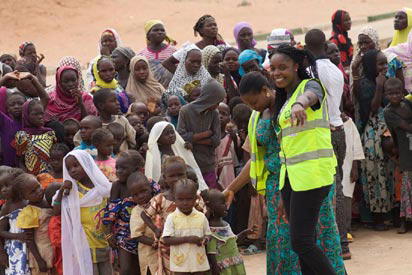
NEMA officials distributing reliefs materials to displaced persons at an IDP camp in Yola
By Gabriel Ewepu and Rebecca Amos, ABUJA
Though the 2016 World Humanitarian Day with the theme: ‘One Humanity’, has come and gone, it will be recalled that aid workers and internally displaced persons, IDPs, had used the opportunity to cry out for support to overcome their worsening plight. Indeed their cry of distress was heard loud and clear by notable dignitaries from the government and humanitarian organisations who attended an event organised by the National Emergency Management Agency, NEMA, in collaboration with Oxfam Nigeria. It held at the International Conference Centre, Abuja.
Organisers and invitees could not help as they were emotionally moved as tears rolled down their cheeks as they listened to the narration of some of the survivors. The tales of suffering were amplified by a photo exhibition and video clips of the misery, frustration and pain suffered by the victims of the senseless attacks by the insurgents.
Various aid workers from humanitarian organisations who were at the IDPs camps also narrated their experiences, including how families struggled to survive under harsh conditions, particularly the challenge of food and health care services, coupled with insecurity as a major hindrance in their operation to reach the IDPs.
According to the UN Humanitarian Coordinator, Munir Safieldin, the precarious situation the IDPs find themselves demands that all Nigerians should immediately intervene by rendering the needed support to these unfortunate individuals.

Safieldin said: “There are two million internally displaced persons in Nigeria, and that is a huge number. There are less than 150, 000 Nigerians who cross the borders looking for assistance outside Nigeria, and only 200, 000 displaced people who are in camps, and 1.8 million of them are in host communities. It tells us that the theme ‘One Humanity’ calls for caring for one another in Nigeria.
“In Bama Camp, where we have close to 25, 000 displaced people the first and only school built for 2, 000 children was established by the Nigerian Army; the students are also being taught by volunteers from the Nigerian Army. This is very unique and it goes beyond the call of duty of the Nigerian Army.
“I went to Gwoza, and there are more than 20, 000 displaced people who came around; there were no health facilities, hundreds of them were queuing in front of the Military Hospital for assistance. While I was there I witnessed two deliveries of new born babies, one was normal delivery and the other through caesarean section and all conducted by doctors, midwives and nurses of the Military.
“These are the kind of stories we need to share and also use in advocating for more human needs, for solidarity for the people in the North East and other parts of Nigeria who need support.
“In Dikwa there are 70, 000 displaced persons in the camp coming from 118 villages around Dikwa. Unfortunately, people could only eat a meal once a day: beans or rice day after day, and no assistance reaching them from the international and national humanitarian communities. People were only fed on the rationed food provided by the Nigerian Army. These are the people we need to support. Let us put our hands together nationally and internationally to respond to human suffering.”
Disclaimer
Comments expressed here do not reflect the opinions of Vanguard newspapers or any employee thereof.