Petro station
By Emeka Anaeto, Economy Editor
Last month’s price adjustment and quasi- liberalisation of downstream sector of the oil and gas industry may have started throwing up unpleasant challenges even before the policy fully takes root, following the adverse developments in the diesel and kerosene product lines in the past few weeks.

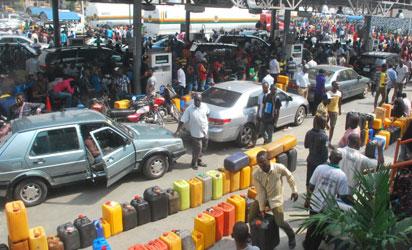
Long queue of jerry cans at a petrol station as fuel scarcity bites harder, yesterday.
Prices of Automated Gasoline Oil (AGO) or diesel and household Kerosene have skyrocketed across the country with dealers and industry observers pointing to foreign exchange constraints, international crude price dynamics, freight cost increases and overall cost of funds in the Nigerian financial market.
Consequently, price of diesel and Kerosene which have been deregulated long ago, have risen over 30 and 50 per cent since the 68 per cent price mark up was effected in the petrol product line. Industry observers are now projecting that all the factors that have pressured prices upwards in the deregulated products would come on petrol following the deregulation except if government subsidizes the price differential.
Moreover, they are also worried about what they see as emerging oligopoly in the product lines as a result of deregulation. Oligopoly is a market structure in which a small number of firms have the large majority of market share. An oligopoly is similar to a monopoly, except that rather than one firm, two or more firms dominate the market.
Diesel dealers told Vanguard that only about six companies, less than 10 per cent of the operators (importers) in the product lines control over 80 per cent of the market. They said the market dealers dictate both supply and price of diesel while and another set of dealers control Kerosene though the dominant importer is the Nigerian National Petroleum Corporation, NNPC.
Industry analysts believe this situation would likely play out in the petrol product line where not only upward pressures in prices would be expected, market dominance and price manipulation by a few dealers would also come into play.
Disclaimer
Comments expressed here do not reflect the opinions of Vanguard newspapers or any employee thereof.