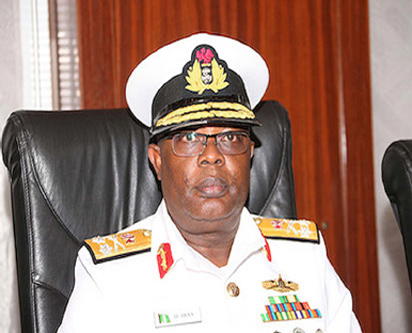
•Rear Admiral Ibok-Ete Ekwe Ibas
By Emmanuel Aziken
Success indeed rolls into success, and so it is no surprise that the Diamond Jubilee of the Nigerian Navy is attracting the high-level international participation. At least 26 naval chiefs and flag officers from international navies are expected to grace next week’s international conference on maritime security which is part of the activities to mark the 60th anniversary of the Navy. The high level participation also affirms the nation’s increasing position as one of the naval powers in Africa.

•Rear Admiral Ibok-Ete Ekwe Ibas
The International Maritime Conference holding from May 24 to 25 is part of the 60th anniversary of the Nigerian Navy that was founded on June 1, 1956, as the Nigerian Naval Defence Force, NNDF with eleven ships and by an act of parliament was designated as the Royal Nigerian Navy. Nigeria’s evolution into a republic in 1963 led to the renaming of the force as the Nigerian Navy.
The Navy has since its establishment grown in size and responsibility shocking the world with its achievements during the country’s civil war when it mounted the coastal blockade that cut off the Biafran regime from getting international support through the seas. Besides the blockade, the nascent Nigerian Navy was also involved in the amphibious landings on the coast, including the Bonny landing in July 1967 which was lauded the world over as the first ever by a third world country.
The success of the operation helped to underpin the fact that Nigeria as a coastal country could not afford to neglect its coastal security. It is no surprise that following the war that successive administrations sought to build up the capacity of the Navy. However, it has not always been a fair sail for the navy especially given the tides of budgetary constraints that confronted the country. The navy which has had 20 naval chiefs since it was inaugurated has Vice Admiral Ibok-Ete Ekwe Ibas as its current chief helping to navigate it towards calmer seas.
Apart from its success in its key mission of warding off external invasion through the country’s territorial waters, the Navy has also had successes in calming the country’s restive creeks. The navy under Admiral Ibas launched the Choke Point Control Regime under which a strict watch is mounted by naval patrols to ensure that all vessels which pass through the creeks and channels within the country’s territorial borders are interrogated. It is thus not surprising that under the present administration that the rate of Crude Oil Theft (COT) has drastically reduced with a number of those involved in the illicit activities being apprehended.
The NN commenced the choke point regime to ensure that no vessel goes in and out of the creeks/channels without being interrogated. Two houseboats have been deployed at Akassa and Ezeotu long Num and Pennington rivers while another 4 are at the verge of deployment. This has enabled enhanced presence at the estuaries where vessels transiting in and out of Nigeria’s backwaters could be interrogated in order to check illegal oil bunkering, Crude Oil Theft (COT) and other forms of maritime crimes.
Key indicators of the success of the President Muhammadu Buhari administration between May 29, 2015, when it came on board and the end of 2015 included the arrest of 42 vessels involved in suspicious activities, the foiling of 16 piracy attempts and the destruction of 221 illegal refineries, 34 barges and 167 wooden and Cotonou boats.
The success achieved by the Navy under Ibas underpins the naval chief’s strategic directive 2015-1 which according to him is focused on ensuring zero tolerance for illegal conduct within the country’s territorial waters.
Besides its increasing siege on militants in the Niger Delta, the Navy is also set to deploy its platform and Special Forces in the fight against insurgency in the Northeast in the Lake Chad region. The exercise aimed to augment the military operation codenamed as Operation Lafia Dole is also expected to deploy troops and equipment to Tongeji Island by the Nigeria-Benin maritime boarder.
The navy has also had successes in the building and refitting of its platforms within the country and by that not just saving foreign exchange for the country but also providing invaluable experience for local military and other maritime experts. Among the local efforts in ship building is a tugboat which is expected to be commissioned during the Diamond Jubilee celebrations.
Even more, the navy under its current leadership has been involved in the renewal of its fleet with the launching of 30 riverine warfare boats which have been deployed to fight crude oil theft in the creeks of the Niger Delta. Another 50 boats also manufactured locally are expected to be commissioned during the ongoing celebrations.
Under the current administration, two mine sweepers, NNS Ohue and NNS Barama which have not been operational since the mid-nineties are currently undergoing trials before being re-launched into service. Besides the navy under the Buhari administration has enhanced effective maintenance activities leading to availability of ships, boats and helicopters to confront threats to the country’s maritime security.
Among the ships are NNS Centenary, NNS Okpabana, NNS Prosperity, NNS Andoni and NNS Obula while helicopters NN08, NN09 and NN10 are operational.
Nevertheless, challenges continue to confront the Nigerian Navy. Among the challenges currently facing the Navy are shortage of platforms, degraded operational support infrastructure, low level of Research and Development (R&D) efforts and low national industrial capacity. Others include poor maritime culture, inadequate Maritime Domain Awareness (MDA) infrastructure, inadequate facilities for operational training, requirement for improved personnel welfare and inadequate funding.
It is significant that a number of the platforms have seen better days and their situation compounded by lack of operational service over the years. Even more, naval dockyards and Forward Operating Bases, FOBs which were established to help local service of platforms have not always been in operational service or developed forcing operational platforms to go long way to harbour.
Besides the maritime conference, a two-day maritime exercise is expected to be mounted in Lagos between 26th and 27th May. The exercise which is aimed at boosting international cooperation between participating countries and Nigeria will especially see navies in the Gulf of Guinea and foreign partners such as the United States and the European Union upgrade their strategies on maritime safety and security. The participating countries will also expand their scope of synergy and collaboration, according to information supplied by the Nigerian Navy.
Among the foreign navies that have confirmed participation are Cameroun, Ghana, and France. The Diamond Jubilee celebration is expected to climax with a Ceremonial Sunset, which is an age old naval custom that points to the end of an era and the beginning of another era. The Ceremonial Sunset according to Navy sources will hold at NNS BEECROFT parade ground, Apapa, Lagos.
As the source said: “Ceremonial Sunset is a social and at the same time regimental affair; it is an age long naval custom observed to signal a close of an era and a celebration of a milestone of success. The NN has come a long way from her humble beginning 60 years ago, and without appearing immodest retains a sense of progress to feel a revel of some sort justified.
“I hasten to add that this growth is a product of the contributions and sacrifices of all Nigerians. In marking this milestone, the NN therefore rightly pays tribute to Nigerians for their accomplishments through their Navy and has accordingly invited a leading representative of the people, the President of the Senate of the Federal Republic of Nigeria, His Excellency, Senator BukolaSaraki to attend as the Special Guest of Honour.”
Disclaimer
Comments expressed here do not reflect the opinions of Vanguard newspapers or any employee thereof.