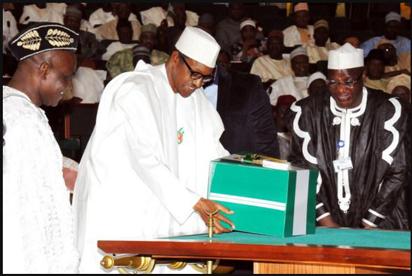
File: Buhari during the 2016 budget presentation to the National Assembly.
By Emmanuel Aziken
The budget is unquestionably one of the major levers of the legislature in determining the shape and structure of governance. By holding the power of the purse, the National Assembly is able to determine the expenditure of the Federal Government in any given year. It is thus not surprising that the committees on appropriation are about the most coveted in the Senate and the House of Representatives. Legislators would crave, covet and bribe to become members of the committee on appropriation. In almost all cases, the chairmanship of the committee on appropriation in either the Senate or the House of Representatives is almost always reserved for close associates of the Senate President or the Speaker of the House.
In the present dispensation, the chairman of the committee in the Senate is Senator Danjuma Goje, one of the closest associates of the Senate President who it is claimed, dropped his aspiration for Senate President in the assurance of getting the position of chairman of the Committee on Appropriation.
In the House, the chairman of the committee on appropriation is Rep. Abdulmumin Jibrin who at one time postured himself as a contender for the office of speaker before turning round to support Dogara.
The power of the committee on appropriation is underlined by the fact that all other standing committees of the Senate and the House turn into sub-committees of the committee on appropriation during the budget making process. Though the standing committees may scrutinise the budget of an agency of government, the Committee on Appropriation is not bound to accept what the committee presents as its report on an agency.
There was a case in time when one of the committees was scrutinising the budget of a ministry when Senator Iyiola Omisore, during his time as chairman of the committee on appropriation, ignored the committee to table the report on the budget before the Senate.
Besides Senator Omisore, other remarkable names who have held the office of chairman of the Senate Committee on Appropriation were Senators Udoma Udo Udoma and Abubakar Maikafi.
Why the insinuations about Odigie-Oyegun will not go
In normal situations, Chief John Odigie-Oyegun, the national chairman of the All Progressives Congress, APC should have been allowed to enjoy a normal ten day holiday without much hullabaloo. Indeed, after suffering a bout of malaria penultimate week, the 76 year old party leader clearly told newsmen last weekend that he would proceed on a ten day holiday effective Monday, February 29. He even added that there should be no controversy over his absence.
However, by Tuesday, a day into his ten-day leave, controversy again brewed with speculations that the leave was a safe landing for the 2011 All Nigeria Peoples Party, ANPP vice-presidential candidate to step down as national chairman of the APC. Mischief makers claim that most of the power blocs in the party are against Odigie-Oyegun.
The Muhammadu Buhari tendency in the party it is claimed, distrust him on the fact that he was running mate to former Governor Ibrahim Shekarau in the 2011 ANPP presidential ticket. Shekarau it is recalled turned round to challenge Buhari after riding on his coattails to become governor in 2003. Meanwhile, the influential Asiwaju Bola Tinubu tendency also look at him with askance given what they claim was his incapacity to stop the emergence of Bukola Saraki and Yakubu Dogara as the presiding officers of the National Assembly.
The political parties’ conspiracy against Ese
In a week in which the nation was regaled with the pathetic story of 14-year-old Miss Ese Oruru, it was remarkable that none of the country’s major political parties was able to comment on the issue. Not one of them seemed interested in a case that shook the majority of Nigerians who read the pathetic story of the girl and her family.
The seeming quietness of the political parties is indeed reflective of the lack of ideology in the parties. It is also reflective of the delicate fault lines that link the nation’s geo-ethnic and religious linkages which no party is willing to address.
Disclaimer
Comments expressed here do not reflect the opinions of Vanguard newspapers or any employee thereof.