By Ebele Orakpo
Engineer Ahmed Atere is the Chief Operating Officer of Meed Networks, an ICT consultancy and training outfit that is into Integrated Network, LAN, Fibre Optic and Telecom Infrastructure solutions, Cabling and Wiring systems, Biometrics, Test and Security Network solutions. In this chat with Financial Vanguard in Abuja, the Agricultural Engineering graduate from the Obafemi Awolowo University, Ile Ife, speaks on why he went into ICT, the challenges, and says his start-up capital was the idea in his head. Excerpts:
Motivation:
This has been my passion
since I was young. I have always been a fan of somebody doing what he loves and I feel so much empowered by this. I started doing programming and IT stuff as early as in junior secondary school. I first learnt how to use DOs system so before I got into the university, I knew I wanted to study something that has to do with ICT but unfortunately, I did not get the course I wanted.”

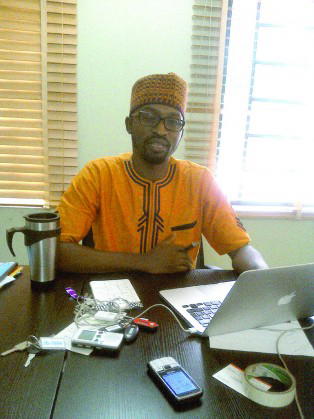
Engr. Ahmed Atere
Combining major with ICT:
While studying agric engineering, Atere pursued his first love, ICT, by doing computer programming and writing professional exams – CISCO, Networking etc.
“I made a second class upper, meaning that I was not bad with my agric engineering. Again, agric engineering is something I will go back to because when I retire and can no longer go up and down with ICT, I want to retire to a home with a large expanse of land where I can do mechanised farming. This will bring me back to agric engineering,” he said.
“During my industrial training, I ensured that I wrote one exam or the other so by the time I got back to school in year four, I started working in cybercafés because I already had the certification that could help me. All these boosted my CV when I finished school because I started working in my third year. In fact, we were still waiting for NYSC call up letter when I got a job in Lagos.
Just before I went for the youth service, we got a job with the Cross River State Government (to connect all the ministries to the headquarters) and I was made to head the team. I was shuttling between Lagos and Calabar and by the time I got back to Lagos, I started doing training too. I was actually one of the first Fibre Optic Association’s trainers in West Africa on fibre optic technology.
Starting my own business:
“After a while, I felt it was time to be on my own. I had a partner, Mr. Sheriff Adeyanju and co-partners, Mr. Oponle and Daramola Alayande. Along the line, we got a very big job from the Ahmadu Bello University, Zaria to connect the campuses – Kongo, Samaru and Shika. I was head of the technical team.
“Our mentor and my first boss, Mr. Babajide, taught us that we could actually make something out of this. That was how we started growing, bit by bit and here we are today!”
What we do:
“The whole thing is about you knowing what you want to do and what you actually enjoy doing. I enjoy lecturing so I train people on fibre optics apart from the normal job. I enjoy imparting knowledge.
I have trained people from NCC, former NITEL, NEMA, etc. I have a contract to train in East Africa with Africa e-Development Centre in Kenya, Tanzania and Uganda in fibre technology. We train professionals who are already in the field. Because we also do deployment to site, we are able to meet both site deployment and classroom work; so that is one of our major strengths. We also train children. I believe in catching them young.
Starting early enough is good because years of experience were what helped me. My boss thought I had already worked for two years and he was looking for someone with two years experience and because I started when I was in school, I got those years of experience before I left school.
“Even when you get to the university and you don’t get the course you wanted, that does not mean that you will not do something. I had wanted to read electrical engineering but I didn’t get that but my reading agric engineering was a blessing in disguise because now, I know that there is another way I can use agric engineering when I retire.
“However, most of my mates who actually got that same course never liked it so they ended up with bad results. Those that got what they wanted felt they were on top of their game and so did not go the extra mile of learning the new technology. What I did was to learn the newest technologies then that people in electrical engineering and computer Science should have been learning.
“So it’s all about knowing what you want, starting early enough, and all things being equal, being prepared for opportunities, the sky is the limit.”
Start-up capital:
“Initial capital was zero. It was just being prepared for opportunities because we knew what we wanted to do. Our first job was actually a very big job and we had nothing so we went to meet with a finance house in Lagos. They asked us what we had and we told them we can deliver the professional side of the project such as services, consulting etc. This means that the only thing we had then to start up the business was what I had in my head, so when we took that part of the bill, it was up to the minimum percentage that we were supposed to have for the finance house to partner with us.
For example if the project is worth N10 million, that means you must have at least N3 million so on the value of the project, we were able to at least with all the things we could do, come up to that percentage so I will say the initial capital was what I had in my head. We were lucky they were able to help and again, because they had seen that I had actually headed some previous projects in that line successfully. So preparedness was part of the initial capital.
Challenges:
“People saw me as a small boy. It was very ironic. They look at me and think ‘oh, you are too small,’ you cannot do this. In fact, the very first major job we got, we actually went to rent a CEO because we were too small/young and we were competing with the big guys in the industry. So the challenge was getting people to believe in us and luckily, we had people who believed in us that time and that was what helped. It was always ‘can you do it? You are too small for the job.’ That was then. Imagine starting a company at the age of 25 years. In fact, the job we went to do, a company had actually done it and it failed so we were going to salvage the entire thing.
Finance was another challenge but we were bailed out by the finance house. Getting the right people with the right mindset was also a challenge because now, people do not want to work for experience or passion, they want money. My first salary was N4,000 which could not even fuel my car when I was in school but I was doing it because I needed the experience. People would call me to help them solve some of their problems and as I was doing that, I was learning. Nowadays, people are not willing to do that kind of thing, they just want money. I tell interns who come here that I will not pay them and I will not take them until they accept that condition. I actually get to pay them later but if they cannot accept that condition, I won’t take them because we want to remove that money consciousness.
“The business environment is challenging. Nigerians generally do not give out jobs on merit, it is always on who you know and sometimes when you are not in that circle, it might be a challenge for you even when you can do the job. You have to know somebody in the environment before you can actually get the job.
Finally, I will want to say to anybody or parent who has a younger one, whatever anybody wants to do in life, the first thing is to ensure they start early.”
Disclaimer
Comments expressed here do not reflect the opinions of Vanguard newspapers or any employee thereof.