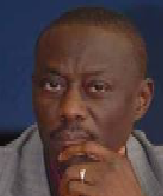
• Mr. Billy Harry
By Udeme Clement
Mr. Billy Harry is the President, South South Chamber of Commerce and National Vice President, Nigerian Association of Chambers of Commerce, Industry, Mines and Agriculture, (NACCIMA), he spoke with Sunday Vanguard, on the prevailing poverty crisis in Nigeria’s economy and the need for the Federal Government to develop a blue print for poverty alleviation and job creation. He advised the new government on what measures should be put in place to resuscitate the nation’s economy, to enhance capacity utilisation in all sectors, especially in the real sector

• Mr. Billy Harry
Looking at the economy holistically, do you think we are going to achieve the change that Nigerians are so desirous to see?
The new government just came in and it will be unfair to evaluate the government now on if that desirous change is on course or not. I think the President really needs to sit in Nigeria to address major issues in the economy. For instance, the indices of economic growth in different sectors.
If he does not sit down to put the best strategies in place to move the country forward, the economy will suffer. He should look at major indicators needed to grow the economy, and the key issue now that we can immediately notice is about petroleum products. This is because crude oil has suddenly become a major indicator on how the economy of Nigeria performs. Right now, this has given a big punch to economic activities in the country, as people are queuing for hours and days to buy fuel, productive hours are lost, and people cannot really give in their best into economic activities.
In that case, should the new government continue to pay fuel subsidy?
Subsidy is what every country enjoys in one sector or another. In America, people enjoy subsidy in agriculture and in other countries the citizens enjoy subsidy in health. In Nigeria, we are blessed with crude oil and I think Nigerians should enjoy subsidy on petroleum products. But you must ask yourself, when the subsidy is actually evaluated, do the common people have value for that subsidy? When this question is thoroughly analysed, you can see if this subsidy is valuable of not.
So, what precisely is your position on subsidy issue?
As it stands today, subsidy is not useful to ordinary Nigerians and the issue is not what anybody should take advantage of because of class to do business. If subsidy is not impacting positively on the masses, it must be removed immediately. It must be removed without delay because it is a drain on the economy, therefore it is of no use to Nigerians.
The real sector is still in comatose despite efforts by government to revamp the industry. What should government do to achieve a complete turn around of this sector?
The real sector that ordinarily ought to boost our economy to improve the standard of living is lagging behind because government policies have not been consistent. For example, policies on agriculture, real estate and industrial development are only celebrated on the pages of newspaper and television. Those saddled with the responsibility, starting from legislative houses to the executive are not really evaluating and implementing policies that will impact on the growth of the economy. The reason is because we have poor policies, the implementation strategies are also poor. The main target of policy drive, which should be to give a boost to grow the capacity is not there. So, as long as policy formulation and implementation are wrong, we cannot get the real sector right, and it is a major problem.
As the President of an organisation like South South Chamber of Commerce, which is a representative of numerous industries, what should government do about industrial policies?
What government needs to do is simple. Everywhere in the world, it is the private sector that drives the economy. In Nigeria, government is not doing any good when they call few people, those they call private sector players and give contracts to recycle, such that no clear entrepreneurial values are put on the table to grow the economy, other than just bringing in additional dollars and naira to clean the wealth of the country by few individuals. That is not the way private sector should partner with government. Private sector is made up of the Organised Private Sector (OPS) and informal sector, where you have entrepreneurs, business men and women of proven talents who have the capacity to drive economic growth and development. Government should do much more than just giving contracts to few individual companies, or making those who are not really contributing immensely to the growth of the economy to grow fatter, while the rest in the country are struggling to survive.
What is wrong here is the same policy drive. For instance, what is the policy for Micro Small and Medium Enterprises (MSMEs)? The key thing there is that private sector should play a strategic role in policy formulation and implementation, as far as it concerns the real sector, even oil and gas that is now our food basket. It must be planned in a way that will grow the capacity of Nigeria’s economy because in oil and gas, you may not have enough opportunities to employ people in terms of job size, as almost everything in that sector is automated. There must be a re-thinking on how MSMEs can participate in industrial policies in the country.
The immediate past government approved N220billion intervention funds for MSMEs. Why is the sector not making any appreciable progress with huge intervention funds?
This is the issue we are talking about. If such volume of money was released into the sector, why are small scale industries not accessing the money? What are the parameters for accessing the funds? Who are those that have the capacity to access the funds? And if the real MSMEs are not accessing the money, what is the use of such intervention funds? We are only hearing it on television, and it goes from policy table to announcement, and that is the end. I am a business man and I have not accessed a dime from such money. So, where is the money? How is it going to be disbursed? Which banks are disbursing the money? Who are those qualified to get it? What is the process? It means there is no information about it, and without information, Nigerian businesses will not do much.
Again, if government was serious about intervention funds, they should have used organisation like chamber of commerce, which is a representative of businesses across the whole country. We have chambers of commerce in 36 States of the Federation and Abuja. There should be penetration for MSMEs to work with government policies to enhance more effectiveness. For now, I don’t think there is any intervention fund of any kind, that is the reality. If there is, who are those benefiting from the money? I challenge the banks and government to publish the list of companies that have access to MSMEs intervention funds for us to know why it has not been able to grow the capacity of the economy. Certainly, I do not think those things are real.
The economy currently has poverty rate of 70 percent and unemployment ratio of over 28 percent. How do you think the new government should tackle these challenges?
You are being fair to the statisticians because such statistics cannot give a vivid description of the poverty situation in the country. We probably have 90 percent of Nigerians who are poor, five percent who are rich and others who are just struggling in between. It is a major problem and a bomb waiting to explode, because with this kind of poverty ratio in the country, any conflagration will escalate. So, there is need for government to give serious attention to poverty alleviation and job creation, not the type we see from National Poverty Eradication Programme (NAPEP). We need programmes that are designed to build entrepreneurship capacity to engage people in all segments, whether agriculture, trading and small scale production of industrial goods. There must be a blue print that should be directed to give effective result.
Buhari’s administration has come out with a promise to tackle economic growth, and poverty issue is the major area where government must tell the people exactly what is going to happen. There must be real engagement with Nigerians on this issue. I believe Buhari with his age and time is not in government to do any corrupt practice, but to revive the economy. Not because he has antecedent of not being corrupt in the past, but with his age, all he needs is to serve his country and be grateful to God. We need committed technocrats who are sincere to work with him to grow the capacity of institutions, to develop ideas that are real, not voluminous 1,000 pages of policy documents but simple two to three pages of ideas that are workable to make the economy thrive.
Gas flaring has been a big issue in the economy for years and previous governments could not address this problem frontally. Do you see Buhari’s administration tackling this problem?
We are talking about unavailability of gas to power our turbines, yet we are flaring gas. We have been flaring gas since oil was discovered in Nigeria. The regulation authority should sit up. The issue of allowing oil exploration companies to pay fines because they are flaring gas must stop. Such oil firms should be sanctioned, and their operating licences withdrawn. So, they can realise that this is an issue that must be handled with all sense of urgency. Gas flaring is also damaging the environment where this particular business is being undertaken. So, there is need for this administration to tackle this problem. Regulatory authority should be given the opportunity to work with necessary infrastructure and logistics to evaluate these areas to give a good answer to gas flaring. The gas must be channelled to something useful for the economy than flaring it away. It is a big business waiting to be tapped.
This is the first part of this interview, the second segment on, Petroleum Industry Bill (PIB) that has been in the Senate since 2008, multiple taxation and other issues on industrial development will be Published next week.
Disclaimer
Comments expressed here do not reflect the opinions of Vanguard newspapers or any employee thereof.