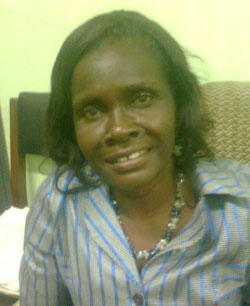
Gloria Obajimi
Gloria Obajimi is the Acting Director, National Institute for Sports. Obajimi, a former Nigerian international athlete in this chat with Jacob Ajom recalls her days as an athlete and speaks on the challenges facing the school. Excerpts
The National Institute for Sports churns out coaches in different disciplines of sports every year. Is it just a matter of getting the certificate? Or simply put, why is it necessary for one to pass through the NIS as a coach?
We need the coaches to go into the grassroots to fish out the raw talents because that is where we have the talents really coming out. That is why we are happy that many are coming for the advance certificate in coaching. We want them to be able to go to different schools, to the different local governments because that forms the breeding ground from where we get athletes at the national level. If these student athletes are not identified at the appropriate time and are not nurtured appropriately, and given the right skills and development, then we will not get it. We want a situation where if an athlete is called to the national camp, even if it is U-15 in football, for instance, he should know the basics, like how to trap the ball, play with each other or when to strike. That is why we train the coaches to know the anatomy of sports, know the different muscles that are working and what those different muscles are capable of generating and the different areas of the energy they are going to be using, the percentage of the training that is being given to them and they expect those students to get.

Gloria Obajimi
Sports is science. That is why we are thinking about the athlete. After giving a particular training schedule, one should be able to compute those individual differences in skills among the athletes and you should be able to know exactly what you are doing.
Very often some Nigerians take to coaching without going through the NIS. Some who passed through the school have no employment and nothing to show for attending the course.
We have had a situation where those that have represented us at international sports are now coaches and so we ask them to come to the NIS for training. It is good to come to NIS. Being on the fence and being outside you will not know the quality of what you are missing when you have not enrolled to be at the NIS. When you come and become part of it, you will be able to beat your chest that you have the basics in coaching and will be able to take care of the talents that God would be putting in your charge.
You were one of Nigeria’s finest athletes. In your active days, as an athlete, did you ever dream of one day becoming the Director of Nigeria’s premier institute for sports, the NIS?
When I started sports, I was privileged to attend St Theresa’s Ibadan and my sporting career started in 1971. In 1972 I was given a full secondary school scholarship by the Nigeria Olympic Association(now Nigeria Olympic Committee). Looking back all these years, I never even though I would represent Nigeria to the level I was at the Olympics in 1980 and then, to be able to do my Health and Physical Education at the University of Ife, I never thought, even when I was graduating from Ife that I would climb up to this level of becoming the Director, National Institute for Sports.
I joined the NIS in 1983, after my youth service. The Principal of the Institute then was Dr Awoture Eleyae and he was very happy to have me, being a former athlete and being able to get the qualification to become a lecturer at the NIS. At that time the Nigeria-German cooperation pact was still on and I liked what they were doing. I keyed into giving knowledge to people that were coming into the institute. Today, to God be the glory that I am the Acting Director of the NIS. I have been able to earn this to give a ray of hope to former athletes that whatever you are doing, do it to the best of your capability and the God that rewards will reward every one of us accordingly. And when I look at the female athletes, I will say, I have been able to do this for the female athletes also and I advise them not to relent, you have to work hard and earn a living.
Flash back to your active days as an athlete, and tell us which of the races you that you took part in remains most memorable to you?
I attended so many competitions, but let me start from the beginning when I wore the outfit of a national athlete representing Nigeria in 1971 and the then Head of State of Ghana, General Achempong named me the Most Valuable and the Most Talented athlete of the event. I did not know what to do and the senior athletes were telling me, “Gloria make shakara, jog towards him, you are just walking”. It was funny because they couldn’t get my size of track suit because I was very tiny and the track top they gave me was past my knees.
Which event was this in particular?
It was the Ghana/Nigeria Athletics competition before it became ECOWAS.
Now at the helm of affairs at the NIS, what are your immediate challenges?
The number one challenge is that the budget has not been properly operational. Even if it becomes operational, there are numerous other challenges; like power failure, the students always want power to read and we don’t want them to read for their exams with candles, they want water, the lift is not working. They cannot pay so much and they don’t get what it takes for them to have power at any time that they want to read. We don’t want them to be using candle so that it doesn’t damage their eyes because they came to NIS. They are ready to burn the candle but we pray that everything works out well like an institution they all can be proud of. Power is our major problem.
Nigerian sports, particularly athletics have gone down. The NIS is supposed to lead the fight for the revival of sports in the country. Is your institute being given its pride of place in policy formulation and implementation?
In our policy planning and implementation, the National Institute for Sports has the enabling Act to be able to be in existence but we need so many things that will make us to work and be able to achieve our desired goal. We are a research institute and in the budget, there hasn’t been any money being appropriated to the National Institute for Sports for us to carry out research. There are so many researches we can do in sports that can chart the course for us to follow in our sports development and we want the NIS to be given that responsibility of doing those researches that we can beat our chest.
The people are wondering that the Black Race is running, it is the black man you find, lined up in the finals of 100 metres. The Jamaicans are doing it. We need to do some research studies to be able to find out what is in the make up of the black race? What is giving them an edge when it comes to competitive sports or combat sports. We know the Cubans are good in boxing. What is it that they have? We know that sports is science and some other things would be able to add up for them to be there. We need to know what is giving us(blacks) that edge when it comes to sports.
Disclaimer
Comments expressed here do not reflect the opinions of Vanguard newspapers or any employee thereof.