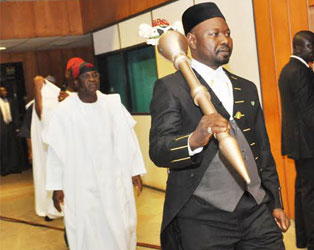
SENATE—Senate President David Mark being led out at the end of the 7th Senate in Abuja, yesterday. Photo: NAN
By Owei Lakemfa
THE Senate made some of us proud on Wednesday when it pushed Nigeria into the record books; passing 46 bills in ten minutes. That is less than 13 seconds per bill. Even in the 100 metres race, that can fetch a gold medal.
The Seventh Senate whose life expired a day later was quite patriotic in working so hard in ten minutes to ensure that the huge money spent on the bills, including time on public hearings do not go to waste. To achieve this, it suspended its rules; assumed that the Distinguished Senators had read the bills and that they had passed the First, Second and Third Readings and were therefore ripe fruits to be plucked as laws of the Federal Republic.

The Senate
Rather than being pilloried, the Senate deserves praise for executing in ten glorious minutes, a job it was assigned four years to complete. This is nothing short of a miracle. It also shows that the succeeding Eighth Senate can go to sleep for most of its life span, collecting the normal allowances, and then spend one or two hours doing the work of law making.
To be sure, many of the thirteen-second bills passed are quite important. These include those on Tertiary Education Trust Fund, Diaspora, Witness Protection, Economic Intelligence and Whistle-blower Protection. Prior to that glorious day, the busy Senate had passed 77 bills in four years, but with the new ones, the bills came to 123. It shows that in politics, not just 24 hours, but ten minutes can be a long time. It is also a reminder that politicians should not be taken for granted. You can imagine that if this were an election, with almost all votes counted totaling 77, then just as the collation is coming to an end, 46 votes came in, that would be the clincher.
It was also necessary for the Senate to correct the impression that the hallowed chambers is a grave yard for bills. Some media, trying to cast aspersions, informed that the National Assembly spent N600 billion in four years doing little work. First, it is not only members that spent this money, they include the Assembly bureaucracy and office maintenance. Also, such media does not realise that the work of the Senate is quite enormous; first it is not just about making laws, but also carrying out over sight functions, which we all agree, it does very well. Also, it does the tedious work of screening some officials like ministers. As the last screening of Ministers like Musiliu Obanikoro showed, this can be an hazardous task that needs careful timing and execution. In any case, it is not the number of bills passed that matters, but the quality.
The impression is given that the House of Representatives is more proactive and hard working. This mistaken view might be due to the fact that the Honourables tend to be younger and more agile. But the older people in the Senate might be more deliberate and reflective. The Senate is a privileged place; home to former and out-going governors, former commissioners, prospective ministers and elder statesmen. So it is not a chamber that can be hurried. Although a number of its members may look old, but the Senate’s action last Wednesday, showed it can rise up to the occasion.
It is necessary to point out that the impression we have about a snoring Senate is not peculiar to Nigeria. The Senate in the United States, the country we take as the ultimate in democracy is certainly in a worse state. In October 2010, the US Senate was sitting on a total of 420 Bills already passed by the House of representatives. On July 20, 2014, Hon Lynn Jenkins, a Republican held a press conference to express her anger against the Senate which she christened the “Do nothing Senate” for sitting on 352 bills one week before it was to wind up. The bills she claimed were so important to the lives of Americans that at the House, 50 percent of them had passed unanimously with no opposition, while 70 percent were passed by two thirds of the House, yet the Senate sent them to the grave yard. But killing bills cannot be the sole prerogative of the Senate; there are also bills passed by it which were pending in the House.
Some of us think that Nigeria already has too many laws, so the Eighth Senate to be inaugurated tomorrow does not need to be as hard working as its predecessor. But for its over sight functions, it could have been suggested that after inauguration, the Senate can go on sabbatical.
This raises an old issue: do we need a bicameral legislature? Can’t one chamber do the legislative work the country needs? I think it can. In any case, the mere concurrence of the Senate to the 46 bills in the belief that the House must have done a thorough job, gives credence to this. If the argument is that like the Americans, we need both, is the number not unwieldy; 109 in Senate and 360 in the House making a total 469 legislators. The prevailing argument in the country is that we need to reduce the cost of governance, and free funds for needs like building and maintaining schools and hospitals. Should we not start with the National Assembly? Let it not be assumed that I think the National Assembly is not very useful; in fact, were we, to make a choice between having a country without a Senate or one without an Executive, my vote will be for the former.
Disclaimer
Comments expressed here do not reflect the opinions of Vanguard newspapers or any employee thereof.