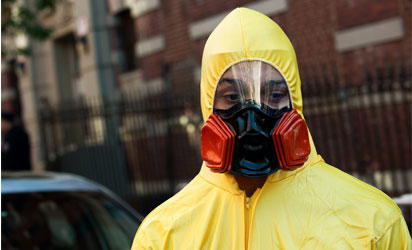
NEW YORK, NY – OCTOBER 25: A young man, dressed in a biohazard costume, stands on the corner of 546 West 147th Street on October 25, 2014 in New York City. After returning to New York City from Guinea, where he was working with Doctors Without Borders treating Ebola patients, Dr. Craig Spencer was quarantined after showing symptoms consistent with the virus. Spencer was taken to Bellevue hospital to undergo testing where he was officially diagnosed with the Ebola virus on October 23. Bryan /AFP
By Jennifer Aladetan
EVER since a Liberian woman was diagnosed with Ebola after having sex with her spouse who is a survivor of Ebola, doctors can no longer tell for certain when it’s safe for Ebola survivors to return to a normal sex life.
According to a report in Popular Science, It used to be the belief that the Ebola virus could live on in a man’s semen for up to 82 days,but there wasn’t any evidence of the virus within the man’s blood, yet tests revealed that his semen contained genetic material of the Ebola virus, closely matching the strain that infected the woman.
Previously the World Health Organisation had advised Ebola survivors to abstain from sex or use a condom for up to three months after getting sick. But latest findings show that Ebola can be spread up to five months later, doctors no longer know when it’s safe for Ebola survivors to return to a normal sex life.
So how is it possible for Ebola to live longer in the testes than in other parts of the body? It likely has something to do with the body’s “immune privileged” areas, the report noted.
A person’s brain, eyes, and gonads are so important to survival and reproduction that they’re actually shielded from the body’s own immune system. That’s because the same molecules that can fight off foreign invaders can also damage nerves and other cells. And it doesn’t help that the immune system doesn’t play nicely with sperm. White blood cells see the little spermatozoa as invaders–probably because males don’t start producing semen until after the body’s immune system has already been established.
The testes are protected from the immune system by a wall of cells. This blood-testis barrier surrounds the tubes where sperm are made, making sure immune cells can’t move from the blood into the tubes. Should the barrier be breached, the testes are armed with immunosuppressive molecules that would cripple any invading immune cells.
While the testes do have a resident population of macrophages and T-lymphocytes (both cells that fight infection), their ability to kill intruders is also suppressed to protect the developing sperm.
Suppressing the immune system may be good for sperm, but unfortunately it’s also good for pathogens. Once a virus infiltrates an immunologically “privileged” area like the testes, it can be hard to get rid of. This is one of the factors that makes HIV so difficult to treat.
Disclaimer
Comments expressed here do not reflect the opinions of Vanguard newspapers or any employee thereof.