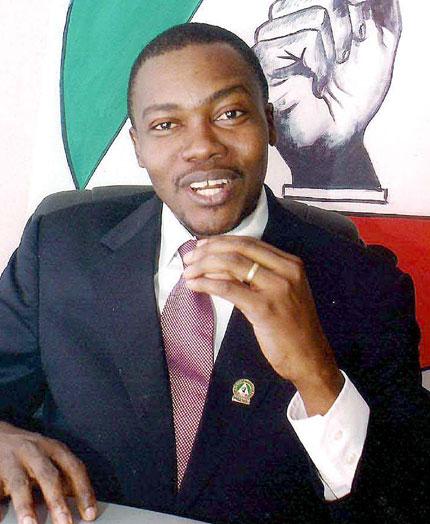
Comrade Esele
By Michael Eboh
The release of the full report of the Nigerian National Petroleum Corporation (NNPC) forensic audit, as well as possible removal of the subsidy on petroleum products have been a major talking point in the country.
Peter Esele, a former President of the Trade Union Congress as well as the Petroleum and Natural Gas Senior Staff Association of Nigeria (PENGASSAN), shares his views on the issues.
In this interview, Esele talks about the rot in the NNPC and indicts the executive and the legislative arms of government for corruption in the oil industry.
He warns the incoming Buhari administration to focus on tackling corruption in the NNPC immediately it is sworn in or risk being sucked into the rot within three months.
The NNPC has of late been in the news for so many negative reasons. What is your view on the recently released forensic audit report on the NNPC?
When people talk about forensic audit of the NNPC, or that the NNPC is this or that, there is nothing that comes out of the NNPC that surprises me. It is people like you that are surprised.
The NNPC is opaque, even its financial system. The way the NNPC is run is, the more you look, the less you see. Again, one other thing that people do not know; the labour movement, especially PENGASSAN, has always talked about this, the need for NNPC to be run as a going business concern.
I can assure you, every government just coming in, military or civilian, always said it will do something about the NNPC, after two months, nothing will be heard about the promise, because NNPC is the cash cow of whoever is in power. When they talk about forensic audit, this or that, how do they expect NNPC to operate?
Now, the first fundamental mistake or error of the NNPC, the Chairman of the Board is the Minister of Petroleum. Now where are the checks and balances? The Minister is supposed to oversee NNPC, now the same Minister chairs the Board. Whatever the Board of the NNPC agrees on who oversees it, who supervises it? How will the technocrats at the NNPC now act? Who can look at the Minister in the face and say no? When you go through all of these reports, we already know that, from day one, the political interference in the NNPC is second to none.
All government parastatals have tenure, only the GMD of the NNPC does not have tenure. The GMD can be fired after four months, after six months, even without being corrupt. You know what it is to remove the CBN Governor; even the NCC, do you know how difficult it is to remove the chief executive? You need two-third of the Senate membership to concur to remove the CBN Governor. Go and check if that applies to the NNPC GMD. At the end of the day, the GMD of the NNPC does not even have time to face his core responsibility. Every day he is summoned, either by one governor or one’ oga at the top’ from The Presidency or somewhere else, hence he does not owe Nigerians or the NNPC Act any responsibility; instead his responsibility is to the president. At the end of day, he is not running any business. Hence the NNPC became something for a few.

Comrade Esele
All of these abuses that are perpetrated inside the NNPC are nothing new. If you have been reading NEITI reports, they alluded to the fact that the financial system in the NNPC is opaque.
When you talk about all of these, where are the oversight functions? The Minister is supposed to do his or own, which is the executive; then you also have in the Senate and the House of Representatives committees that are supposed to oversee what is going on in the NNPC. When you talk about the NNPC being corrupt, you have to look deeper. The NNPC became an octopus because every other agent of the state that is supposed to oversee what is happening in the corporation is also part and parcel of what is going on there.
Just take your time, go and find out who gets the oil wells; go and find out who are behind products coming into the country; find out who are those getting the kerosene contract; you will find that a whole lot of people who are supposed to oversee the NNPC have their hands inside the NNPC.
That is why from 1999 till date, NNPC gets away with anything, because all of those, whether in the National Assembly, whether in the executive or the legislatures, they are all part of the problems inside the NNPC.
What we should be asking is if all the various GMDs of NNPC and those holding key positions, both present and present, will actually come out and start talking. If they are allowed to talk, then we might be able to know of a lot of things.
Remember that at one time, former president Olusegun Obasanjo was both president and minister of petroleum. Where is that done? The corruption and whatever that has been happening in the NNPC was done with the connivance of both the executive and the legislature, so let nobody come and do holier than thou here.
The incoming administration must have to decide what they want to do with the NNPC before they get there. If they dilly dally, I can assure you that after three months, they will be part of the problems, because NNPC is big and financially strong to handle anything.
What changes would you like to see in the NNPC?
First of all, I would advise that they look at the areas of the Petroleum Industry Bill (PIB) that they think they can work with. If I am the President, the Minister of Petroleum would have to leave the Board of the NNPC. The Minister of Petroleum has no business on the Board. Let the NNPC run like a business.
Another thing, no matter how little it is, is that the office of the Minister of Petroleum is inside the NNPC Towers. That in itself is also very wrong. It is like telling me that the office of the President will now be domiciled in the Ministry of Foreign Affairs. No. The Ministry of Petroleum has to leave the NNPC Towers and the Minister must know that his or her role is to oversee what is going on inside the NNPC, not to be part of what is going on in the NNPC. What has been happening is that the Minister is part of what has been going on inside the NNPC, so the executive cannot say they not know what is happening there.
Another aspect the incoming administration has to look at is all those who are within; those who are inside, you can go through what they are doing. What if those in the NNPC see themselves and set tasks and targets for themselves? Tasks and targets must be set for the GMD of the NNPC from day one. Then the GMD will now set that out for the various Managing Directors and other officers. That way, people will be responsible for what they have to do.
Everything must be done transparently. There must be transparency in bidding process. I will tell you now that if you go to the IOCs, you go to the NNPC and the CBN, there are discrepancies in the amount of crude oil that is being lifted in the country on a daily basis. The figure from NNPC, IOCs, CBN, tax, are all different. Why? The incoming government must also look at those that have really breached the system and use one or two of them as example, because that way you are sending a signal to others that this would not be business as usual.
Do you support plans to remove petroleum subsidy?
I am not going to say whether I support or do not support, but the first thing I am going to say is that in any society, when there is a change of government, the reason you have a change is because the people are saying they want things done differently or they want the new leadership to take them to a different dimension.
So, if what we are talking about now is still removal of subsidy, which is still the old way, then we are going to get the same response that we have been getting.
What I expect the incoming administration to do about the subsidy matter is to go down to the bottom of the issue and look at the nitty gritty, determine what are the problems and challenges? Why does the labour movement always reacts the way it does?
The first thing is, we have to identify if there is subsidy with the price of crude at $64; if there is subsidy, how much is it? And then how many litres of petrol do we consume on daily basis and then we now need to get how much is our average consumption level? Why is it that in January we consume same; June, July, we consume same and in the last quarter we also consume same? Why would the amount that we pay for subsidy be the same figure, it never comes down; it is either it is the same figure or it goes up.
These are all the challenges that I expect the incoming government to grapple with and find solution to. By the time they go through all of these, we will be in a position to say if subsidy should go or not.
Just coming up to say subsidy should be removed, is like behaving the way we have always reacted and we will get the same result. Labour and government must have data analysis. There must be data analysis of everything that has to do with that sector. Importation must be looked at and how much is being paid. There was a time we said we were consuming 25 million litres, later they now said it was 27 million litres, a difference of about two million litres a day.
I will be worried if the incoming government is also talking the way of the pat government. They must do something different.
From you interactions with the labour movement, do you think it will support this issue?
We have to wait for the new government to be sworn-in, and then we can actually know the way it is going to handle it. I think it all depends on the way it is managed, because effective communication around it is key to determine whether subsidy goes or remains. What labour is always after is: if you are taking away the subsidy, where actually is the subsidy, where is the money going to and how is it going to improve the lives of the ordinary Nigerians?
However, if they are able to manage it and labour sees that the subsidy has to go, it will not be averse to it, because we now have to know if there is subsidy. We were paying N97 per litre before, now it is N87 per litre, you reduced it and you are still telling us there is subsidy. How? How do you marry those two, that the price of crude was over $100, we were paying N97 per litre, now the price is almost half of that, you now reduce by N10. How do you even arrive at that subsidy that you are paying?
Are you factoring in the devaluation of the naira and its effect on fuel price?
Of course I know that when the naira was devalued, this was what was likely going to happen. Let us not look at it from a single angle approach or what I call a helicpoter viewpoint. I prefer the bird eye view, to look at it carefully and look at all the rot that is there.
This is because whether you like it or not, if the price of crude oil goes up to as high as $120 or $140 per barrel, we are in trouble, if it is as low as $60, we are still in trouble. Why must we be in trouble? All other countries are so happy when the price is high. It gives them room to save. But when the price is high here, the next thing we talk about is that we are subsidising; when the price is low, the next thing is that we devalue our currency and we still say we are subsidizing. So, it is more like head, we lose, tail, we lose.
The best that government said they do is that they save money in the Excess Crude Account. You save money, yet the lives of your people are not in any way getting better.
The only way out of this is for us to put on our thinking cap, leave out emotions so that we can sit down and really look at this sector; how many jobs can we guarantee? How do we open up the sector to make sure more people are gainfully employed? When we talk about producing two million barrels daily, the jobs that it generates are few, compared to the jobs that the downstream sector will generate in terms of functional refineries. Why are our refineries not working?
It does not matter if you talking that the highest that you will save is N10 per litre. If you save N10 for one million litres, you know how much that is. Not to talk of saving N10 from about 20 million litres daily.
Those are areas where I expect the incoming administration to look at. Fortunately, the president-elect has what I call goodwill. It is very clear that, whether you voted for him or not, whether you like him or not, there is a general agreement by Nigerians that he is not corrupt. That is a very huge moral high ground that he has that he can also deploy.
What advice do you have for the incoming administration on the power sector and the refineries?
Privatizing the power sector, nobody said that was bad, but you have to look at the process of the privatization. I heard the former Vice President talking about reversing it. I will not go for wholesale revision, but I am going to say look at where our laws were breached. There were times I think the Federal Government was paying these people when they were not generating any power. That has to be looked at. If any of them has gotten money they did not deserve, government should take it back.
Whoever wants to generate power let him generate power. They have taken what they have taken; let them now invest in the sector. You cannot say you have privatized power and, right now, their charges are high, we are not getting the power. Of course, power is not like going to the supermarket to buy soap, but we must see the plan of those who have taken over the power sector, to tell us how much megawatts they intend to generate on annual basis. That is for the purpose of planning.
The incoming government said they will create three million jobs per annum. You cannot do that without power. Power is key. Hotels in Nigeria are the most expensive in the world, due to the issue of power, the cost of buying diesel. The generating companies (Gencos) must tell us how many megawatts they can generate on annual basis.
That will help us to project. If for example they said they will be generating 2,000 megawatts annually, then we will know that in the next four years we will add 8,000 megatwatts to the national grid. Similar thing should be done to the distribution companies (Discos). Then there must be somebody somewhere who will hold these people accountable.
One of the biggest problems we have is not that we do not have policies. In terms of policies.
The incoming government does not need to do too much, what they need to do is to dust some of the policies and documents that we have already. There are so many documents in The Presidency. No matter how bad people think Abacha is, his Vision 2010 document is there and we also have the one for 2020. Dust them and put the them in place and make sure there is effective supervision and monitoring. Once you start carrying out the monitoring and everybody is kept on his or her toes and held accountable to the various milestones and projection, while whoever does not do that is shown the exit door, you will be surprised at how much our country will grow.
In the area of refineries, when people talk about labour, they always have this mindset that labour is cantankerous and troublesome. That is not true. The difference is that labour is always far ahead of government in their thinking. When I was PENGASSAN President, we signed for the privatization of the refineries. I signed, the President before me signed also. But we were shocked that the same government that was talking about the privatization of the refineries did not go ahead to carry it out.
There are two options before government. Why have the refineries not worked optionally under the NNPC? I know there was one time that the GMD of NNPC said the refineries will work within six months. I said it was not possible, not because the workers there could not do the job, but because the bureaucracy in the NNPC and interference from outside will never allow the refineries to work.
That was why PENGASSAN, at a time, signed up and said let us have a co-operator for the refineries, let us have the NLNG model. If it does not work, I do not think the union would be averse to the NLNG model, because the model will make the refineries functional, especially as the workers in the NNPC want to work for their pay. That is the worst case scenario that the workers will accept.
In the NLNG model, the co-operator runs the day-to-day business in that place and it has to make profit, it has to make the things work and he pays from whatever profit he gets to government. You have not heard one day that the NLNG has fallen or things are not working there, because there is no interference from anywhere.
As long as the NNPC is the way it is, from now till 500 years time, I do not think they will allow NNPC to grow. Politicians will not. That is why whoever comes on board says all the nice things they will do to NNPC; Obasanjo said the same thing, he did nothing; Yar Adua said the same thing, nothing happened. President Goodluck Jonathan also said the same time and nothing happened. NNPC is still the way it is.
If the incoming government — and I am saying it — if they do not do something about the NNPC within the first 100 days, if they do not have a plan for the NNPC, they too will also be sucked into it.
Sometimes I believe that all the fight about the north and south; all the fight about who gets power; who gets what, is actually a fight about who controls the NNPC.
It is my expectation that the incoming government would not toe the same line. The character and integrity of the president-elect, and as a former Minister of Petroleum, will actually be tested in how he handles the NNPC in particular, the Ministry of Petroleum and the oil sector in general.
Government and labour unions have been silent on the issue of minimum wage and workers’ welfare, what do you expect from the incoming administration in this regard?
When I was asked to project for workers in the new year, I said 2015 was going to be a tough year for workers in particular and Nigerians in general. When they were now doing their first quarter review, I was told that what I said was coming to pass. More than half, about 20 to 24 states, of the federation cannot pay salaries. Some owe as much as 12 months, some nine months, eight months, and four months. We had less than 10 states that have been able to pay salaries regularly.
At the moment, the actual value of the N18,000 minimum wage is like N9,000 if you base it on the fact that the dollar is going for about N200 now. At the time we did the minimum wage, the dollar was between N120 and N140. Now, that N18,000 has lost about 40 per cent of its actual value from when we negotiated the minimum wage. You now look at it that the N18,000 cannot really buy what it was buying when it was negotiated. If you now say based on the current realities and the challenges the states are facing, are you now going to say you are going to increase salary to N50,000? It just does not fly.
What we now have to look at is: what are the areas that you can augment the expenses being borne by the workers? The major areas where the workers spend his money are health, education, transportation and housing. If you are able to make it easier for somebody to transport himself to his place of work, it will be better. Transportation in the UK, whether by rail or bus, is subsidized. We should consider how we now go in that direction to now look at how we can make the transportation system affordable. We don’t have a transportation system, how do we make that affordable? Then how do we go ahead and make healthcare affordable. To treat malaria normally, you go to a chemist, it would not cost less than N3,000 or N4,000. Just divide that sum for a family of four, you will discover that the N18,000 will not take you home.
Disclaimer
Comments expressed here do not reflect the opinions of Vanguard newspapers or any employee thereof.