By Japhet Alakam
In the face of the plethora of challenges confronting Africans on the continent and the Diaspora, concerted and strategic response is required to frontally tackle them.
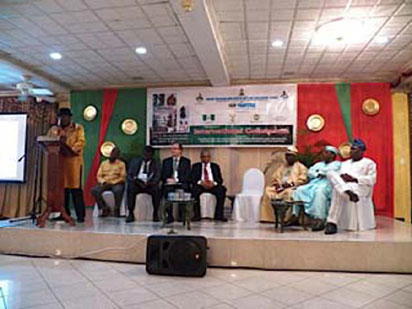
This was the focus of 9thGlobal African Colloquium organised by the Centre for Black and African Arts and Civilization (CBAAC) Nigeria, in collaboration with the University of the West Indies, Mona Campus Kingston, Jamaica, the African Caribbean Institute of Jamaica (ACIJ), the Pan African Strategic and Policy Research Group, (PANAFSTRAG), the High Commission of South Africa Jamaica, and the Nigeria High Commission in Jamaica held at the University of the West Indies, Mona Campus, Kingston, Jamaica 23 –25, 2014.
The conference with theme: “Toward a New Pan-Africanism: Deploying Anthropology, Archaeology, History and Philosophy in the Service of Africa and the Diaspora” set for itself many laudable objectives which includes: create the desirable space and forum for African and African Diaspora experts, students, scholars and researchers to meet, debate, exchange ideas, and present their work particularly the humanistic and social science disciplines of history, the arts, philosophy, anthropology and archaeology. To foster understanding of the relationship between Anthropology, Archaeology, History and Philosophy and identity politics in Africa and the Diaspora; etc.
The Keynote address titled: “Global Africa: Moving Forward” delivered by Professor Augustin Holl,Professor, Université Paris-Ouest Nanterre La Défense, France.
The opening events included music by Rastafari Group, UWI Pop Group and Etu Group. Panel sessions held on Thursday 24 and Friday 25 April 2014. Topics at the plenary include: “Knowing Enough: Africanists Anthropology to the Rescue”, “the African Origin of Obeah: Etymological Inferences and Historical Evidence from Benin Kingdom, Nigeria”, and “Rediscovering The Spirit of Africa and the Africana Renaissance”, among others. The closing sessions took place on April 25 with a reception by the Nigerian High Commission in Kingston, in the evening of April 26.
In all, a total of about Twenty-five papers were presented which spread across the many broad sub-themes exclusively to extending the frontiers of global African unity and networking as well as increasing the tempo of pan-Afrianist consciousness among Africans on the continent and the Diaspora. theme of the colloquium was meant to underscore the significance of multidisciplinary approach to the comprehensive study and wholistic understanding of African and African Diaspora history and culture.
The colloquium was one of the Centre’s several outreaches committed to enriching the enduring connectivity between Africa and the Caribbean, it furthers stronger collaboration and partnership between the University of the West Indies (UWI) and CBAAC on the one hand and between Jamaica, the Caribbean and Africa on the other hand.
It also bolstered Jamaica’s new orientation in favour of renewed South-South cooperation particularly in the direction of seeking friendship with Nigeria in particular and the African continent. It also offered avenue for the celebration of what Jamaica shares with Africa, consolidating the relationship, and further the promotion of understanding between the Caribbean and Nigeria in particular and Africa in general.
The colloquium opened new window of opportunities for constructive engagement between Nigeria and Jamaica and set the pace for productive and mutually beneficial exchanges in education, business, socio-cultural as well as other spheres of human endeavour of our countries’ economies.
It also identified with and complemented UWI’s efforts at rewriting Africa and the diaspora history different from the way European or Eurocentric scholars have written about the continent and its diaspora, as well as foster sustainable inter-continental scholarship.
The Colloquium had participants and delegates from Nigeria; Botswana; France; Cape Verde; USA; United Kingdom; Barbados; Jamaica; South Africa;; and Japan including Edem Duke, Minister, of Tourism, Culture and National Orientation; Professor Archibald McDonald, Chancellor & Campus Principal, University of the West Indies, Mona Campus, Kingston; Gen. Ishola Williams (Rtd.), Executive Secretary, PANAFSTRAG International; Ambassador Olatokunboh Kamson, The High Commissioner of Nigeria to Jamaica; Philip Riley, Counsellor South African High Commission Kingston Jamaica representative of Her Excellency, Mathu Joyini, High Commissioner of the Republic of South Africa to Jamaica and Caricom, Kingston, Jamaica; Brimmo Yusuf, Chairman CBAAC Board and a host of others.
At the end of highly engaging deliberations, the following observations and recommendations were made. It was observed that: Pan Africanism as an ideological framework provided a guide and direction for the course of decolonization and could be a basis for the development of Africa and the Diaspora in a globalized world.
The disciplines of Anthropology, Archaeology, History and Philosophycould be deployed in defining and constructing a new Pan Africanist agenda for development in Africa and the Diaspora. The educational programs are not sufficiently structured or developed to decolonize the African mind and are still generally Eurocentric in curricular and methodologies.
Africa and the Diaspora have enough scholars and intellectual resources to fully reflect on African situations and contexts with better and deeper understanding because of the advantage of their being products of the cultural milieu of their study areas.
Others include that, African scholars and public intellectuals must deconstruct Eurocentric dependencies and develop epistemologies that are reflective of African realities. In encouraging Africans from the Diaspora to visit Africa, CBAAC and similar African organizations should provide a database of interested Diasporan Africans who would like to go to Africa as well as those in Africa who are willing to host brothers and sisters from the Diaspora.
The production of films, movies and documentaries on historical figures and experiences from the continent and the Diaspora should be actively pursued.
Disclaimer
Comments expressed here do not reflect the opinions of Vanguard newspapers or any employee thereof.