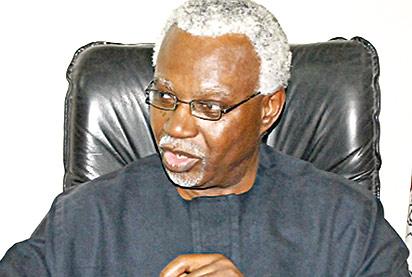
Ekpo Nta
•Says federal administration’s anti-corruption efforts paying off
•Unexplained properties to be forfeited, he warns

In 2011, N5.2 billion was recovered as unspent funds from federal ministries. In 2012, the figure went up to N9 billion. These are funds that could have gone into private pockets but for the close monitoring of the ICPC, according to the anti corruption agency’s Chairman, Mr Ekpo Nta. 45,000 ghost workers were also uncovered. Nta, in this interview, tells the story of graft in Nigeria and what his organisation is doing to combat it.
By Jide Ajani
What is this issue of non-conviction seizure?
This works on the principle that if the chairman of ICPC for instance, is of the opinion that the properties belonging to an individual do not correlate with the income or the circumstances of an individual – by way of inheritance or a lottery – he has every reason to ask you to explain how you came by such properties.And to preserve the properties we can issue an Interim Seizure Order
How long would the order last?
Oh, the individual would have one year within which to discharge that onus or to challenge it in court.
What happens if an individual fails to discharge that?
Failure to do that means that the ICPC chairman can go to court for a forfeiture order – the powers are limited to the extent that he cannot abuse that order. That power I exercised over the Civil Defence matter in seizing those properties and may be if we didn’t move as fast as we did, they would have sold the estates to third parties. The law is very lenient on innocent purchasers who probably may not be
aware that such properties were acquired fraudulently.
What sort of innovations would you say you have brought on board?
Quite a number of them. One very strategic innovation is the building of a better relationship with our whistle-blowers. We get a lot of tips from the local communities now because we have tried to relate corruption to something they can touch. For instance, they now understand that the poor health facilities and the non-provision of infrastructure in the community is the handiwork of a politician who may have put a tap in front of his house so that you can fetch water in a manner that suggests that he is doing you a favour, whereas he may have totally abdicated from and corrupted the process of delivering democracy dividends to the people.
Your children should g to good schools and if they cannot you should be able to ask why.
ICPC has been involved in the draft of a national policy against corruption. Just as there is a national policy on education, health, infrastructure and all that, we are going to have one on corruption.
We are at the forefront of driving that with the inter-agency office in government.
The draft is already with the Attorney General of the federation. ICPC is also in the fore-front of designing a national policy on integrity and ethics. Since 2004, ICPC pioneered the national values curriculum which went up to the national council on education. Nigeria is one of the very first countries to have that in the world. It is only now that the United Nations Office and Drugs and Crimes, UNODC, is trying to introduce the same concept all over the world. They are reviewing that to use in other parts of the world
Would this not tantamount setting up the population against leaders?
No. That is not our intention. For you to be able to ask why, too, have you paid your tax. With all ICPC investigations now, we also find out if the person we are investigating is within the tax net. Surprisingly, some of the big time noise maker-businessmen in Nigeria don’t pay tax. And for those who pay tax at all and who bid for some major jobs in the country, they have attached fake tax papers. This is one of the big issues we are investigating now. An advisory is coming out on that.
Out of 156 bidders that were referred to us from the Federal Ministry of Works, 56 had fake tax clearance papers. We are going after them because these are the people who are shouting corruption yet they are the ones driving corruption.
Even some students in the universities were admitted wrongly for programmes that would not lead them to do youth service so, the universities must tell them the truth. After such programmes the students go and look for money, pay people and get smuggled into the NYSC programme. We arrested 43 recently – and that would just be a fraction of those circulating.
How would you describe your typical day? What do you do?
Well my day has to be situated within the mandate of the Commission and that includes prosecution, investigation, public enlightenment and education and all these would entail internal directive to staff, review of investigative reports, approval of what maters should go to court, which should be investigated further and these would have to be balanced with external partners and also review investigative reports hat have to do with eternal governments.
Today we dealt with the one relating to diplomats because of their immunity. These are issues you must meet on, on a day to day basis. And where parties are not satisfied with our investigations by either not getting good value ofr not being treated well during investigations, I have to listen to them – but I do this in the presence of the investigating officers and the heads of department.
You talked about diplomats now and this relates to the challenging nature of your job: How do you handle a diplomat who, in the estimation of ICPC may have conducted his activities in a manner unbecoming of a diplomat in the realm of corrupt practices? Does that mean you can’t and won’t act?
What we do is that we report such a diplomat to the appropriate authorities or make a presentation to the Ministry of Foreign Affairs in Nigeria drawing attention to what we have observed.
People don’t seem to hear so much from your end because it creates the impression that nothing is happening?
You see we don’t want to trivialise very serious matters and that is what I have brought on board to the ICPC. The anti-corruption war is not a film show, not a comedy that should be accompanied with razzmatazz because people would tend to look at that and forget the substance. We’ve had to go back to the trenches to engage a better approach. We have a five year development plan, a strategic development plan and on a monthly and weekly basis we know exactly what we have to do and what we expect as outcome
And targets are being met?
Oh yes. In fact we set very high standards.
One or two examples?
We’d set a target that we’re going to review a minimum of four major ministries and departments for this year in order to check corruption processes. That we have exceeded. We’ve done prisons service, the ports – because of the corruption-related high cost that goes to the end users and which makes our neighbouring countries the richer (the attendant effect in trying to bring those things in ensures that the level of corruption is raised whereas if the system was clean and done like the neighbouring countries, we would be the better).
It was even the maritime anti-corruption agencies that blew the whistle because they know the effect of corruption internationally and this was a mark of confidence in the agency having sen what we’ve done in other places. We have also finished the one for the electricity regulatory agency and quite a number of things have come out from
there – the power sector affects everybody.
I’m sure there would have been challenges along the way?
Of course there are. The first, even in terms of systems studies that we carried out is that we were not going to be friendly. The thinking was that an investigative agency can never be friendly and I had to go out of my way to make them understand that I was coming with a view to ensuring that their system worked better and that if that is achieved, you are better off at the end of the day and the issue of embezzlement would be reduced and eliminated – bottom line would be that things would be done legitimately. Another point is that we cannot spread ourselves all over the place so we have to do selective targeting. We’ve had to restrict ourselves to the MDGs areas of health, education and water.
Everything relates to a paradigm of quiet reformation but without that corresponding noise, Nigerians would believe that nothing is happening. An example that would illustrate this better is the recent corruption index released by Transparency International and Nigeria’s continually terrible ranking?
The point is that when you had the scourge of HIV starting initially it was as if nothing was happening inspite of all the money that was poured into that sector but today, people who thought they never had any hope of survival are living longer than those without the virus so long as you take your drugs normally. I only got to see the report yesterday but the preliminary findings I have done and even posited by TI is that corruption has gone up more in conflict prone societies and it stands to good reasoning and they have pointed towards the middle east in particular and some sub-Saharan countries that are facing conflicts.
If you look at the Nigerian situation, which part of this country is not going through self-inflicted strife? You want to enjoy the benefits of democracy but at the same time you have groups of violent pockets challenging state authority. What is sovereignty? It means I give up my rights to the nation state and I expect that the nation state will protect my rights and freedom but here we are grappling with high levels of brigandage, kidnapping and terrorism, piracy and the likes.
Let’s be frank, with these indices what do we expect? It is even a wonder that we are surviving because if we didn’t have our police, armed forces and security agencies doing what they are doing now, the situation would have been like what we have in Somalia. These could be products of long term sliding of systems.
Sliding of systems?
Yes. We had three regions before it became four, then 12 states, 19 states, 21, 26 and now 36 states. In the days of three regions, before you could get to the position of a director in the civil service, it was neither by nepotism or favouritism. It was through hard work. As we began to divide the regions further, the manpower resource was being diluted. As we diluted the workforce, another mentality was introduced: States unduly promoted civil servants who were sent to the federal system just for favourable placements of their indigenes – another form of abuse and corruption.
Mind you we were never able to replicate the character formation of the work force in the Northern, Eastern and Western regions at the federal level. People who even owed money in those days kept their words to creditors. The system has been diluted such that even the federal government that remained intact was polluted and diluted by actions of states who sent some times half-baked people to the centre.The federal system absorbed the shock but at great cost to the system. Just look back at what was described as corrupt practices in those days and what is happening today. We cannot lose sight of all these things.
But in the same country that has had this amoebic divisions you still have super stars who have emerged.
Good. So, even in the face of this atrophying of the system, how would you describe the Nigerian in the context of corrupt practices?
He is like any other citizen of the world ready to take advantage of a society that does not have strong institutional systems.
Between the laws and systems…?
(Cuts in) Laws are not systems. There must be strong systems. The law says if you steal you’ll go to jail. But the law would be an ass if you keep N5million in front of an office and you would meet it when you return the following morning. Anywhere in the world you will not meet the money. The system is what keeps everyone on their toes on the side of righteousness and good behavior.
Some have argued that the system should run the individual but the individuals are the ones who put the systems in place?
Good. Your phone has some standards you must follow in order for you to use it. Connectivity; battery power, credit are all conditions that must all be available at the same time before you can successfully use the phone. Now, everyone carrying the phone knows that. The same thing goes for the system. That is why we hear the general talk about Nigerians behaving themselves when they are in the western countries where the system works. People flout the traffic rules in Nigeria with impunity but if you try it abroad, you’ll pay the price.
The issue remains that some people put the system that is working in place. Look, as ICPC chairman, you can decide to turn a blind eye to some things that you are presently pursuing? The system did not appear magically?
Okay, the Nigerian must go back to redesigning the system such that our general conduct would be admirable.
This your preventive mechanism that has been put in place in ICPC, what are the vibes you’re getting in terms of results?
Oh, we’re very comfortable.
Can we have instances we can relate with?
A good example is the personnel salaries of civil servants and that is one vote that some people were monkeying with before. Some heads of agencies were carrying out virements which were illegal. Before, we had a situation where the civil service number was over-bloated and people were just spending the excess the way they wanted because some of the instances were strategically done to ensure that there are surplus funds.
What we did was to carry out a study on the expenditure patterns of ministries and agencies of government and we did that in 2011. We discovered quite a number of irregularities. We called all of them and pointed these things out and issued warnings. 2012 we monitored them and told them to return unspent funds in their custody. In 2011, we recovered N5.2b through that exercise.
In 2012, the effect of our study showed we had roughly N9b. We’ve stepped it up to a situation whereby all salaries of civil servants are being paid straight into their accounts from the CBN. Today, we have removed the temptation because no physical cash is left in ministries that can be spent whimsically because the funds are domiciled in the CBN.
But those ministries and agencies where those excess funds are discovered, is there any mechanism by ICPC through which it tries to find out why such happened?
Great! That is the next phase that we are in. If we discovered that you have a particular amount left in the CBN account, we would like to know. What happened in the past years? How did it come about? And we also go to the banks to be sure that fictitious names are not used to open accounts with a view to making away with government funds. The Minister of State for Finance said through this action government was able to weed 45,000 ghost names from its payroll. That number is more than some entire work force of some states. We have collected the list of how the number came about and we’re doing a back check on all the agencies and ministries that accounted for that number.
Could you explain to curious Nigerians why ICPC refused to jump into the fray in the light of the armoured car scandal involving the NCAA?
I’m happy you’ve raised the question because every Nigerian is entitled to fair hearing. Nigerians must learn to ensure that we do not convict people before they get to court. The whole scenario was such that people wanted the ICPC to step in and stamp a shield of authority to the conviction without trial, thereby jeopardizing investigations. We don’t work that way. Even when you arrest a journalist, the first thing he says is ‘fair hearing’. When you run persons or agencies down, the corrective measures are never commensurate to the initial damage done.
Disclaimer
Comments expressed here do not reflect the opinions of Vanguard newspapers or any employee thereof.