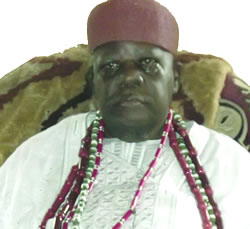
*De Whenu Aholu Menu Toyi 1
By Dapo Akinrefon and Charles Kumolu
THE Akran of Badagry Aholu Wheno Menu-Toyi 1 holds sway over a swathe of territory covering Badagry town and 70 adjourning villages and districts spread across the mainland and islands in Southwest Nigeria.
The influence of past rulers of Badagry is believed to have also reached the Nigerian border town of Seme.
The octogenarian present Akran of Badagry, ascended to the throne in 1977 and before then, was a journalist whose exploits in the pen profession started in 1961 in the then West African Pilot established by Dr. Nnamdi Azikiwe, and spread across several platforms including Daily Sketch and New Nigeria where he rose to the position of Acting News Editor, South.
Before him, Badagary had been ruled by 14 paramount rulers, since the days of Akran Gbafoe in 1425.
Akran Menu-Toyi 1 is the permanent Vice-Chairman of Lagos State Council of Oba’s and Chiefs was honoured with the National Award- Officer of the Federal Republic (OFR) on 7th March, 1981. He is currently the Chancellor, University of Port Harcourt.
Nigeria is celebrating its centenary, do you think the amalgamation was a right decision?
We are enjoying the peace of Nigeria’s amalgamation because we have been together since 1914 when the Northern and Southern Protectorates were brought together. We have been having peaceful co-existence.
Though there have been series of problems since then but such problems have not ended up dividing the country. We should be happier that we are still one.
Looking at Badagry and the centenary, can you tell us the significance of the place to the centenary celebration because some accounts have it that the first administrative office of Lord Luggard and that the amalgamation document was singed here in Badagry. Can you give us insight into this?
All I know is that Badagry is the cradle of West African civilisation starting from 1839 when 500 slaves were liberated from Sierra Leone by the British and they were brought to Badagry to enable them go to their homes. Then, some of the returnees were in Badagry here, Flora Bay compound and they were the ones who appealed to the British government to send missionaries so that Badagry can become the land of the gospel.
That letter was written and dated March 2, 1841 because at that time, there was no such organization in any part of this country. The following year, the Methodist Church sent a missionary on September 24, 1842, they also established the first primary school in 1845 and in the same year, the first story building was built in Nigeria, which is still there till today.
Later on, the British started sending their officers to Badagry. For instance in 1851, one British officer came to discuss with King Akintoye, who was in exile here in Badagry.
That was to prepare the grounds for the British troops to arrive Lagos because they wanted him (Akintoye) to stop slave trade in Lagos.
Before the returnees arrived from Sierra Leone in 1849, Badagry had been a major slave port from the mid 15 century when the kings of Spain and Portugal sent emissaries to West African countries to, find out whether they could get strong and able bodied people to send to the New World, which is now the United States of America.
They wanted to send them to the plantations at that time. So, after the first visit, a slave trader came around 1470, his tomb is still in front of the palace here, he was known as the Smiling Captain.
Other slave traders came after him and went to the various parts of the old Oyo Empire and some parts of Abia State of today which were major slave centers.
There was a slave market which was being developed then, slaves were brought from the hinter land and sold to European slave traders, from there, they were taken to peninsula from where they were finally taken into big boats to travel to the New World, the Caribbean countries and parts of Brazil.
So, we now refer to that journey as the triangular slave trade which is remembered annually and the United Nations has proclaimed that the event should be remembered annually in August.
Today, apart from the United States where there are African Americans, who are free people, there are countries in the Caribbean which are populated by Africans.
Given the historical significance of Badagry to pre-colonial, colonial and post colonial Nigeria, can we know if the centenary committee of the federal government, has any special plans for the town?
As far as I know, there is no programme. I hope the Lagos State government will do something about it.
Don’t you think that Centenary Committee ought to have considered Badagry in the Centenary celebration?
We have not been consulted about that.
There are fears that the multifaceted problems holding the nation down, might lead to the eventual breakup of the country?
(Cuts in) Like what?
Like the Boko Haram insurgency in the north, kidnapping in the South east and other structural problems affecting the nation.
(Laughs) How many people were killed? The Boko Haram insurgency is limited to the north and it started after the 2011 presidential elections. If you can remember, one leader said it will be difficult for the winner of the presidential race to govern and then, what did we see?
What is your message to Nigerians as we celebrate 100 years of our amalgamation?
My message is that we should thank God for His mercy that Luggard announced the amalgamation and after that, we got independence since 1960 and Nigeria had not broken up. I do not think anything can break up Nigeria.
We should not think about any break up, rather, we should continue to work hard to bring about greater cooperation, politically and economically. Nigeria has come to stay.
Disclaimer
Comments expressed here do not reflect the opinions of Vanguard newspapers or any employee thereof.