By Adisa Adeleye
There is little doubt that the year 2014 would mean different things to different people at different times and on different occasions. However, one fact remains unchanged: the year 2014 reminds us of the amalgamation of Southern and Northern Provinces in 1914 by the British to form the present Nigeria.
As it is often taken for granted and sometimes forgotten that the amalgamated Provinces were made of different nations with distinct social and cultural values. Interestingly, Nigeria harbours different nationalities whose identities cannot be mistaken for another and whose values are well defined. In fact, it is not difficult to place Hausa/Fulani land or to describe Yoruba land or Ibo land in Nigeria. With extensive travelling and close dealings within the country, the ethnic configuration of the place is clearly evident.
That many current issues and expressions are viewed in terms of ethnicity or tribalism should not be a surprise because people are yet to rise above their recognized primitive base and instinct. For example, Mallam El Rufai (Hausa/Fulani) was restricted to his hotel and prevented from monitoring the disgraceful show (Anambra gubernatorial election) recently on the ground that he had no business in Anambra. That view was supported by the outgoing governor Obi and others.
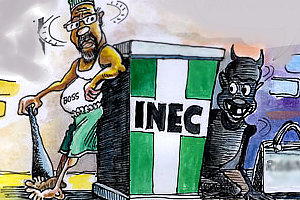
Perhaps, another interesting feature of the ‘inconclusive‘ Anambra election was the focus by some that Dr. Ngige and his party, APC represented foreign interests – Hausa/Fulani and Yoruba. What is yet to be ascertained is whether over 92,000 votes allotted or allocated to Dr. Ngige were transferred from Oshun and Katsina States. It is interesting to note that the PDP party in Anambra State appeared to be jubilating over the defeat of APC in the figures announced than its own regrettable dwindling influence in the state. Another interesting point to note is that the combined votes of both APC and PDP (announced by INEC) were more than that of the candidate of APGA, who has been favoured to win.
I must crave the indulgence of my readers for digressing a bit from the main topic of the moment into ethnic factors which have blocked, over the years, the road to the desired political unity and stability. As it is extremely difficult to defeat a sitting governor (as demonstrated in Edo and Ondo States), the current impression, finally rooted in Nigerian politics, is that APGA candidates would win comfortably. But if he should win, it should be won fairly and justly. The ‘inconclusive‘ nature of the recent election does not give credit to the reputation of many eminent statesmen from that part of the country.
Perhaps, the Anambra tragic episode would solemnly remind the country of the necessity of getting the country‘s electoral processes well regulated. It appears that the existing electoral laws and heavy presence of security forces are no longer enough to ensure a fair and just election. If elections could not be fought and won without the presence of army and the Police, then the exercise is not worth it.
Unless the country is waiting for the doom forecast for 2015, the country‘s political leadership should start now to embrace new electoral reforms that would ensure that the voters have access to voting materials and their votes count without the presence of heavily armed security outfits. Voting should be a regular and normal domestic exercise to be enjoyed by all Nigerians. It looks at the moment as if the country‘s Police and the Army are being drawn into areas not suitable to them and as such, allegation of compromise could not be ruled out.
If electoral reforms should be undertaken before 2015, the appropriate time in the year 2014. Every capable Nigerian should have the right to aspire to any post by right. There should be right of any Nigerian to vote and be voted for in any election; the Independent Candidate issue should be reviewed as it is the practice in many developed societies. Also, the ‘go-home‘ method after screening, should be reviewed so that any voter, after screening could go straight and vote according to his or her preference.
A more fundamental flaw is the substantial compliance with electoral law often used by judges at election petition trials. It is either complete compliance to the electoral law or nothing. Winners must win totally and not partially.
Nigerians are therefore looking upon President Jonathan to look into the inadequacies of the existing electoral laws, or set up a new body or resuscitate the Uwais Report (set up by President Yar‘Adua) in order to give the country a civilized Electoral Law.
THE ECONOMY
Many analysts have argued, with justifiable conviction, that any politically stable state would be based on economic prosperity, macro-economic stability and thriving employment. Therefore, it follows that the current country‘s political inability could not be divorced from deepening poverty, arising from large-scale unemployment. However, some government apologists have failed to see the direct connection between poverty, insecurity and rising crime rate in the country.
It is true that the economy under the able management of Dr. (Mrs.) Okonjo-Iweala appears stable with the rate of growth of over 6.5 per cent (6.81% last quarter), inflation rate of about 8.5 per cent, and stable exchange rate, howbeit, with large unemployment as a recurrent problem. The high employment rate (about 30 per cent), rural poverty and drifts to urban areas, however, cast heavy shadows of doubt on the continuous ability of the Finance Minister and the present government to tackle successfully the problems of poverty and the prospects of prosperity.
Many analysts believe that President Jonathan and his government have insoluble problems on oil subsidy and infrastructural decays. It is economic sabotage for a country well endowed with crude oil to be at the same time, an importer of some refined oil products. The point is that this government has no political will to take its hands off the downstream section of the oil industry – the domain of the private sector.
Many who see in the 2014 Budget, a solution to the problems of poverty might be disappointed.
An economy which still relies on oil as its dominant revenue, which distributes its greater part of oil income to conspicuous consumption (recurrent expenditure) and smaller part to capital development may have paper higher growth rate, lower inflation, but little or no prosperity.
The Nigerian economy which thrives under tight monetary policy, high exchange rate and punitive cost of money to the real economy is fundamentally unstable (even if it appears stable) and a fertile ground for the rise of insurgency and crime. Why not root for poor- friendly policies in 2014?
Disclaimer
Comments expressed here do not reflect the opinions of Vanguard newspapers or any employee thereof.