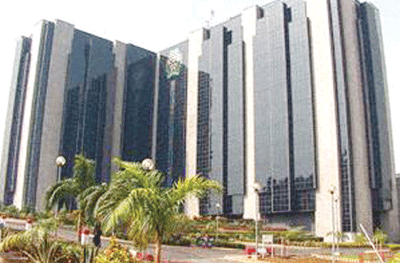
The Central Bank of Nigeria head office in Abuja.
By Babajide Komolafe
I told you how I bought Trade Bank’s shares and it closed down in 2005. Money was refunded to some investors, but mine was not. Please help me.”
The banking consolidation exercise was concluded in December 31st 2005. As far as most people are concerned, it was successful.
Seventy Five out the 89 banks scaled the hurdle of N25 billion capital base requirement. Trade Bank was one of the fourteen banks that did not make it, and along with others, its operating licence was suspended. Subsequently, its private sector deposits and liabilities were acquired by UBA Plc under the Purchase and Assumption model.
As far as the regulatory authorities- Central Bank of Nigeria, Nigeria Deposit Insurance Corporation and Securities and Exchange Commission- were concerned, that was the end of the story. Trade Bank has become history.
But to many investors, Trade Bank and some of the unsuccessful 14 banks are not yet history, and the consolidation exercise is yet to be concluded. This is because, in one way or the other, their money is still trapped in the banks. This is reflected in the complaint above, which is an example of complaints received in respect of some of these banks.
In a bid to scale the N25 billion capital base hurdle, like most of the 89 banks, Trade Bank did a public offer, which regretably was not successful.
Hence SEC ordered that the proceeds of the unsuccessful offer should be returned to investors. But it is obvious that the apex regulatory body went to sleep thereafter. It did not follow-up on its directive, hence a lot of investors did not get the money they invested in Trade Bank.
A similar fate befell those who also invested in defunct Allstates Trust Bank. The Bank was in the middle of a public offer when it was declared insolvent by the CBN, and its licence revoked.
But the proceeds of the public offer is yet to be returned to investors.
The most painful thing about this is the gross insensitivity of SEC and CBN to this matter. Now, while the insensitivity of the CBN may be excused, because its job is to protect depositors and not investors, that of SEC is difficult to be excused.
Definitely, the investors money in the unsuccessful offer of Trade Bank and Allstates Trust Bank is either with the CBN, or the banks that acquired their assets (UBA and Ecobank), or the NDIC or in the personal account of somebody. But it is the responsibility of SEC to ensure that this money is released to the rightful owners.
Hence on behalf of these investors, we appeal to SEC to deploy its full power and authority as the apex regulatory body in the capital market to secure this money, and ensure that it is returned to the rightful owners.
Disclaimer
Comments expressed here do not reflect the opinions of Vanguard newspapers or any employee thereof.