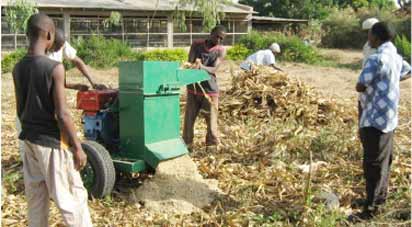
…The machine in operation
By Ebele Orakpo
DR.Mohammed Jibrin is the Director, Technology Incubation Centre, Kano and also Co-ordinator of the National Board for Technology Incubation for the North-West. In this chat with Vanguard Learning recently, the civil engineer who had his first, second and third degrees from the Ahmadu Bello University, Zaria, speaks on the concept of technology incubation centres in Nigeria and says it is all about closing the gap between research and industry. Excerpts:
WHY technology incubation?
According to Dr. Jibrin, “Technology incubation is an integrated programme initiated by the Federal Government under the Federal Ministry of Science and Technology in collaboration with state governments and entrepreneurs. The whole idea is to identify researches that are target-driven and specifically needed for the development of Nigeria so they can be initiated to become new knowledge-driven sustainable businesses. The mandate of the programme is to commercialise researches from our universities and research institutions so that knowledge-driven businesses can evolve. This will discourage unnecessary importation of what our talents can produce. So it’s about closing the gap between research and industry.”
Technology incubation
He said the programme started in 1993 with the establishment of the Lagos Technology Incubation Centre at Agege, followed by the Kano centre in 1994 in appreciation of the progress recorded by the Lagos centre.
“Today, we have 27 technology incubation centres around the country and the target is to ensure that each state of the federation has one centre plus a model technology incubation centre to be sited in Abuja. Memoranda of understanding were signed with numerous organisations to ensure that this technology-based entrepreneurship is taken to various corners so as to create jobs, wealth and reduce poverty. The first MoU was signed with the National Universities Commission and National Board for Technical Education to create institutional-based centres so that researches in the universities can be commercialised within the proximity of the initiators,” he said.

…The machine in operation
The Process:
“If a prospective entrepreneur has an idea and wants to be incubated, he will put his proposal in writing together with the technical and business plans for consideration by the management of the centre and if it is analysed and found to be proactive, then he will be admitted. For the first six months as a pre-incubatee, the ideas will be re-analysed, business plan re-articulated and technical plan redesigned in such a way that benefits will be derived.
The entrepreneur will stay in the centre for three years learning how to translate his ideas into reality. At the end of three years, he will be required to graduate into the technology park. While at the centre, the entrepreneur enjoys all the facilities such as operating space, utilities, security, workshop equipment, quality assurance laboratory, marketing, technical/business support, market research etc. These are aimed at ensuring that the cost of production is brought to the barest minimum as the entrepreneur produces and sells his products and use his savings at the end of his stay to get additional equipment or relocate outside the technology park if he so wishes.“
He noted that there are four classes of incubation viz – Pre-incubation(for the actualisation of the ideas); full residence incubation during which the entrepreneur is required to stay in the centre; extended/ virtual incubation where for one reason or the other, the entrepreneur cannot move to the TIC so he is provided with extended services; then post-incubation during which he is monitored in the technology park or any other place of his choice after leaving the centre. He said the programme is highly subsidised.
Success:
“The programme has recorded tremendous success as quite a number of the graduates are now occupying fully-owned factory buildings, employing numerous dealers, sub-dealers and distributorship. And the idea of technology parks which is the graduate’s destination is being sold to state governments and quite a number of them have taken up the idea of providing technology parks so that the graduating entrepreneurs can comfortably relocate and the synergy being enjoyed at the centres will continue,” he stated.

Dr. Jibrin
Jibrin said the Kano centre has been concentrating on fabrication of agro-allied and food processing equipment as Kano is an agrarian state so they are paying attention to what is happening in the farm. “The time has come for us to simplify the problems encountered by farmers. We should dissuade farmers from using human muscles to solve their problems in the farm because that will lead to low output. So we encourage our entrepreneurs and universities to give us designs in respect of agric processing equipment.”
The Hammer mill:
“One of our products is the hammer mill, a crop residue crushing machine. These are raw materials that can be used by the industry for production of ceiling boards, doors, windows and particle boards. On the other hand, it could serve as feed for animals. But by the virtue of the fact that it cannot be processed in that part of the country, it is being wasted as the animals cannot even consume 30 per cent of it, so for that reason, the machine was fabricated and developed and is now into operation. Farmers having realised the value are really buying it and it has made most cattle rearers to stay in one place since the feed can be made available to the cattle in one place.
“Also this will settle the issue of cattle destroying farmlands and farmers clashing with cattle rearers. Cattle should not be left to scavenge if they are required to produce good quantity of meat or milk,” he said, adding; ” One interesting thing is that as a result of this machine, hundreds of jobs have been created and with the campaign of sensitisation the centre has embarked upon, quite a number of people are coming to place orders and the task before the entrepreneurs now is how to meet demand. We have other related fabrications like rice processor, fertiliser granulator etc.”
Job creation: Dr. Jibrin said it is very easy to create jobs for the teeming youths of this country. “The time has come for us to make use of the departments of knowledge particularly the universities, polytechnics and research institutions in collaboration with entrepreneurs to create jobs and wealth. As a strategy, we can bring out one product from each of the 9,955 wards in the country. We can identify one product per ward and then get funds from good funding agencies. This should involve the academia, the community as well as the entrepreneurs. At the end of the day, that simply implies that we will produce 9,955 businesses that will employ people.
If for example on the average, each creates 1,000 jobs, that means we are already creating nine million, nine hundred and fifty-five thousand (9,955,000) jobs and this will be on a continuous basis. Government needs to look at this as a matter of serious concern. Technocrats need to be involved so as to bring out a blueprint that can be implemented within a reasonable time frame. This is very simple if the proposal is taken by government and in no time, the entire country will be transformed in terms of technology development, job creation as well as becoming exporters to other countries,” he suggested.
Disclaimer
Comments expressed here do not reflect the opinions of Vanguard newspapers or any employee thereof.