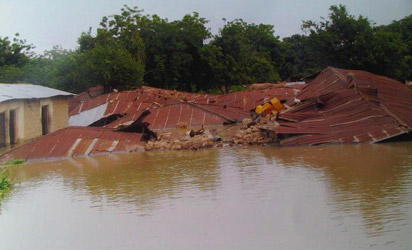
THOUGH Nigerians are yet to recover from the devastating effects of the 2012 excessive rainfall, the nation is again confronted with predictions of unusual rainfall in 2013. In view of the havoc this might create if the predictions become real, fear is the word across the country. CHARLES KUMOLU reports.
WHEN the Director-General of the Nigerian Meteorological Agency, NIMET, Dr. Anthony Anuforom, while presenting the 2012 seasonal rainfall prediction and the review of 2011 Nigerian climate, last year, said Nigeria was expected to witness normal rainfall, while some parts would experience flooding that may likely wash away houses and farmlands, not a few heeded the warning. And by the time the rains came, the states of Anambra, Bayelsa, Benue, Cross River, Delta, Edo, Kogi, Kwara and Niger, among others, were virtually submerged by floods.
First, it was the flood which ravaged Lokoja and parts of Kogi that made the headlines. Then came more reports of other incidents of flooding across the country. Areas that were never imagined would be flooded recorded same in destructive forms.
By the time the raging flood had calmed down, the country reportedly lost assets worth N300 billion which is equivalent to two percent of its Gross Domestic Product GDP. Like the previous year, NIMET had on February 15, made public its 2013 weather predictions for the country, predicting normal rainfall, except in Sokoto, Kebbi, Niger and Kwara states, where it might be excessive.
2013 predictions on rainfall pattern
Anuforom noted that the rainfall pattern in most parts of Nigeria was likely to be similar to that of 2012. “However, some areas in the North-Western parts of the country, which also fall within the catchment area of the River Niger, the total rainfall predicted for 2013 may exceed that of 2012.

Submerged houses
Rainfall for 2013 is predicted to be normal over large areas of the country. The expected changes in the annual rainfall are well below normal in Abeokuta and above normal over Ibadan and Yelwa areas. Predicted rainfall for the Northwest areas of Sokoto, Kebbi, Niger, Kwara and environs is likely to be above normal in comparison to 2012,” he said.
Consequently, he advised relevant authorities to use NIMET’s updates issued regularly to control possible adverse impacts. Anuforom also said the forecast was not automatic as the predictions could change due to climate change, adding that the volume of rainfall for the year would range from 420 cubic metres spread over 120 days in the extreme North-East to 2,980 cubic metres over a period of 290 days.
“These forecasts are statements of probability and are based on the available scientific knowledge and data. Man’s knowledge is still limited and, therefore, some margin of error within tolerable limits is not unusual. The conditions that determine the rainfall pattern over Nigeria have become more variable due to the effects of climate change and global warming.
Adequate preparation against risks: “This is a big challenge for atmospheric scientists all over the world. NIMET will continue to monitor the trend in all parts of the country and publish updates as the rainy season progresses, early release of the forecast is to create good lead-time for adequate preparation against risks and hazards associated with weather and climate extremes.” In the heels of this was the recent call by the Lagos State government on residents of the state, to be prepared for heavier rainfall this year.
General Manager of the Lagos State Emergency Management Agency, LASEMA, Dr. Femi Oke-Osanyintolu, said NIMET had predicted heavier rainfall for Lagos this year. He said: “NIMET has informed us that there will be heavier rainfall in Lagos State this year but we are well prepared.
We have changed the way we are now doing our roads.” Accordingly, he said the state government was ready for the rains as it had started mapping out strategies to ensure that disasters were mitigated during the period. He added that the state government, through the Ministry of the Environment was working hard to ensure that flooding was minimised this year.
Similarly, the Head of Geography Department, University of Lagos, Prof. Iyiola Oni, had at a recent workshop on Mainstreaming Climate Change in the university’s curricula, warned that the probability of flooding was more because of the unusual rainfall appearing in January this year.
He noted: “We are not supposed to have rainfalls in January, as we have in some cities like Lagos. It is part of the changing climate patterns that we have been experiencing over the years which is one of the effects of climate change.”
Fears of excessive early rains: On the strength of these frightening predictions, VanguardFeatures, VF, findings indicated that many are worried given that the nation is yet to recover from the devastation of the 2012 excessive rainfall which resulted in destructive flooding across the country.
This apprehension is further heightened by the early rains recorded in some states recently, which could be an indication of what to expect during the year. Accordingly, the states of Lagos, Ogun, Kaduna, Plateau, Oyo, Anambra, Ondo, Cross River, Imo, the FCT, among others, have recorded first rainfall in January-a period which before now falls under the dry season.
With the development increasing fears of excessive rainfall, not a few are scared about the possibility of having another year of damaging rains. For instance, the first rain in Ibadan this year was accompanied by heavy storm, destroying many building roofs, filling stations, shops, worship centres, and the Power Holding of Nigeria, PHCN, poles.
Worst hit were Ajegunle, Olorunsogo, Toll Gate, Felele, Basorun, Muslim, Soka, Fodasis, Ring Road, Baba Nla, Challenge, Molete and Olunloyo. Also affected are Ighodalo, Academy, Omiyale, Olomi, Olunde, Ayegun, Aba-Alfa, Jaloke, Papa-Eleye, Aladi, Ire-Akari all in Oluyole Local Government Area. It is against the backdrop of this scenario, that many question the preparedness of concerned agencies at all levels of government in the event that the predictions become true.
Disaster reduction strategies: Responding to the level of preparedness for the rains this year, Head, Public Relations of the National Emergency Management Agency, NEMA, Mr. Yushau Shuaib, told VF that the agency had prepared for this year’s rainfall before NIMET’s prediction.
Disaster reduction strategies
Shuaib said: “Before the prediction, NEMA had intensified its efforts in its Disaster Reduction Strategies to ensure that the major stakeholders at the national, states and local governments are abreast of their responsibilities in putting in place structures and programmes that could reduce the negative effect of heavy rainfall.” While debunking the view in some quarters that NEMA’s handling of last year’s flooding was unsatisfactory, Shuiab said the agency was presently introducing new measures in disaster management.
He noted: “While there were some challenges during last year’s flooding in the country, there were some levels of accomplishment in ensuring minimal damages to people and their properties. We were able to deploy massive public awareness campaigns as early warning mechanism as well as force evacuation of some residents living on flood plains.
This year NEMA has started in earnest its consultations with stakeholders like respective State Emergency Management Agencies, SEMAs, and the respective Local Emergency Committees, LEMECs, to be proactive in their strategies to reduce the risk since as humans we can’t prevent or control heavy rainfall and overflowing of dams. We have initiated awareness on basic safety measures like clearing of water channels of refuse and debris.”
Building along the flood plains
In addition, Shuaib said: “Since the prediction this year is more specific to some states, the Director General of NEMA, Muhammad Sani-Sidi, has instructed the zonal coordinators of the agencies to examine the structures in areas that were adversely affected last year whether they could withstand heavy rainstorms and also whether there are buildings along the flood plains and water channels that could be reported to appropriate authorities. In fact, the assessment tour would commence very soon based on the directive of the Director General.
“NEMA is a federal body with only seven zonal offices located in each of the geo-political zones. Therefore, since the agency could not be at each of the 36 states and 774 local governments of the federation at all times and at each emergency situation, as the coordinating agency on disaster management in the country, we rely on the cooperation and supports of other stakeholders, especially response agencies and volunteers group. For that reason we have continued to build the capacity of emergency workers and the training of our different volunteers groups that could assist whenever the need arises.”
Further speaking on efforts to ensure that 2013 rainfall does not catch Nigerians unawares, Oke-Osanyintolu told VF that Lagos State is putting all necessary measures in place to handle the resultant effects of the rains. He said: “Lagos State is ready and we are doing everything necessary to ensure that Lagosians are not taken unawares. LASEMA as an agency has continued to sensitise stakeholders on the matter and our sister agency, LAWMA, is also assisting in addressing any impediments that would work against our efforts to handle any situation that might arise.”
Disclaimer
Comments expressed here do not reflect the opinions of Vanguard newspapers or any employee thereof.