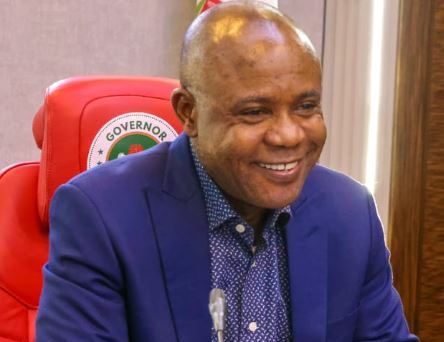
Gov Mbah
*Roads, water, healthcare, transport, schools get major investment
…Abandoned facilities revived, legacy projects delivered across sectors
By Nnamdi Ojiego
For years, residents of Enugu State lived with a familiar list of public infrastructure problems: poor roads, unreliable water supply, ageing healthcare facilities, inadequate public transport and government-owned assets that had fallen into disuse.
Some of those problems remain unresolved. But across the state, a number of projects that had either stalled, deteriorated or existed largely on government plans are now being rebuilt, revived or put to use.
From the rehabilitation of the long-abandoned Hotel Presidential and the rebuilding of Enugu State University Teaching Hospital, ESUTH,, to new roads, schools, water infrastructure, transport terminals and the establishment of Enugu Air, the pace of public investment under Governor Peter Mbah has become one of the defining features of the administration.
Residents and stakeholders have responded differently to the changes. While some commend the government for addressing problems that had persisted for years, others point to gaps in service delivery, the burden of taxation and the need to ensure that the projects remain functional after the administration leaves office.
That mix of approval and reservation provides a more useful measure of the administration’s performance than political endorsements.
The water problem that would not go away
Few issues illustrate Enugu’s infrastructure challenges better than water. For decades, water supply has been one of Enugu’s most persistent infrastructure problems.
Residents grew accustomed to buying water from tankers, wells and private water vendors because public water supply was largely unavailable.
Ekene Eneh, a resident of Abakpa Nike, said although water pipelines existed in the area, public supply came only once or twice a month. Residents, he said, sometimes had to fetch water from streams or buy from tankers.
The situation became one of the major challenges inherited by the Mbah administration. The government subsequently embarked on an extensive rehabilitation of the state’s water infrastructure, including the Ninth Mile and Oji River water schemes. The state says water production has risen from about two million litres daily to 120 million litres daily following the rehabilitation of the schemes.
But production is only one part of the problem. Much of Enugu’s distribution network is old, with about 90 per cent of the pipeline network reportedly made up of ageing asbestos pipes. The government is therefore replacing the old network with ductile iron pipes while expanding distribution to communities that have remained underserved.
In April 2026, Mbah and the French Ambassador to Nigeria, Marc Fonbaustier, flagged off a 14.5-kilometre high-capacity transmission pipeline from Nsude to the Miliken Hill Terminal Reservoir. The project is expected to strengthen water transmission to Enugu metropolis and complement the rehabilitation of the Ajali and Oji River waterworks.
The broader programme, supported by the French Development Agency, includes rehabilitation of waterworks, construction of transmission pipelines, replacement of about 240 kilometres of old asbestos pipes and thousands of new connections.
The effect is already being felt in some communities. Ukamaka Asogwa, a teacher in Abakpa, acknowledged an improvement in water supply.
The government has since expanded the intervention, with areas including Emene, Idaw River, Agbani Road, Trans-Ekulu, Meniru, Uwani, Robinson Street, Kenyatta Street and Zik Avenue among the areas targeted for restoration.
Roads become a major feature
Road construction has been another highly visible aspect of the Mba administration. In March 2025, the government flagged off the construction of 141 urban roads across 13 zones of Enugu metropolis. The projects cover areas including Abakpa, Achara Layout, Asata, Awkunanaw, Coal Camp, Independence Layout, New Haven, Old GRA, Thinkers Corner, Trans-Ekulu and Uwani.
The intervention extends beyond the state capital. The government has also embarked on the construction and rehabilitation of roads linking rural communities and agricultural areas, with several major corridors included in its infrastructure programme.
For rural communities, the significance of the roads goes beyond convenience. Better access can reduce transportation costs, improve movement of farm produce and make it easier for traders and service providers to reach communities.
Residents who had previously complained about impassable roads now have a growing number of completed and ongoing road projects to point to.
The challenge, however, is maintenance. The quality of construction and the ability of successive administrations to maintain the roads will ultimately determine whether the current investment produces lasting value.
A different story at ESUTH
Healthcare offers another example of the administration’s attempt to rebuild an existing public institution. Enugu State University Teaching Hospital, ESUTH, had for years struggled with inadequate infrastructure, equipment and manpower. The Mbah administration has undertaken extensive rehabilitation of the facility, alongside investments in equipment and staff welfare.
The Chief Medical Director of ESUTH, Prof. George Ngwu, said the improvement in working conditions had begun to affect the hospital’s ability to attract personnel. “Previously, doctors were leaving, but today, doctors from other institutions are seeking opportunities to come here,” Ngwu said, attributing the change to improved welfare, remuneration and working conditions.
The administration is also developing the 300-bed Enugu International Hospital as a specialist facility and has continued the expansion and rehabilitation of primary healthcare centres across the state. Its stated objective is to create a healthcare system in which residents can access more specialised services within the state.
For patients, however, the real test will be affordability, availability of skilled personnel, equipment and reliable services.
Reviving abandoned assets
Perhaps the clearest example of continuity is the Hotel Presidential. The iconic hotel, built in 1963 under the administration of former Eastern Region Premier, Dr Michael Okpara, remained largely abandoned for about 15 years. Its deterioration became a symbol of the fate of several public assets across the state.
In August 2025, the hotel was recommissioned following rehabilitation under a concession arrangement with Amber Hospitality. Its reopening has restored one of Enugu’s most recognisable landmarks to commercial use and brought back an asset that had generated little or no economic value for years.
The government has followed a similar approach with other moribund enterprises. One is Enugu United Palm Products Limited, whose plantations cover about 6,700 hectares across parts of Ezeagu, Oji River and Uzo-Uwani.
The state entered into a N100 billion partnership with Pragmatic Palms Limited to revitalise the company, restore palm production and develop processing capacity. The objective is to turn an idle public asset into an operating agricultural enterprise capable of creating jobs and supporting a wider value chain.
Transport gets a new direction
Public transportation has also undergone changes. The administration introduced modern transport terminals and launched a mass transit system using compressed natural gas buses.
Five terminals were inaugurated at Holy Ghost, Nsukka, Abakpa Nike and Gariki, while the government rolled out 100 CNG buses and more than 80 modern bus shelters. The system is intended to provide residents with safer and more organised transportation options.
For workers and traders who spend a significant portion of their income moving around the city, the effect of reliable mass transit can be substantial.
The state has also established Enugu Air, a state-owned airline launched in 2025. The airline began operations with three Embraer aircraft on routes linking Enugu with Lagos and Abuja and has subsequently expanded its fleet and network. The move has given Enugu an additional aviation link while reinforcing the state’s ambition to position itself as a commercial and regional hub.
Schools designed for the future
Education is another area where the government has adopted a large-scale construction programme. The administration is building Smart Green Schools across the state’s 260 wards. The schools are designed to provide modern classrooms, laboratories, libraries and ICT facilities, with technology, robotics and other forms of practical learning incorporated into the model. The schools also include boarding facilities in some locations.
The United Nations Resident Coordinator in Nigeria, Mohammed Malick Fall, described a visit to the Owo Smart School as an “eye opener”, noting the use of technology in the learning environment.
The scale of the programme is significant because it seeks to spread investment beyond major urban centres. The challenge will be maintaining the facilities, providing qualified teachers and ensuring that the infrastructure translates into improved learning outcomes.
Bringing back the ‘Cathedral’
The Nnamdi Azikiwe Stadium, popularly known as The Cathedral, is also undergoing rehabilitation. The stadium is being prepared as one of the venues for the 2026 National Sports Festival. For decades, the facility has been central to Enugu’s sporting identity, particularly through Rangers International.
Its rehabilitation is expected to restore the stadium to a standard capable of hosting major sporting events while stimulating commercial activity around the facility.
The administration has also invested in the rehabilitation of the Awgu Games Village. The stadium project is part of a wider attempt to restore public facilities that had deteriorated over time.
From commerce to investment
The administration’s infrastructure programme extends into commerce and investment. The International Conference Centre has been rehabilitated and is now being used for major events, while the Enugu International Trade Centre is undergoing reconstruction. The strategy is to improve the state’s capacity to host conferences, exhibitions and commercial activities while attracting private investment.
The state has also pursued investment in agriculture and industry. The proposed N100 billion palm oil investment is expected to create jobs and revive agricultural production, while other partnerships are aimed at returning moribund state-owned enterprises to operation.
The state has also sought private investment in other moribund assets, including Sunrise Flour Mills and Niger Gas. The underlying idea is that public infrastructure should support private economic activity rather than exist as isolated government projects.
What residents think
The assessment of the administration among residents is not uniform. Some have pointed to visible changes in roads, water, healthcare and public facilities while others expressed reservations.
Okechukwu Nwafor of Concerned Professionals for Good Governance said the administration has distinguished itself by focusing on measurable outcomes in infrastructure, education, healthcare and economic growth, and that residents report reduced travel time and improved access to markets, schools and healthcare.
Chief Arinze Ogbodo, Chairman, Enugu State Council of Presidents-General, commended Mbah’s outstanding performance, transformational leadership, and unwavering commitment to the development of Enugu State, citing the 267 Smart Green Schools, 260 Type 2 Primary Healthcare Centres, 260 Farm Estates, improved security, and road projects.
Chief Sunday Orji, Chairman of Nkanu Consultative Forum said the administration has been nothing short of transformative, marked by unprecedented achievements*; repositioning our dear state on the path of sustainable development and prosperity.”
Chris Mustapha Nwaokobia Jnr., Convener, Governance Advocate & CountryFirst Movement, noted there are visible indicators of progress in infrastructure, education, healthcare and security by the present government in the state. “While expectations remain high, the direction of governance suggests a deliberate effort to deliver on campaign promises”.
His assessment is similar to that of other residents who acknowledge improvements while retaining reservations about specific government policies.
Ken Nnaji, a youth leader in Amechi, Nkanu, said the administration had shown seriousness through physical infrastructure and administrative reforms, although he also raised concerns about taxation.
Ukamaka Asogwa, a teacher in Abakpa, similarly acknowledged improvements in water supply and road construction, while pointing out that some challenges remained.
That combination of praise and reservation is perhaps a more useful measure of public perception than political endorsements. The administration has clearly changed the physical landscape of Enugu through projects ranging from roads and transport terminals to hospitals, schools, water infrastructure and revived public assets.
However, a government can deliver infrastructure and still face criticism over taxation, service gaps or the cost of maintaining the projects.
For Mbah’s administration, the larger question is whether the current pace of investment can produce changes that will outlast the political tenure that produced them.
Beyond the projects
The scale of the current infrastructure programme has changed the physical appearance of several parts of Enugu. But physical development alone will not determine its long-term impact.
The water network will have to be maintained and expanded. Roads will require regular maintenance. Hospitals will need sustained funding, equipment and skilled personnel. Schools will require teachers and maintenance. Revived public assets will need sound management. Transport systems and Enugu Air will have to remain commercially viable.
Those are issues residents and stakeholders will continue to judge the government on. For now, however, the administration has created a substantial record of projects for residents to assess. Some are entirely new, others represent attempts to complete, rehabilitate or revive assets that had been abandoned by previous administrations.
That distinction may ultimately be one of the more important features of the Mbah years. The success of the programme will not be determined solely by how many projects are commissioned before the end of the administration, but by whether the roads remain motorable, the taps continue to run, hospitals retain their professionals, schools maintain their standards and revived public assets continue to generate economic value long after the political administration that restored them has left office.
Disclaimer
Comments expressed here do not reflect the opinions of Vanguard newspapers or any employee thereof.