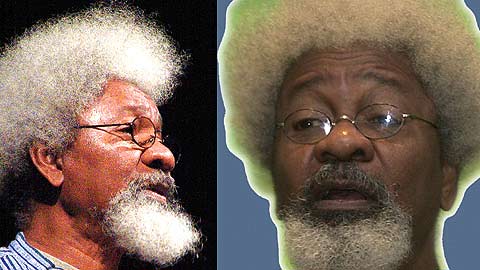
*Soyinka
By MCPHILIPS NWACHUKWU
Yesterday at the June 12 Culture Centre, Abeokuta, Ogun State, Home, a play written by Samm Art Williams was staged as part of activities by Zimrage Multimedia Company to mark Professor Wole Soyinka’s 78th birthday. Among the cast that delivered the scripts are actors and actresses drawn from Nigeria and abroad.
Interestingly, some members of this interesting cast are coming to Nigeria and Africa for the first time. In this conversation therefore, the cast of Home share their experiences about the country and the play with Vanguard’s Arts on Sunday.
Bashar Evans
My experience last year was more than I expected; it was an exchange that I didn’t expect. I felt so much love from the community and everywhere we went in Nigeria. It was so much love, even more than the American love; there is a real and honest thing here, and everyone was very welcoming. I plan to entertain, and make sure that everyone connects to the story that I will be telling.

*Soyinka
Doing it a second time…it feels great coming back to do it again, to be able to entertain with a different type of performance, getting to the different levels and range, areas that are way different from what I had done before, but in a way similar to what I had done before, a different aspect of my performance. I intend to consolidate on the achievement of last year by doing it again. I am not afraid. I want to give more than the last time; I can give more.
Lauren Connor
I just love meeting people from different cultures, understanding how people live and work. And when you hear about Africa in America, people just say you are from Africa, you are descendants of slaves, and it never really hits you. But when we arrived, and I got off the plane, I just saw all these black people, and it was really amazing.
So I am just looking forward to learning from you all, being able to immerse myself as much as possible in the life here. Talking about what I have learnt in America about Africa, one learns that everyone here is poor, dirty and people are living in huts, and people are mean.
Then they talk about a lot of animals like tigers running everywhere. I have parents who are very rooted in African American history; my dad is really into it, and he would tell me that ‘you know we are kings and queens, we have resources and we are proud’ so I got that perspective from him before I got into school.
This (the opportunity to be here to perform) is amazing, and I am very much looking forward to it. One, to get another professional acting opportunity, and two, to be able to go out there and perform to a whole different audience like I might not be familiar with, and one never knows what to expect, and that would be exciting…Just to be able to see reactions help me as an artiste. So, I am looking forward to it.
I think the play really gives an accurate perception of what African-Americans go through…I feel like the audience would understand what it is for us in America; I am sure they already know. I really feel like it would be helpful to you understanding us, and to us understanding you, and to depict the struggles on the two sides. There are a lot of things that happen in the play that are really truthful, so hopefully, we will be able to cross-over and get a better understanding of each other.
Femi Ogunjobi (Nigerian actor based in London)
It means a lot to be in this performance; the message of the play resonates with me, and I believe that Nigerians will be able to identify with the play. It may be an African American play, but the story is one that Nigerians would be able to relate to because that story is the story of every Nigerian.
Though it is an American play, it is a play that you and I can identify with in terms of how things will go as you make decisions, and do your day-to-day things. There are many symbolic things in the play that you as a Nigerian would identify with.
For me personally, it is alucky home coming. There are two Africans – one is the Africa of the government people, which is bad, and the other of the people getting by with their lives. I identify with the latter one where people are getting by with their lives, taking those individual decisions, which either make or unmake a man.
There is a symbolic reference to crossroads in the play. I believe a crossroad is a road that we all get to at one point in our lives, a point where you decide to either go this or that way, and you know it is those situations that count in life. I will say it is more about the individual against every odd that he comes across, while trying to survive.
I believe that is what happens (universally). Government or no government, people have to do what they have to do to survive, and we devise all sorts of means to combat the odds that we meet. This play is about taking decisions, dealing with the consequences of your decisions, and knowing when to chop and change things.
I have to go back to something I can identify with a lot. This play will tell an average Nigerian that even in all those so-called whiteman’s country, people have their day-to-day struggles, like we do here. Everything is not rosy. In this play, you see people going through all those stages of life that if you pick a man in Abeokuta, and take away the language barrier…I think the play will bring reality into people’s expectations by letting them know that things are not as glamorous as they may appear.
We have our reasons why we take such decisions, and that is what I referred to when I said there is something symbolic in the play, like where the play is situated. We always find ourselves at crossroads every time.
Brandi Austin
This is my first time in Africa, but I have been here in Nigeria in my head, many times. In the States, I have a few friends who are Nigerians, so I had more of a realistic perception of what it would be like. The first thing that really struck me when I came here is that as I arrived and walked off the plane, the first thing I heard was ‘hi pretty,’ and I said ‘oh my God, I am home’. The second thing is that this place is owned and run by African people.
As an African American, I am marginalised in society, and the government is all white, so coming here I also see that you guys have billboards and all the people in the advertisement are black people, whereas in America, out of every ten, there may be just one billboard that has a black person in it. It is just amazing to be in a place where I feel completely accepted, and embraced.
Disclaimer
Comments expressed here do not reflect the opinions of Vanguard newspapers or any employee thereof.