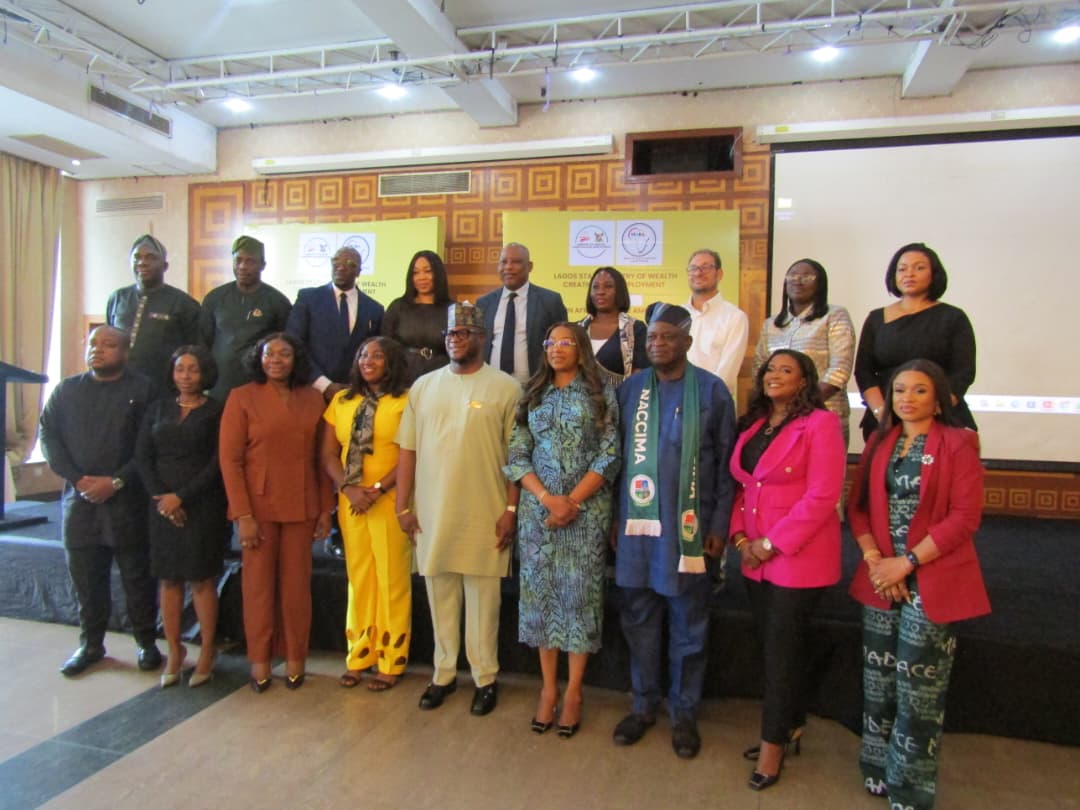
CEO of Made in Africa Brands Ambassador, Flora Mbeledeogu (4th from left) accompanied by speakers at the SheExports Conference held recently in Lagos.
By Cynthia Alo
Women entrepreneurs have been urged to invest in product quality, value addition, certification and branding to improve the competitiveness of Nigerian products and unlock opportunities in regional and international markets.
The call was made at the 2026 SheExport Conference held recently in Lagos with the theme, “Produce, Add Value, Export: A Catalyst for Sustainable Economic Growth,” where government officials and industry stakeholders said Nigeria must move beyond exporting raw commodities to finished products if it hopes to increase export earnings and create jobs.
Convener of the conference and Founder of Made in Africa Brand Ambassador (MABA), Mrs. Flora Mbeledogu, said the initiative was created to equip women entrepreneurs with the skills, partnerships and market access needed to compete globally.
She disclosed that over 300 women applied for the SheExport programme, with 120 selected for intensive export and international trade training.
According to her, the programme has already secured partnerships with international distributors, including a distribution company in the Netherlands interested in sourcing Nigerian products.
She, however, said many Nigerian products continue to be rejected abroad because producers fail to meet global standards on quality, packaging, traceability and certification.
“We have a lot of work to do locally before we talk exports. We must get product quality, packaging, certifications and traceability right before taking products to the international market,” she said.
In his keynote address, Lagos State Commissioner for Wealth Creation and Employment, Mr. Akinyemi Ajigbotafe, said the Lagos state government remains committed to supporting women entrepreneurs through access to finance, business development and export readiness programmes.
Ajigbotafe noted that the future of Nigeria’s economy depends on empowering women entrepreneurs to move beyond primary production into value-added exports.
He said: “Raw exports are the economy of the past. We must move from being mere commodity exporters to becoming manufacturers, processors and innovators. When cocoa becomes chocolate, shea nuts become cosmetics and cassava becomes premium starch, we do not just export more; we earn more, employ more and build stronger businesses.”
According to him, stronger collaboration among governments, financial institutions and the private sector is needed to improve access to finance, strengthen export infrastructure and position more women-owned businesses to benefit from opportunities under the African Continental Free Trade Area (AfCFTA).
In his goodwill message, Plateau State Commissioner for Agriculture, Mr. Buguma Ishaku, said women are at the centre of agricultural production and should be empowered to drive Nigeria’s export economy.
He noted that women account for more than 60 per cent of vegetable producers in Plateau State, while the state produces over 95 per cent of Nigeria’s potatoes, presenting enormous opportunities for agro-processing and exports.
Ishaku said the administration of Governor Caleb Mutfwang has made agriculture the cornerstone of its economic agenda through its Agricultural Transformation Agenda, with emphasis on value addition and wealth creation.
“Raw commodity exports belong to the past. The future lies in processing, value addition and creating products that can compete globally. That is how we create more wealth, more jobs and stronger businesses,” he said.
He disclosed that the state is establishing a Special Agro-Processing Zone around the Jos Airport, including dedicated facilities for women-owned agribusinesses, and invited investors to explore opportunities in Plateau’s potato, vegetable, coffee, sesame and shea value chains.
The commissioner also assured the organisers of the state’s support to host the next edition of the conference in Jos.
Guest speaker and President of the Nigerian-Indonesian Chamber of Commerce and Industry, Mr. Ishmael Balogun, said Nigeria must abandon its long-standing dependence on exporting raw materials and focus on processing, branding and exporting finished products.
“We export cocoa and import chocolate. We export cotton and import textiles. The future of Nigeria’s economy lies not in exporting raw commodities, but in processing them, packaging them, branding them and exporting finished products,” he said.
Balogun described bilateral trade as a strategic tool for industrialisation, technology transfer, investment and market expansion, adding that stronger Nigeria-Indonesia trade relations would create new opportunities for women-owned enterprises and other small businesses.
He urged entrepreneurs to invest in quality, certification, packaging and branding, saying: “Start local, but think global. Let us move beyond exporting raw materials and proudly export finished products made in Nigeria.”
Also speaking, Founder of Women in Agribusiness, Trade and Export (WATEX), Dr. Queen Okpa, blamed the rejection of many Nigerian products in international markets on poor infrastructure, weak post-harvest handling, lack of traceability and the use of banned preservatives.
She lamented that high transportation costs from production centres to the seaports have made Nigerian products less competitive globally.
“If we are serious about exports, the first thing is infrastructure. Without it, we’re just making noise,” recalling the rejection of 15 containers of zobo exported to Mexico after they failed quality tests.
On her part , Director-General of the Nigerian-British Chamber of Commerce, Adaobi Onyedum, said although Nigeria’s non-oil export sector continues to expand, the country still accounts for only about 0.26 percent of global trade, leaving significant room for growth.
She said countries that earn the most from international trade are those that process and add value to their products rather than exporting raw materials.
She urged Nigerian entrepreneurs to prioritise quality, branding, compliance with international standards and strategic partnerships to improve their competitiveness in global markets.
Disclaimer
Comments expressed here do not reflect the opinions of Vanguard newspapers or any employee thereof.