Leadership capability has been identified as a critical factor in Africa’s ability to navigate an increasingly complex security environment, as concerns grow over terrorism, organised crime, cyber threats, climate pressures and geopolitical uncertainty across the continent.
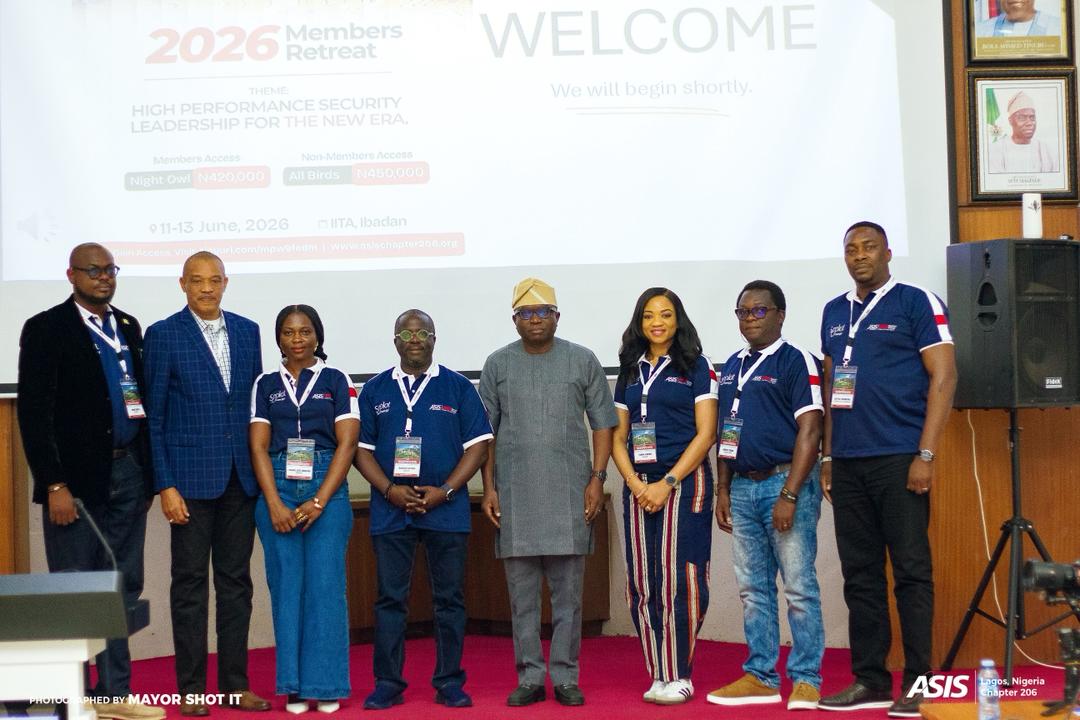
Against the backdrop of an increasingly complex threat landscape, security executives, risk professionals, intelligence practitioners and business leaders gathered in Ibadan for the 2026 ASIS International Chapter 206 Members’ Retreat. The event examined emerging risks and the leadership capabilities required to navigate a rapidly changing security environment.
Setting the tone for the retreat, retired military officer and security strategist, Major General Charles Ofoché (retd), delivered a keynote presentation titled “Achieving High-Performance Security Leadership for the New Era in Africa.”
He argued that organisations can no longer afford to define success solely by their response to crises. Rather, he said, the ability to anticipate risks, adapt to change and build resilience has become the hallmark of effective leadership.
According to Ofoché, many of today’s threats are no longer isolated challenges. From violent extremism and organised crime to cyber insecurity, demographic pressures and climate-related conflicts, the risks confronting institutions are increasingly interconnected. He stressed that addressing them requires strategic foresight, innovation and intelligence-driven decision-making, rather than reliance on traditional approaches alone.
Chairman of ASIS International Chapter 206, Olufemi Kayode, CPP, described the retreat as a timely response to Nigeria’s evolving security realities. He noted that kidnapping, organised criminality, cybercrime and maritime insecurity continue to place significant pressure on organisations and communities. In his view, the changing threat landscape has made continuous learning, strategic thinking and professional development more important than ever.
Kayode also highlighted the Chapter’s efforts to strengthen capacity within the industry through certification programmes, strategic partnerships and targeted development initiatives. He pointed to recent engagements such as the Women in Security Conference and professional webinars, while outlining plans for university roadshows aimed at attracting and mentoring future practitioners.
For Chairman of the Retreat Planning Committee, Hector Ikemefuna, the gathering was designed to equip participants for the realities of a rapidly changing world. He said the programme combined strategic leadership discussions with practical learning opportunities focused on emerging technologies, crisis management and collaborative problem-solving.
Also speaking during a webinar organised as part of the retreat, Adam Samuels, Crisis Response Director at Convex, emphasised that successful kidnap management is built on preparedness rather than reaction. He stressed that organisations must develop clear response strategies, establish crisis management teams and prioritise stakeholder coordination long before a crisis occurs.
The retreat equally featured sessions that expanded the conversation beyond conventional security concerns. Dr Isaac Orolugbabe of Lagos Business School challenged participants to view security leadership as a strategic business function with a place in executive decision-making. In another session, Mrs Omamofe Ugboma of Stanbic IBTC Asset Management spoke on financial resilience and long-term wealth creation, highlighting the importance of personal and organisational preparedness.
The strategic direction of the retreat’s sessions was steered by Vice Chairman Adetanwa Ashiru, PCI., who masterfully synthesized complex technical takeaways, managed a high-level audience, and ensured rigorous, engaging discourse across all panels. Her expert guidance seamlessly connected the technical, geopolitical, and business threads of the presentations, elevating the overall executive depth of the retreat.
Throughout the retreat, discussions repeatedly returned to a central theme: Africa’s future will depend not only on its ability to confront threats but also on the quality of leadership guiding its institutions. Participants agreed that ethical governance, strong institutions and a commitment to continuous improvement remain essential to building resilience across both the public and private sectors.
As the retreat concluded, delegates departed Ibadan with renewed insights, stronger professional networks and fresh perspectives on the challenges ahead. Beyond the presentations and panel discussions, the gathering reinforced a clear message: in a world defined by uncertainty, the strength of leadership will remain one of the most important determinants of security, stability and sustainable development.
Disclaimer
Comments expressed here do not reflect the opinions of Vanguard newspapers or any employee thereof.